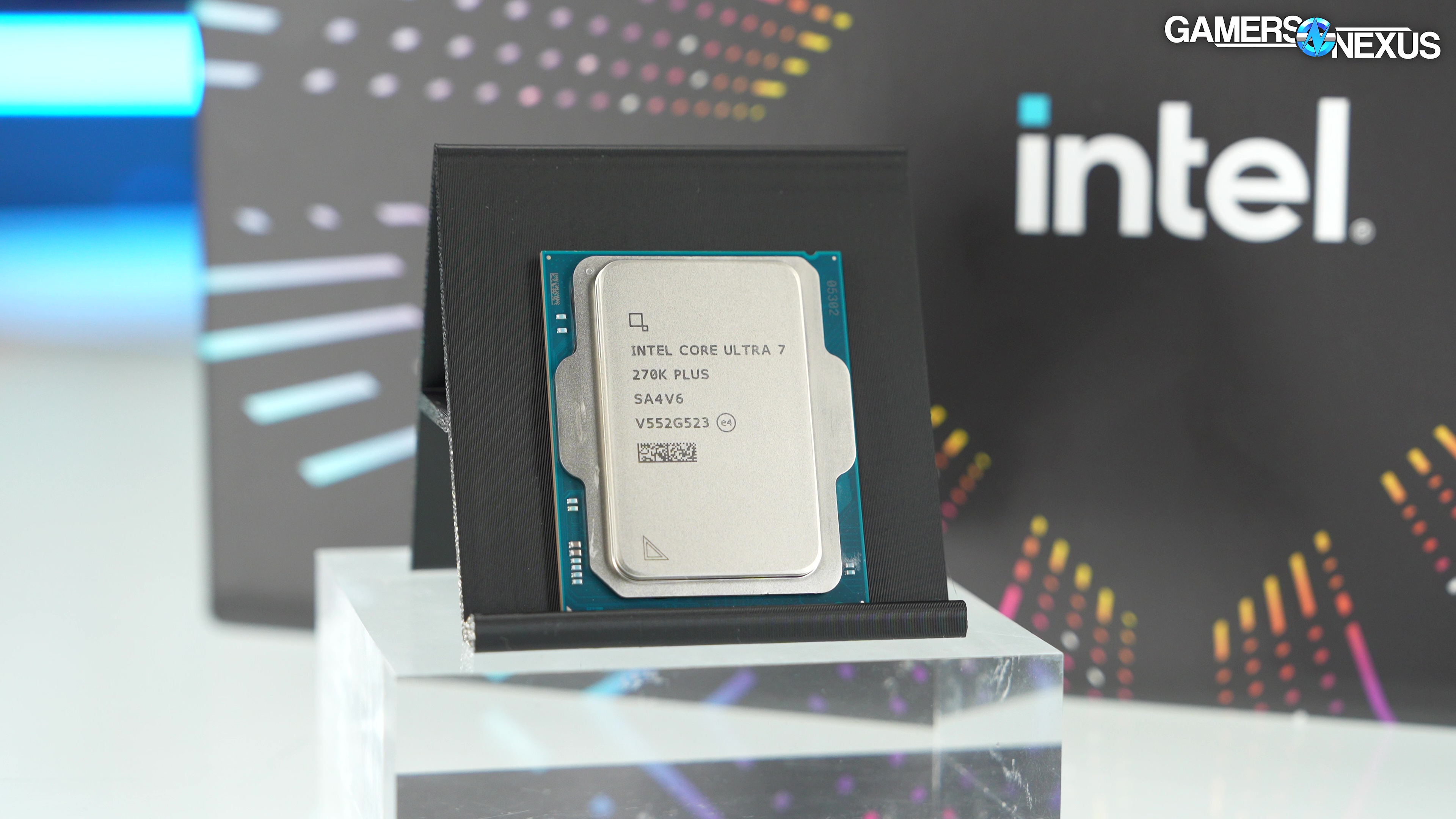
We benchmark the Intel 270K Plus against the 250K Plus, AMD's X3D CPUs, and Intel's past processors
The Highlights
- Intel's Ultra 7 270K Plus (270KP) is one of the most promising CPU launches we've seen in a long time, and has some similarities to AMD's Ryzen 1000 and 2000 era of CPUs
- The unfortunate downside is that the CPU will be used within Intel’s dead-end platform
- The 270K Plus is pretty good in production and much better in gaming than it used to be
- Original MSRP: $300
- Release Date: March 26, 2026
Table of Contents
- AutoTOC

Intro
Intel is showing some signs of life, and dare we say, even remote signs of intelligence -- like some distant, cold asteroid that we’ve suddenly realized isn’t on a collision course spelling doom. With the 250KP, we didn’t say it was a waste of sand, already a great sign. With the 270KP, Intel has the makings of an AMD 2017-era Ryzen takeover of the production charts, with gaming not far behind AMD’s X3D parts. The biggest problem is that it’s on a dead-end platform.
Editor's note: This was originally published on March 25, 2026 as a video. This content has been adapted to written format for this article and is unchanged from the original publication.
Credits
Test Lead, Host, Writing
Steve Burke
Testing
Patrick Lathan
Mike Gaglione
Video Editing
Vitalii Makhnovets
Camera
Tim Phetdara
Writing, Web Editing
Jimmy Thang

We’ll respect your time and give you the TLDR right now.
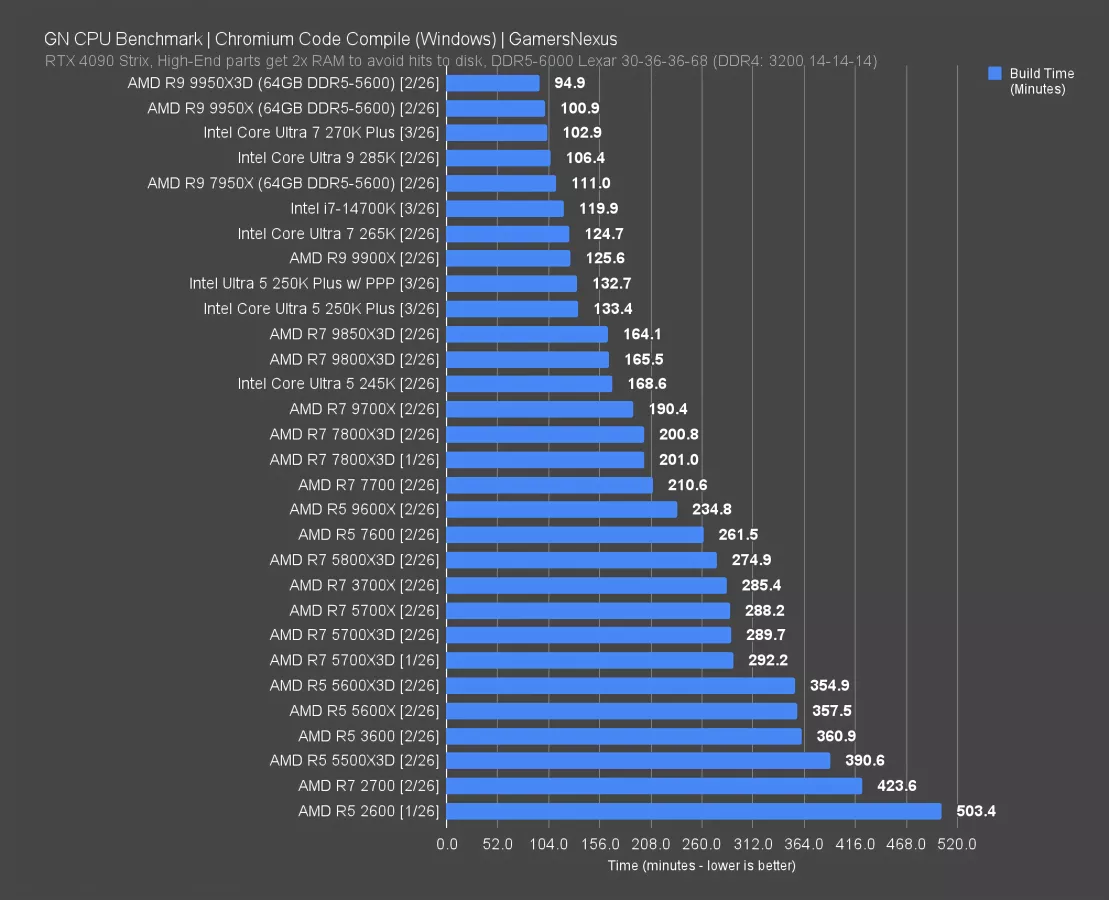
The 270KP is a $300 CPU, already a good start. Its performance in our Chromium code compile testing put the 270KP up at the top of the board, with a 103-minute result. Most critically, that has it only 2 minutes slower than the AMD 9950X, which commonly costs $500 to $520 now. To be within error of the more expensive 9950X spells danger for AMD’s high-end solution in its desktop platform. The 270KP beat the 14700K (read our review)(finally) in this test also, with a 14% reduction in required compile time.
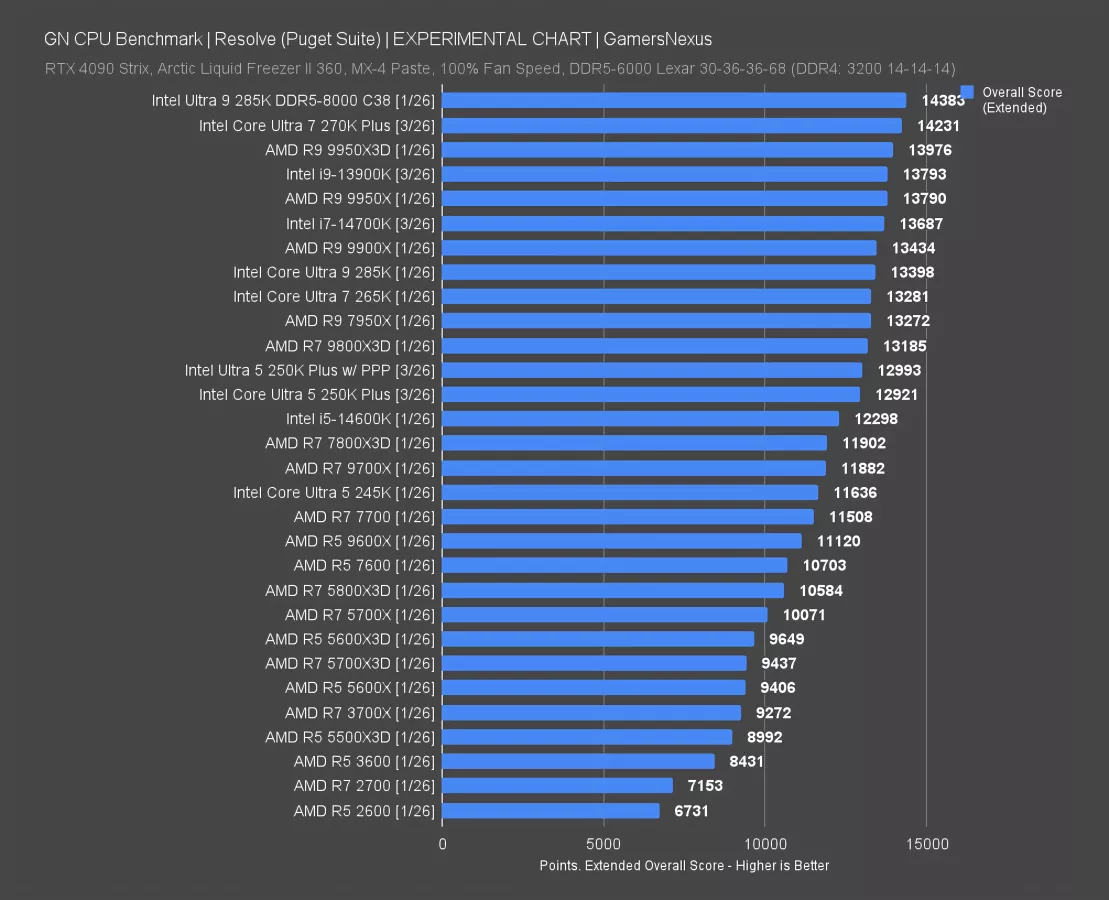
In Puget Suite testing with DaVinci Resolve for video editing work, the 270KP again lands at the top of the chart; in fact, ignoring the 285K with non-like-for-like higher speed memory, the 270KP is actually now the best performer on this chart in our like-for-like testing. Behind it sits the 9950X3D, which is over $600 when we can find it available.
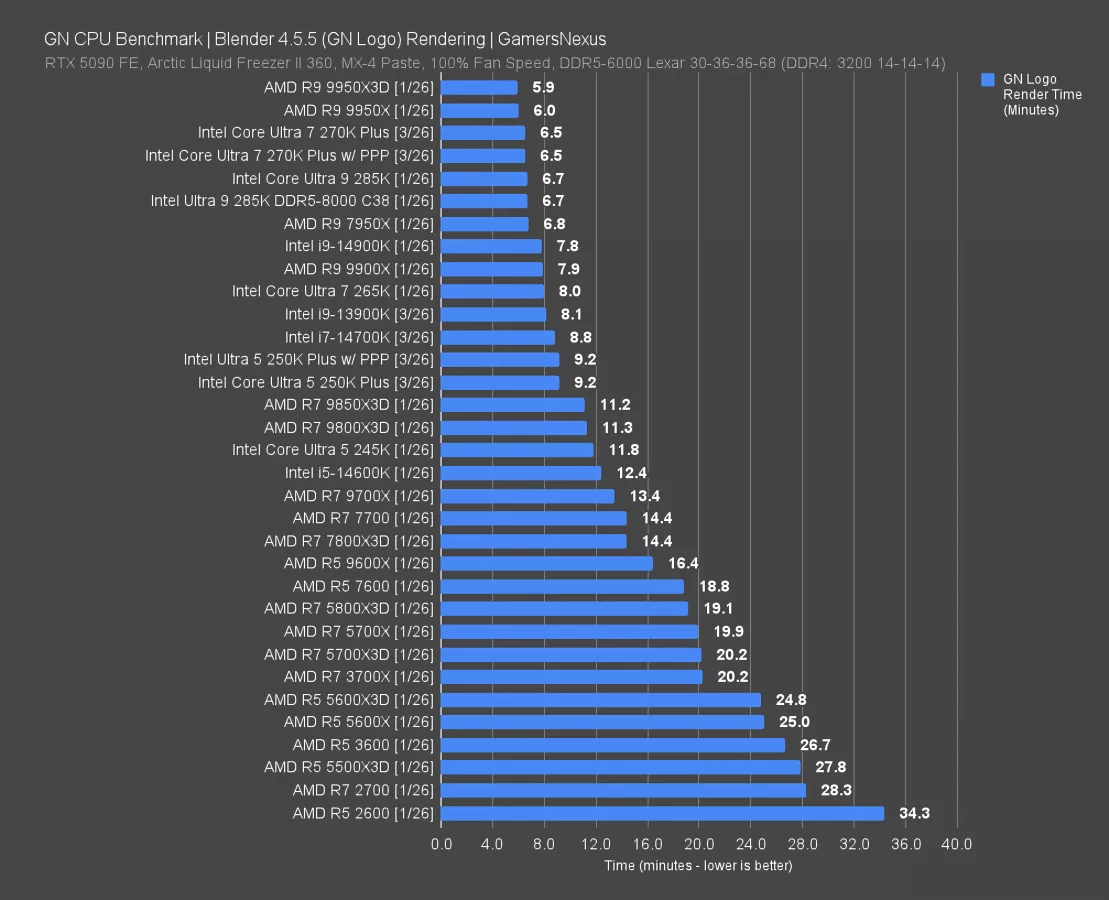
In Blender tile-based rendering, the 270KP is barely behind the 9950X. The 9950X is over $200 more expensive, and yet, it only required 7.7% less time to complete the render.
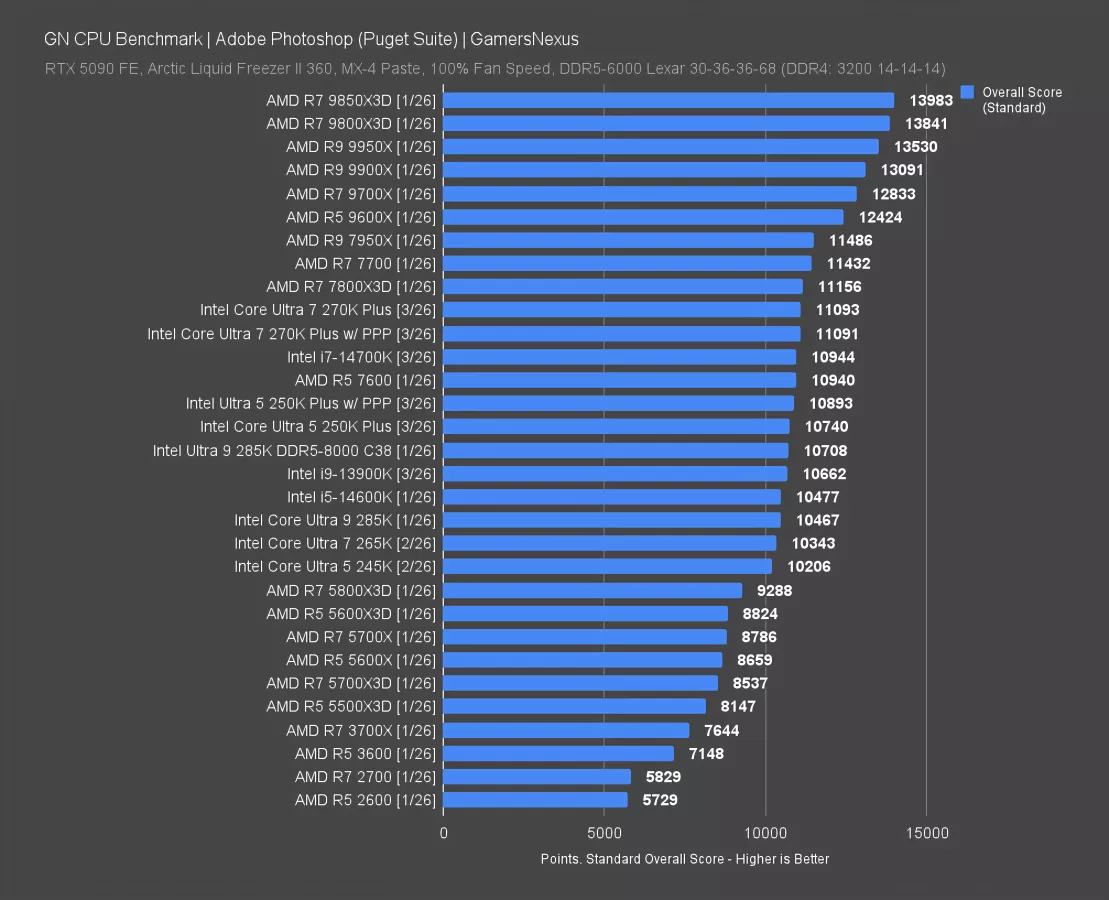
The 270KP isn’t always better, like in Photoshop, but more often than not, it is.
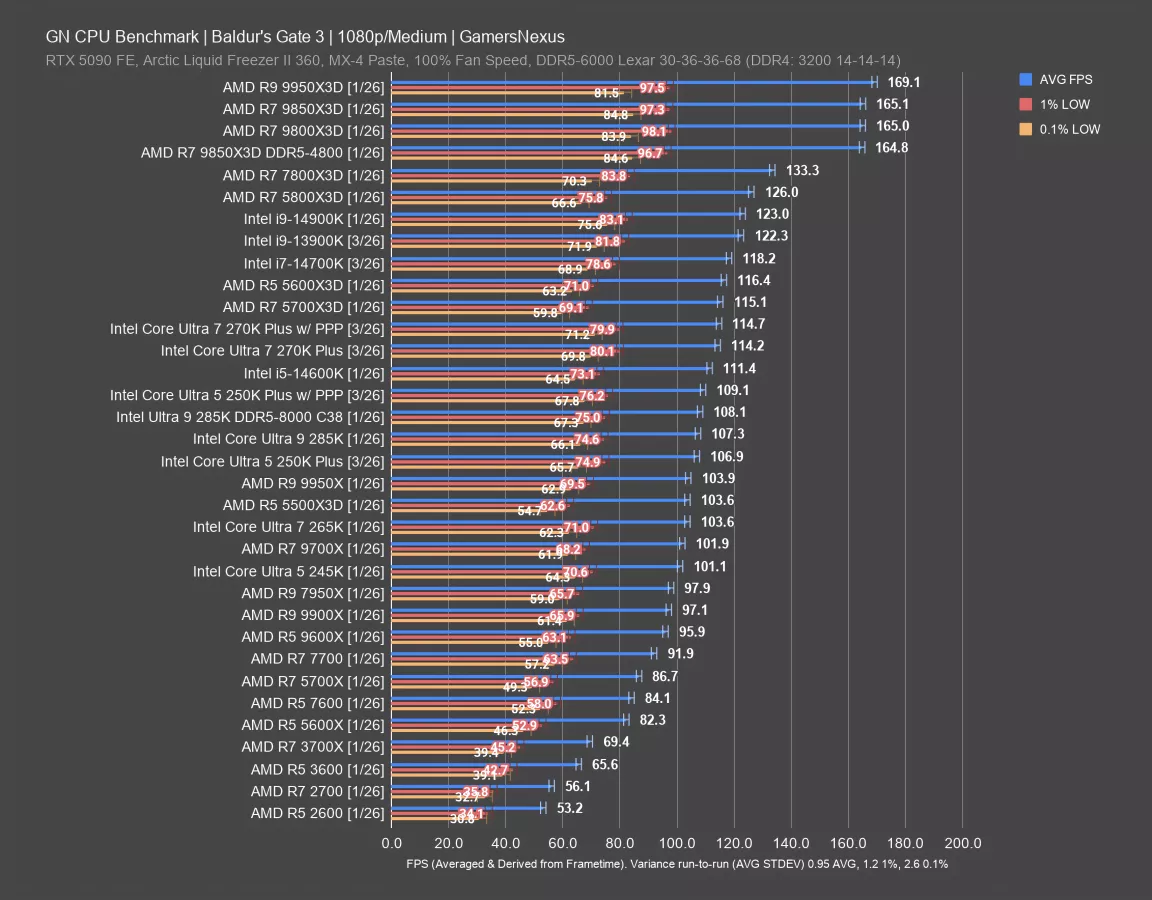
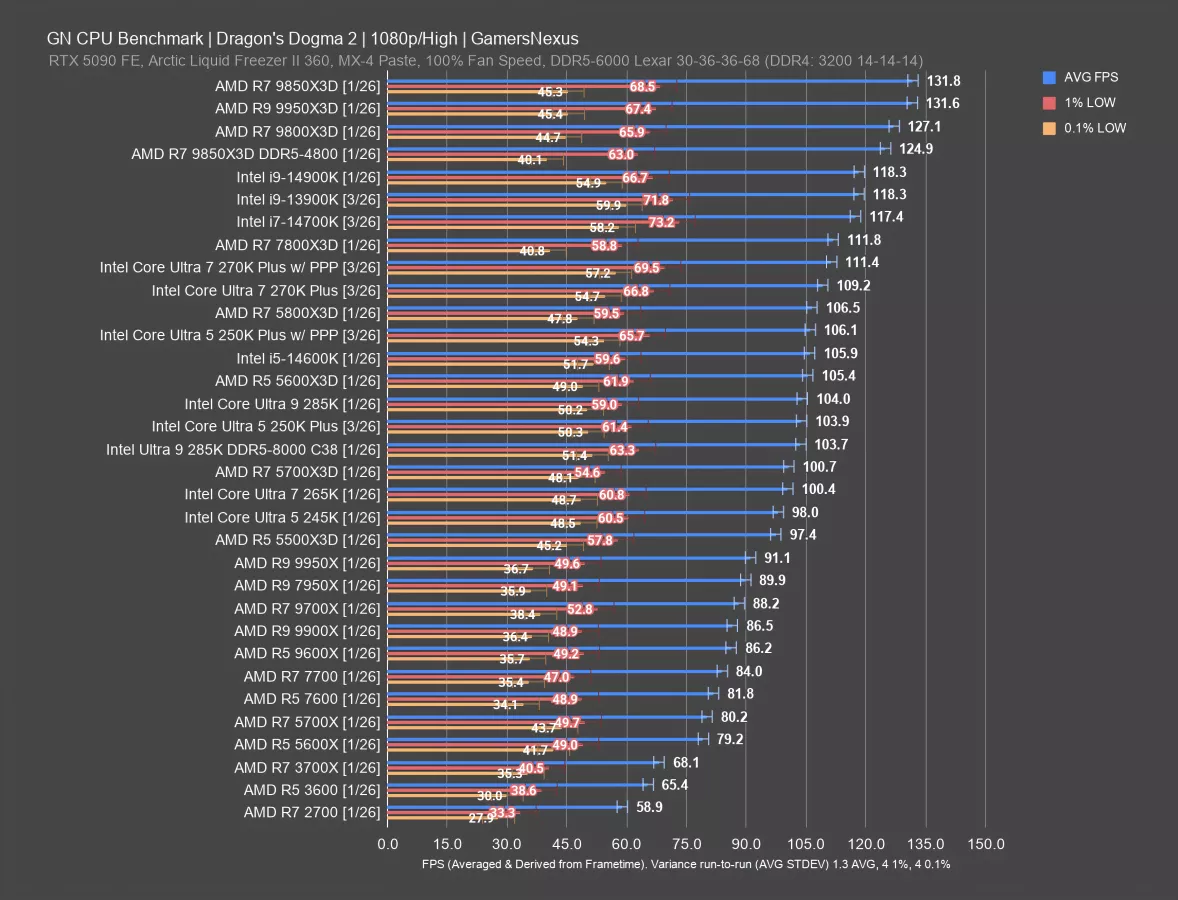
Gaming also shows promise: AMD maintains a lead with the more expensive 9800X3D (read our review) and with the 7800X3D (watch our review) (which is closer in price to the 270KP when we could find it in stock, but still more expensive); however, despite AMD’s lead, Intel is gaining on it -- including in tests where we know for fact that we aren’t GPU-bound.
Other than platform longevity, we only had one serious complaint against the 270KP.
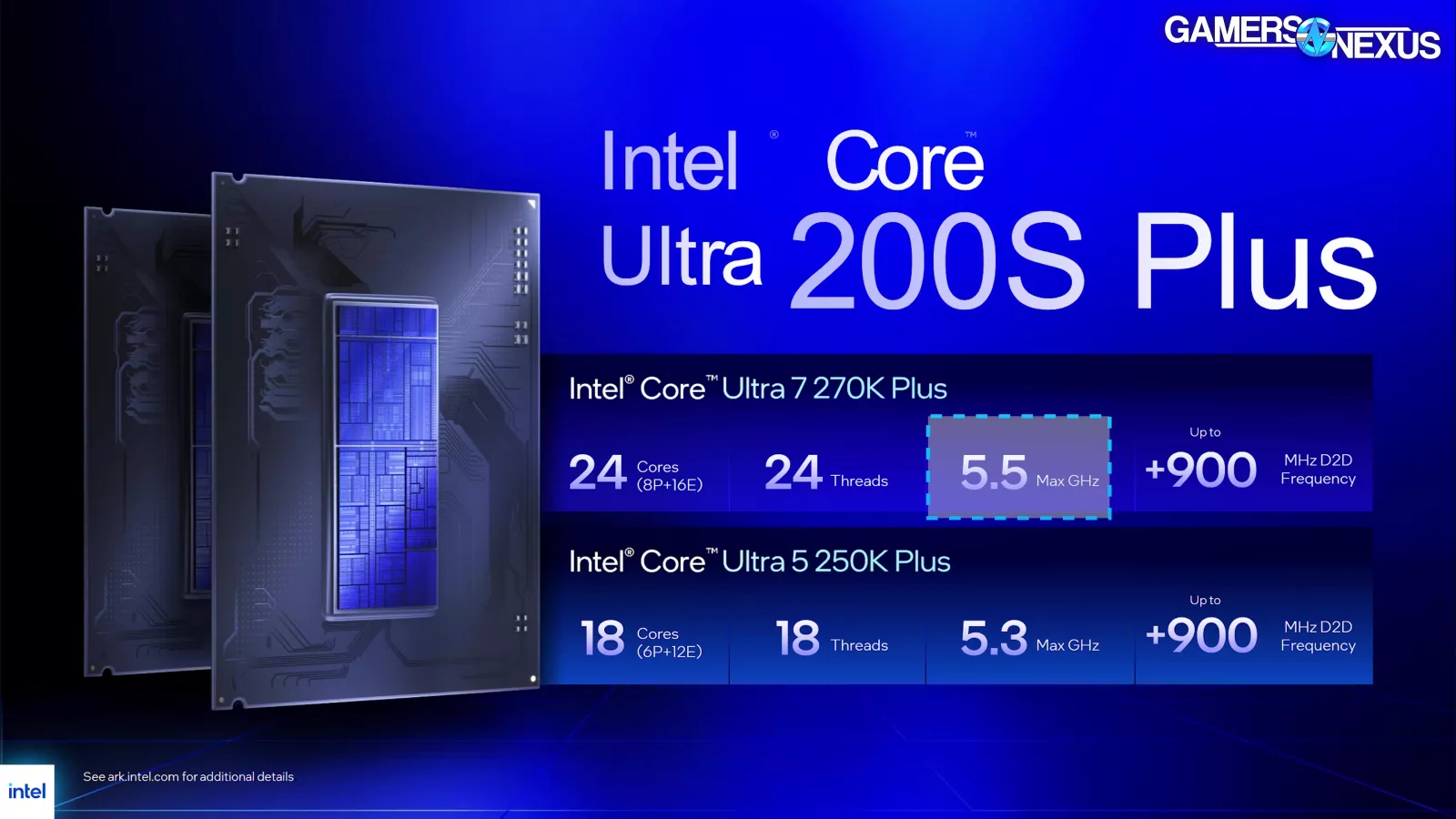
In our single-thread frequency testing, the 270KP underperformed and failed to meet Intel’s specification and advertised clocks. It is 100 MHz short of Intel’s marketing claims, which is a big swing-and-a-miss that we haven’t seen in this testing for years. Either Intel is misrepresenting the capabilities of the CPU or the combination of the ASUS Z890 board plus this CPU result in underperformance that needs to be addressed in a firmware update.
Still, it at least performed well in spite of its deficiency against the marketing claims.
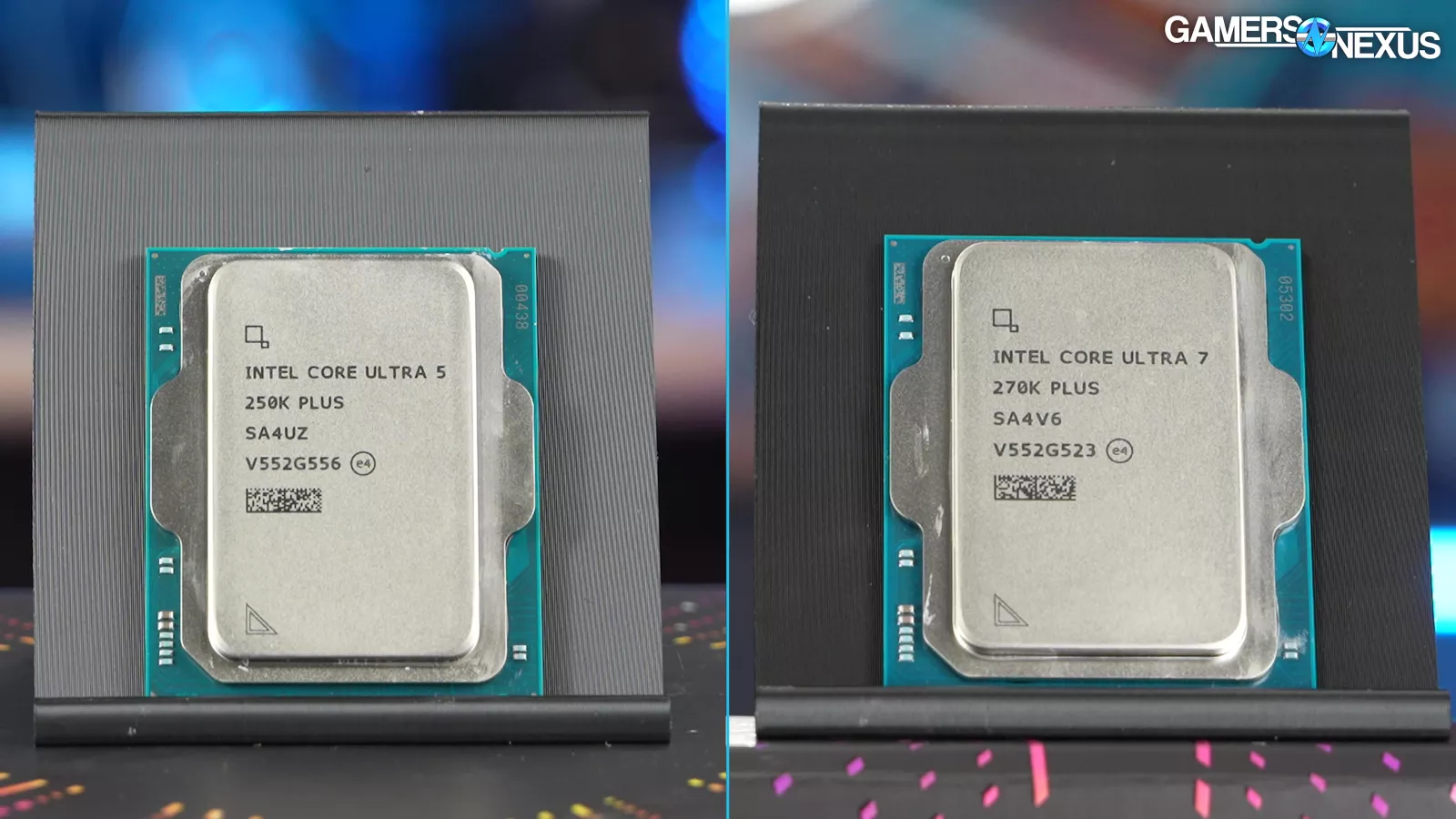
The 250KP was a good introduction to this series, but the 270KP is the one that’s giving us flashbacks to AMD’s Ryzen 1000 and 2000 CPUs. For that series, we found that many of AMD’s CPUs weren’t that competitive in gaming yet -- although they were slowly getting there -- but that AMD was quickly establishing a foothold in production workloads. Intel is now exhibiting signs of the same.
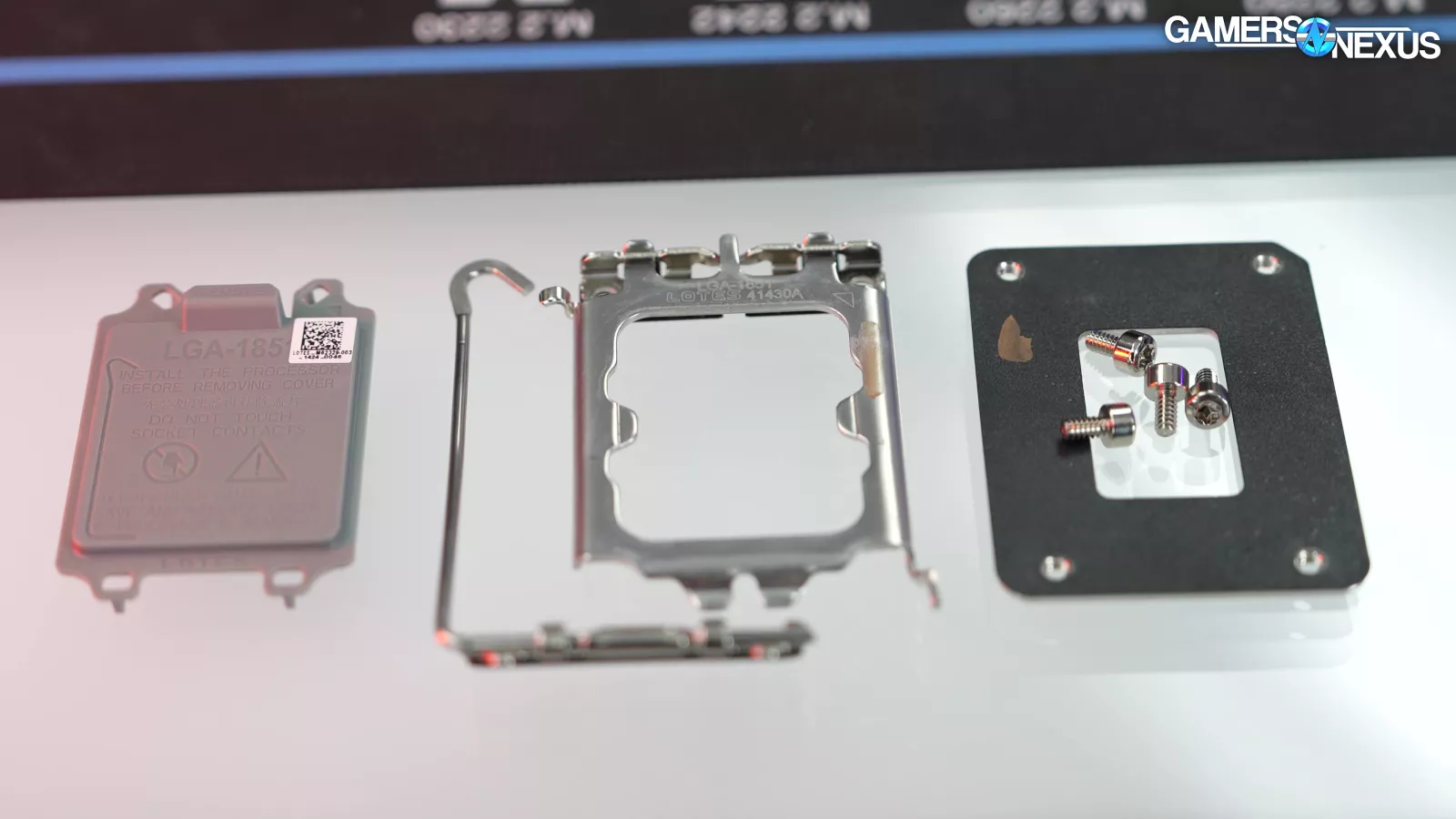
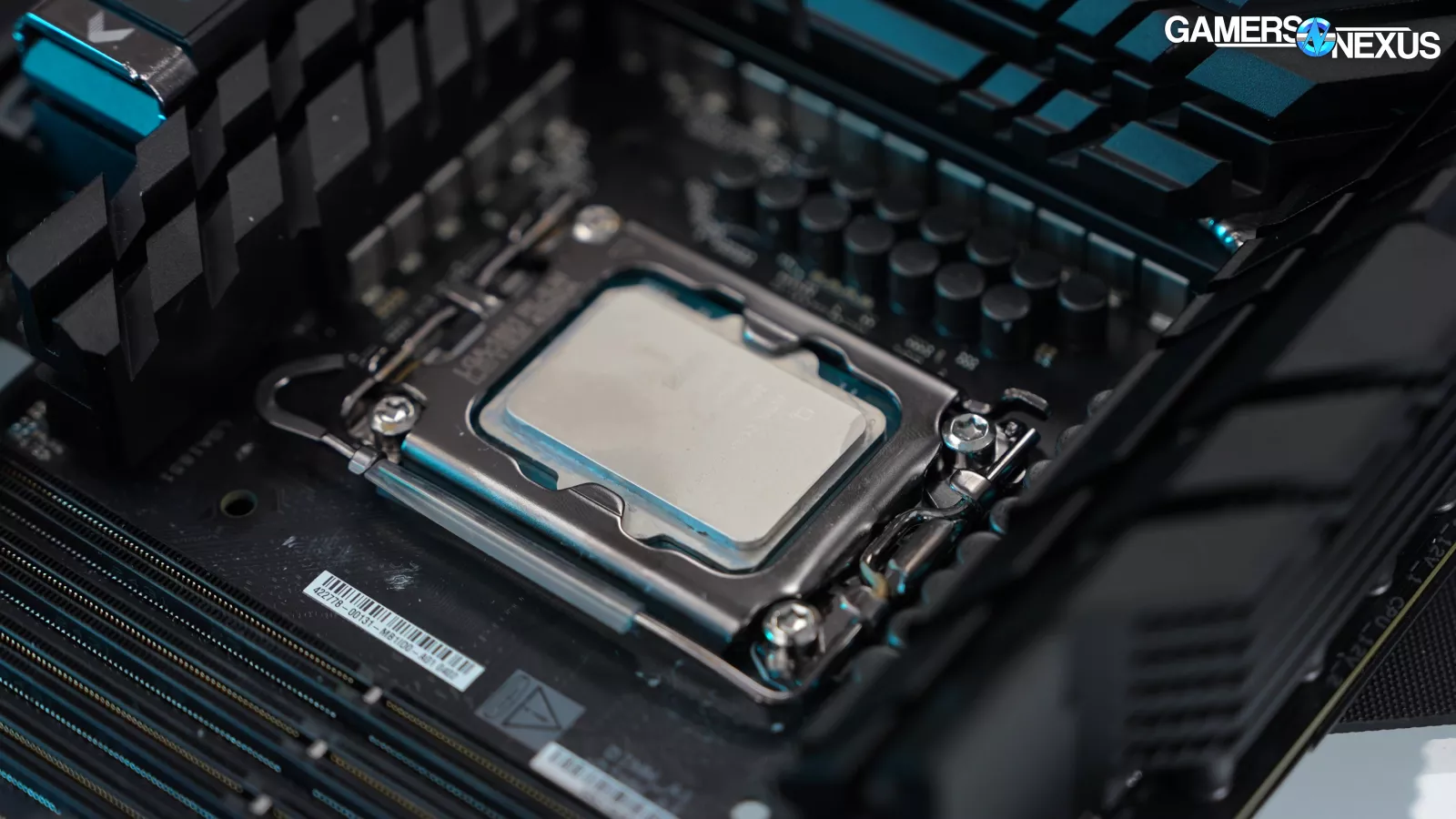
Our single biggest criticism of Intel is that its 270KP is launching on a doomed platform. LGA 1851 isn’t long for this world, and this will likely be the last architecture for it. If Intel can repeat a launch like the 270KP, but on a platform with some actual life to it, they’d be negating the number one complaint of their CPUs. Intel really needs to make a platform that will have some longevity to it.
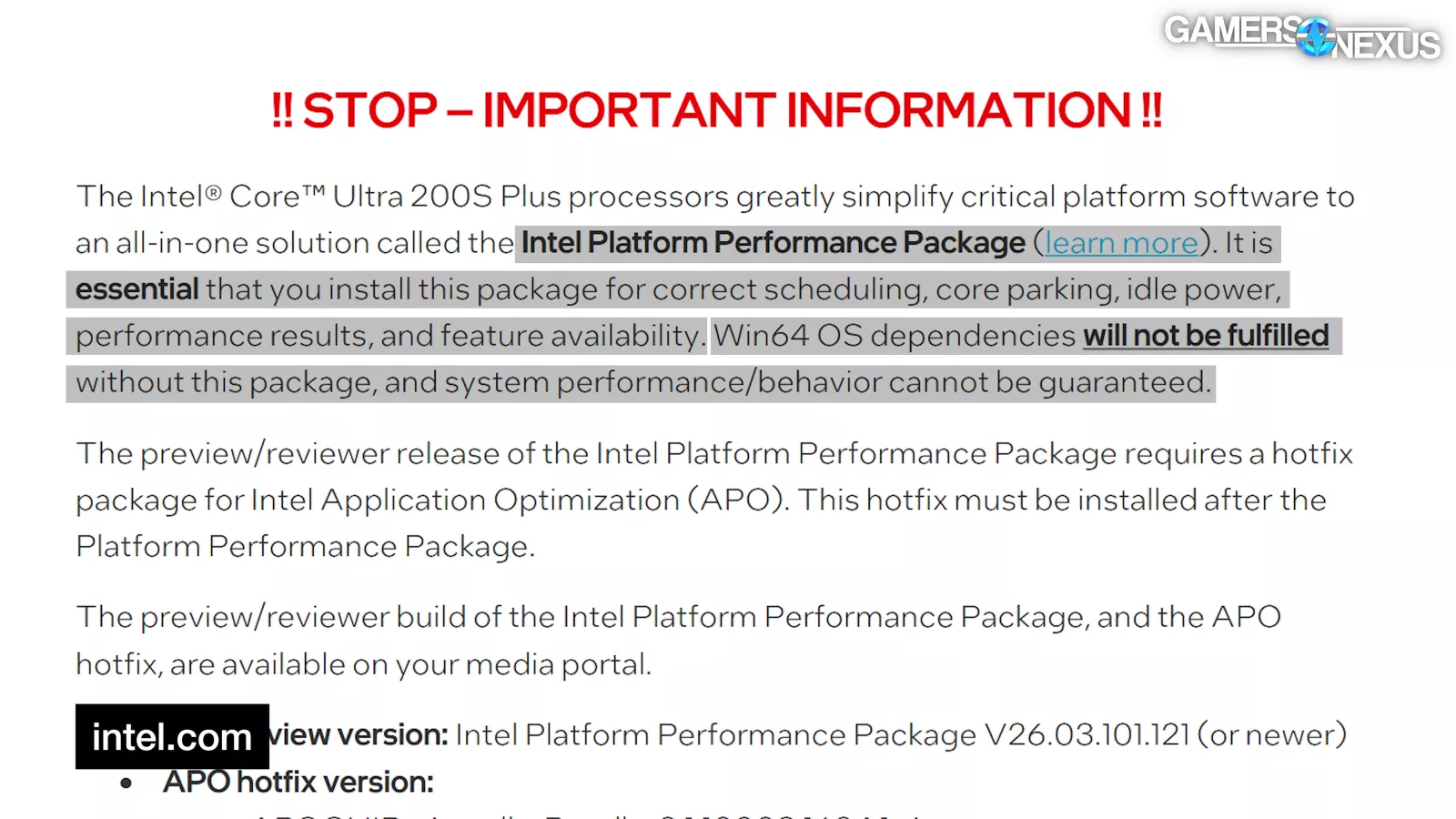
Today, we’re reviewing the 270K Plus CPU. Like the 250KP we reviewed, this requires software that’s called the Intel Platform Performance Package. Or, for short, Intel’s PP Package. Or alternatively, its Platform PP. We already explained this requirement and how it works in our 250KP review, so we won’t be going over that again. If you buy one of these CPUs though, you should check out that section of our review to make sure you’re installing the right software.
Overview
We posted our 250KP review recently. That article goes over the basics of this Arrow Lake refresh of CPUs. Unlike most refreshes, this one actually is kind of exciting in that Intel has improved its overall performance against the disastrous Arrow Lake launch while also bringing its price down.
We’ll skip the stuff we already covered, including whether or not Intel’s PP Package is big, and leave that to the prior review.
Specs
We’ll keep the specs quick:
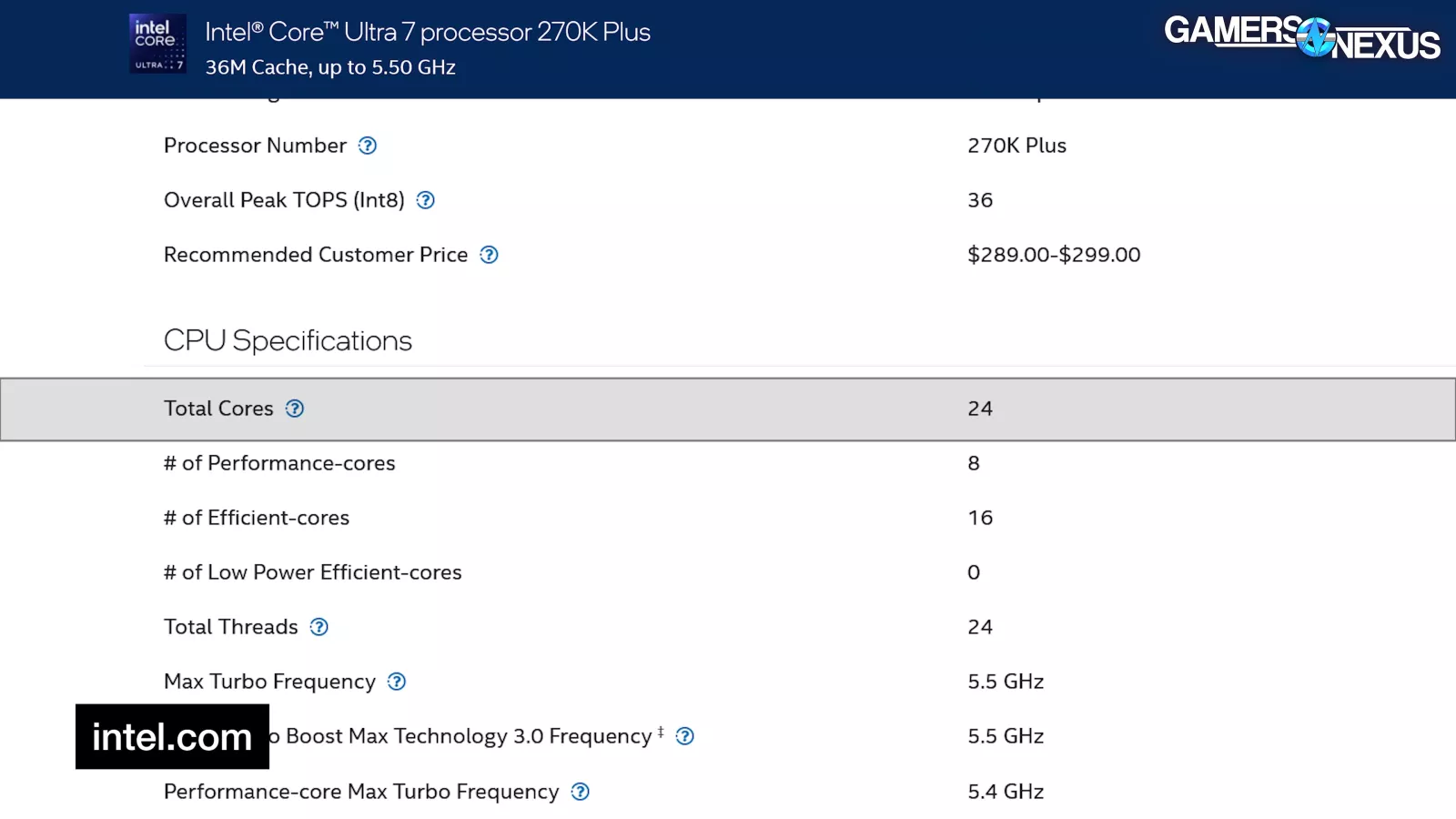
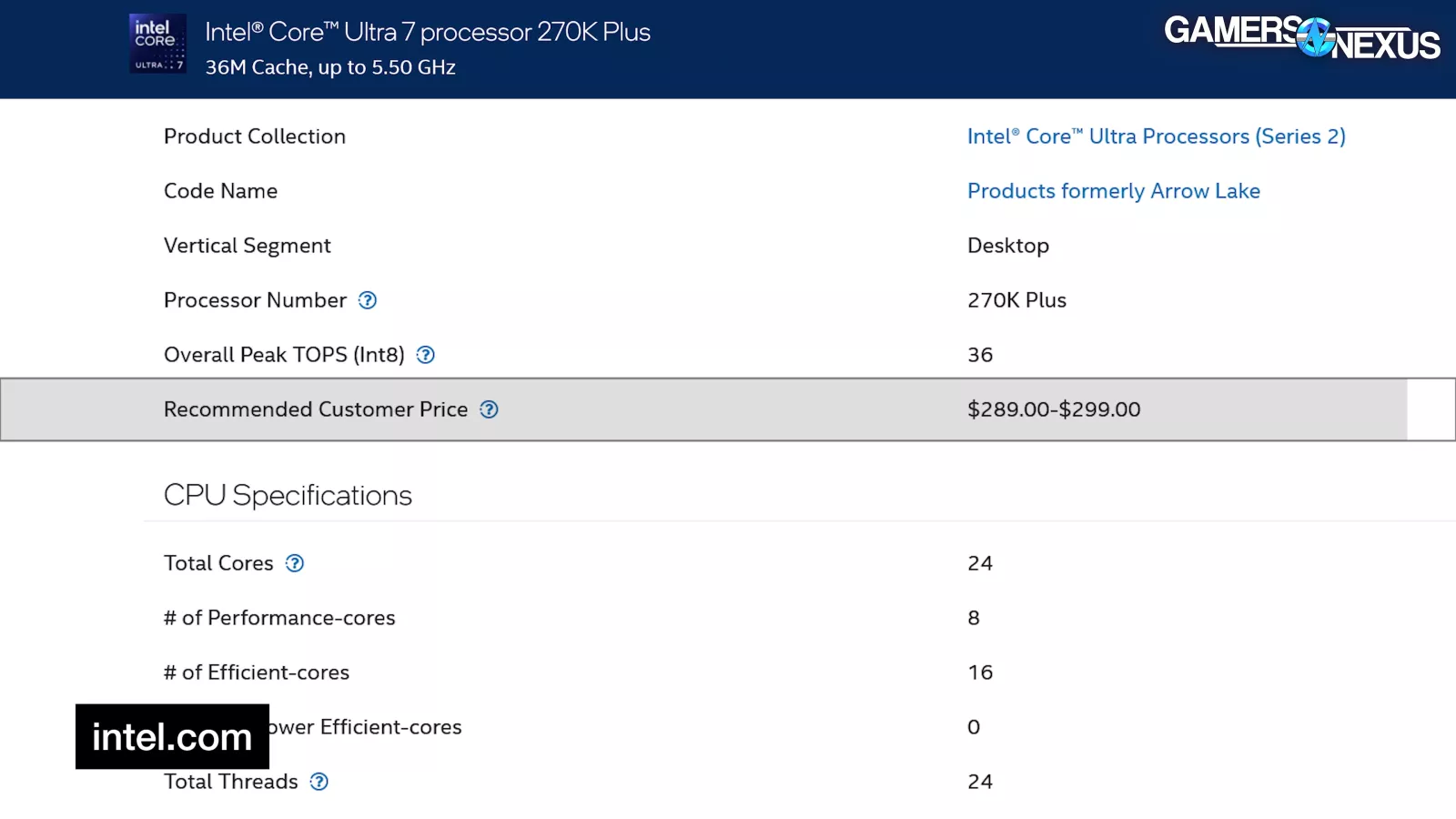
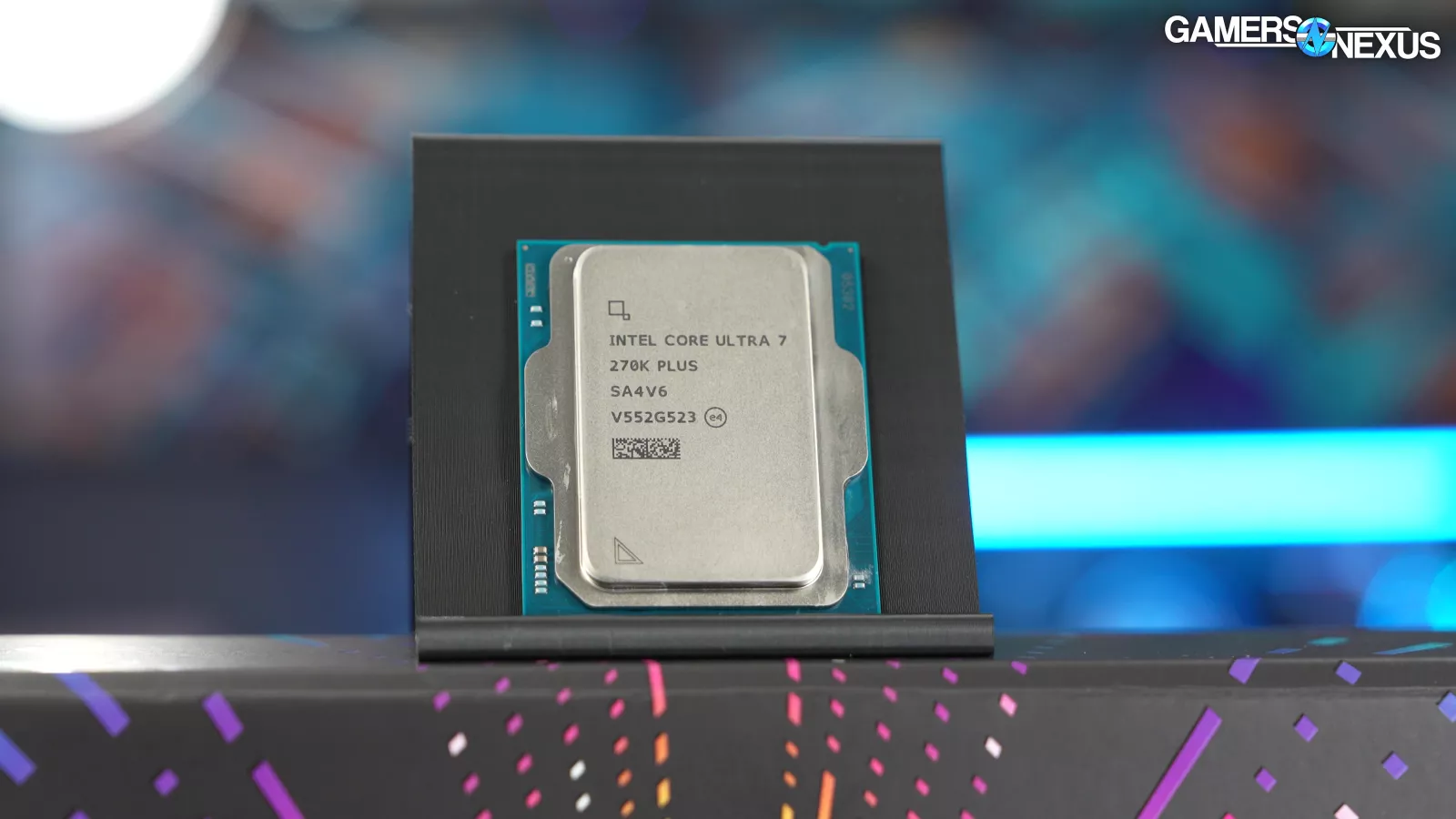
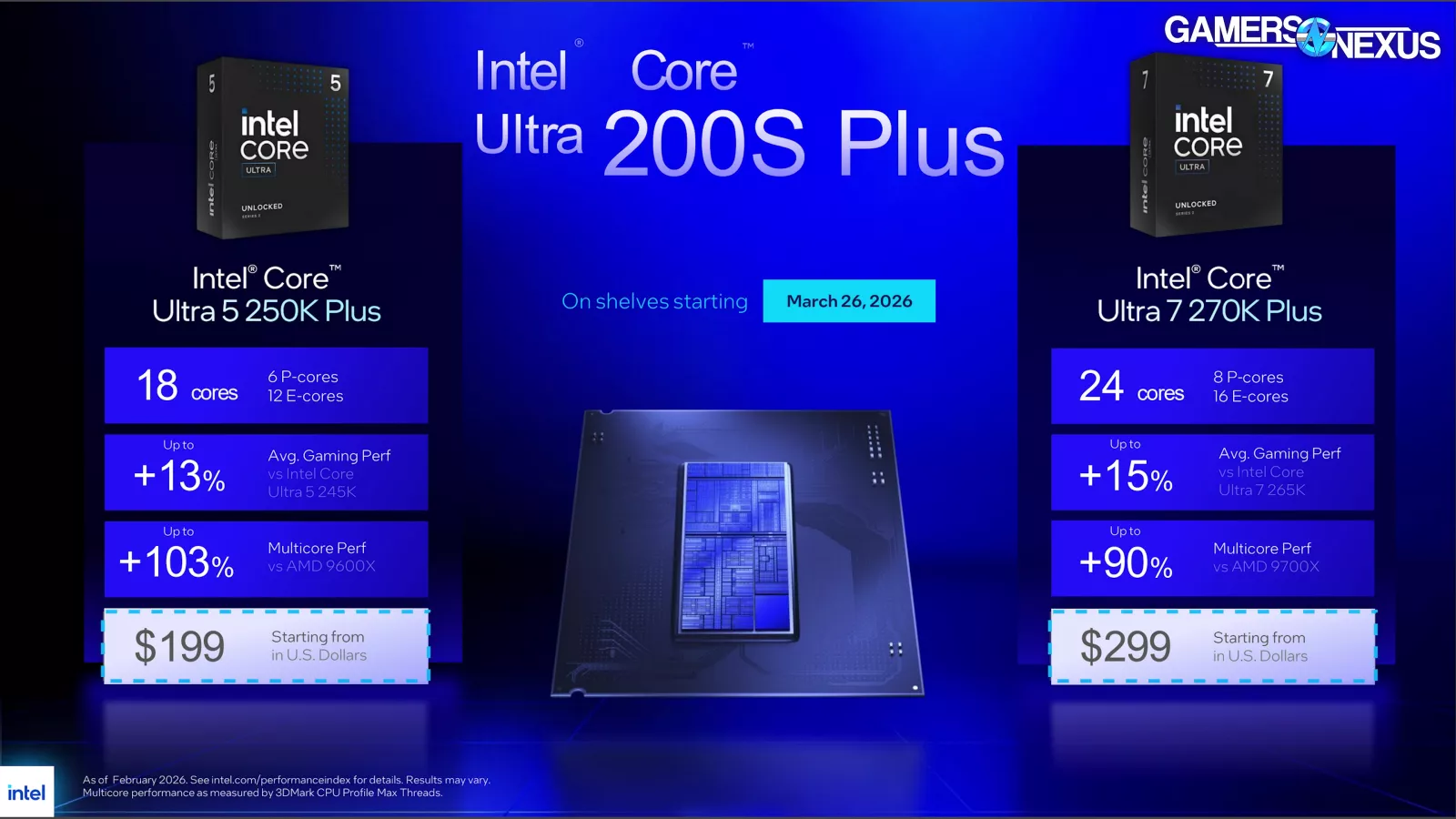
The Ultra 7 270K Plus CPU is a 24-core/24-thread part with 8 P-Cores and 16 E-Cores. As a result, it’s running a 40 MB L2 cache, so the core count and cache size are both increased from the 265K (read our review). The 265K is a 20-core/20-thread part with 8 P-Cores and 12 E-cores, so Intel has increased E-Core count by 4, and alongside that, L2 cache is up from 36 MB to 40 MB. Clock speed is advertised at 5500 MHz max for the 265K.
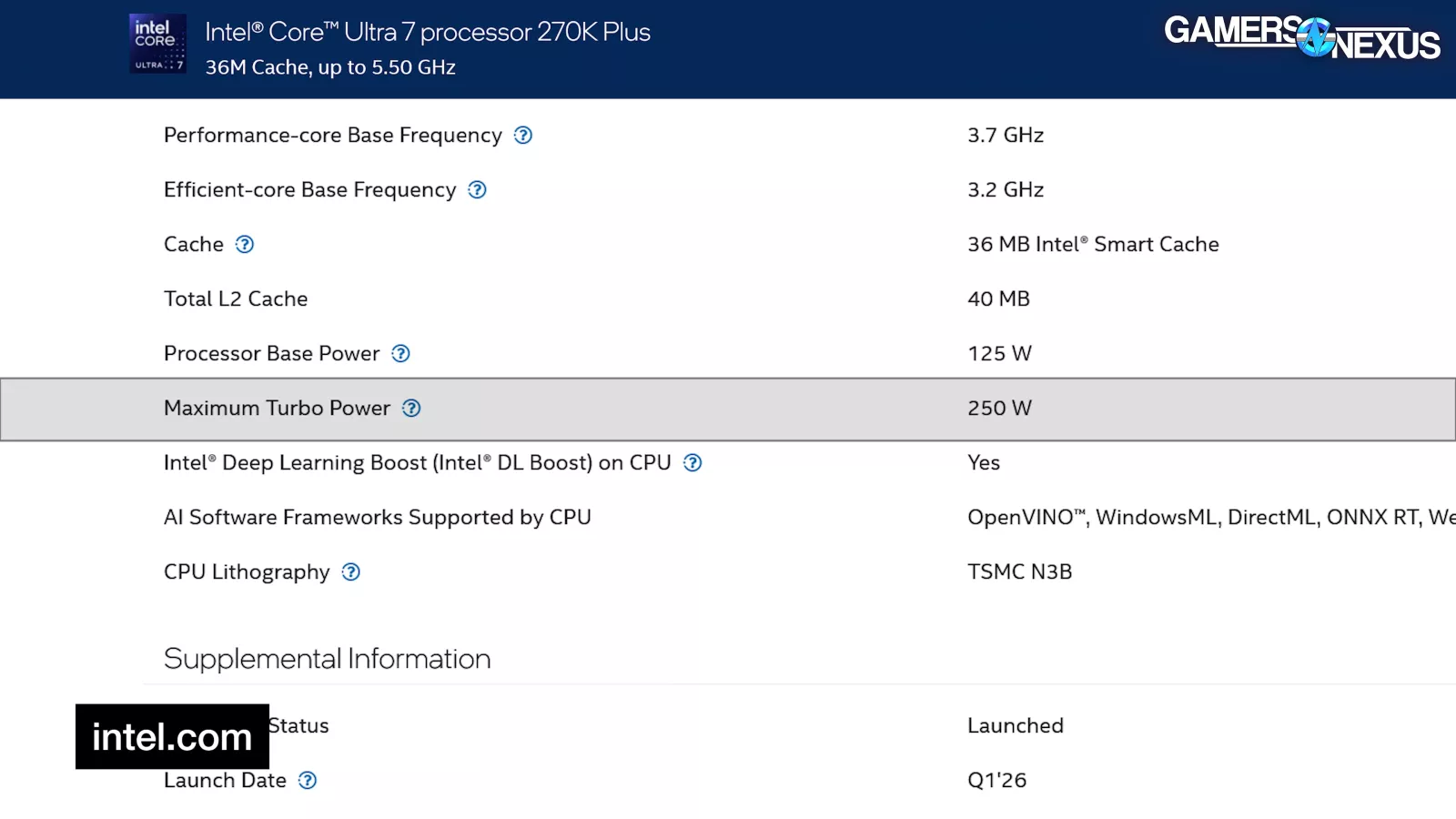
TDP is about the same, still at 251W for the 270KP. Advertised clock speed is also 5500 MHz for the 270KP.
Price Update
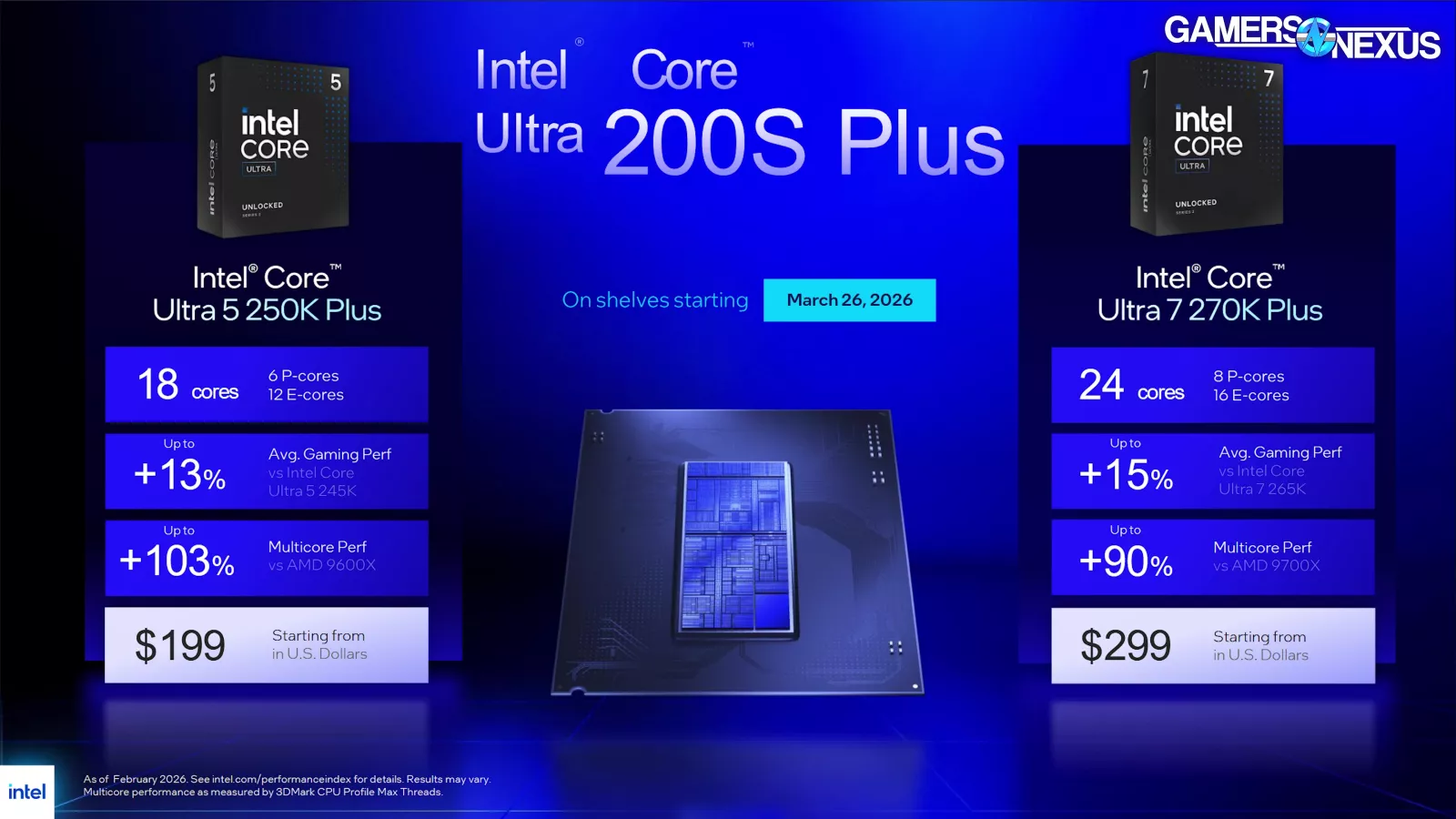
We’ll quickly check Newegg for some nearby CPU prices. The 270KP is supposed to be a $300 part that launches in a couple days. Other relevant parts include: The 265K, which is about $285 on Newegg now. The AMD R7 9700X AM5 CPU, which installs in a platform with some life to it, at $296. The 7800X3D, which remains one of the best gaming CPUs after the 9800X3D, but is now $375 when available (and sometimes $350 from third-party sellers, although those are less trustworthy). That’s going to be the closest gaming competition, and that $50-$75 price increase can be soaked by the fact that the motherboard has more than one use and the RAM can be slower while getting most of the benefit.
There’s also the 9900X, a $374 part that might be an option for production builds. However, even the $520 9950X is beaten by the 270KP in some of our production tests.
Frequency Validation - All-Core
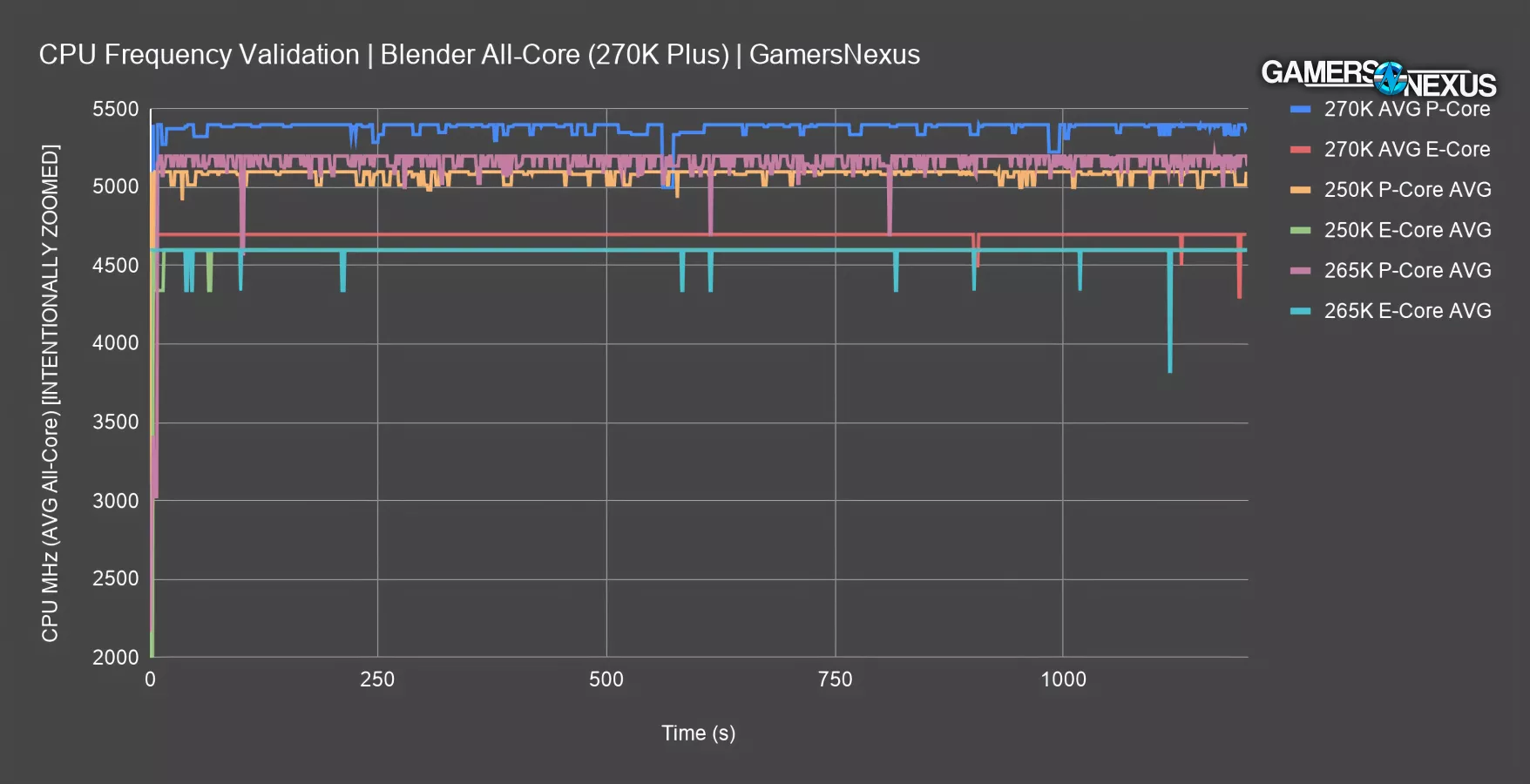
Our first test is for frequency validation, which is to ensure the CPU is working properly and that it’s able to hit Intel’s advertised targets, and in one case, it wasn’t.
In an all-core workload with Blender, the 270KP’s peak P-core frequency was 5400 MHz. That’s below Intel’s 5.5 GHz claim, but this is expected behavior since the CPU is under an all-core load.
The E-core average was 4700 MHz for the 270KP, which exactly matches the advertised claims on the spec sheet.
For perspective, the 250KP’s P-core peak was about 5100 MHz under this all-core workload. The 250KP’s E-Cores ran at 4600 MHz.
Adding the 265K for perspective, the preceding Ultra 7 CPU ran at a 5200 MHz peak for P-Cores and 4600 MHz peak for E-Cores. Under an all-core load, Intel has boosted the frequency by about 200 MHz P-Core and 100 MHz E-Core compared to the 265K.
Frequency Validation - Single Thread
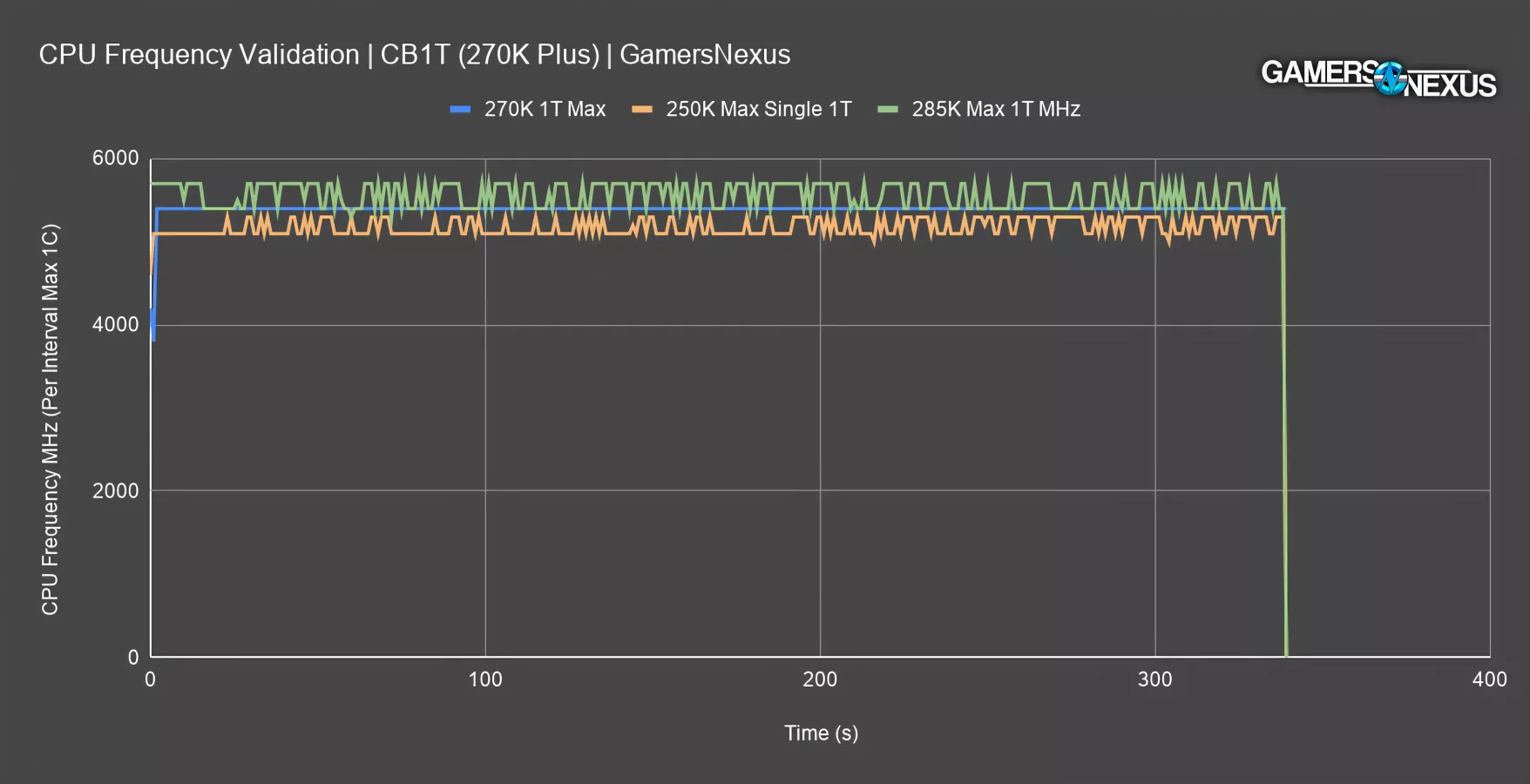
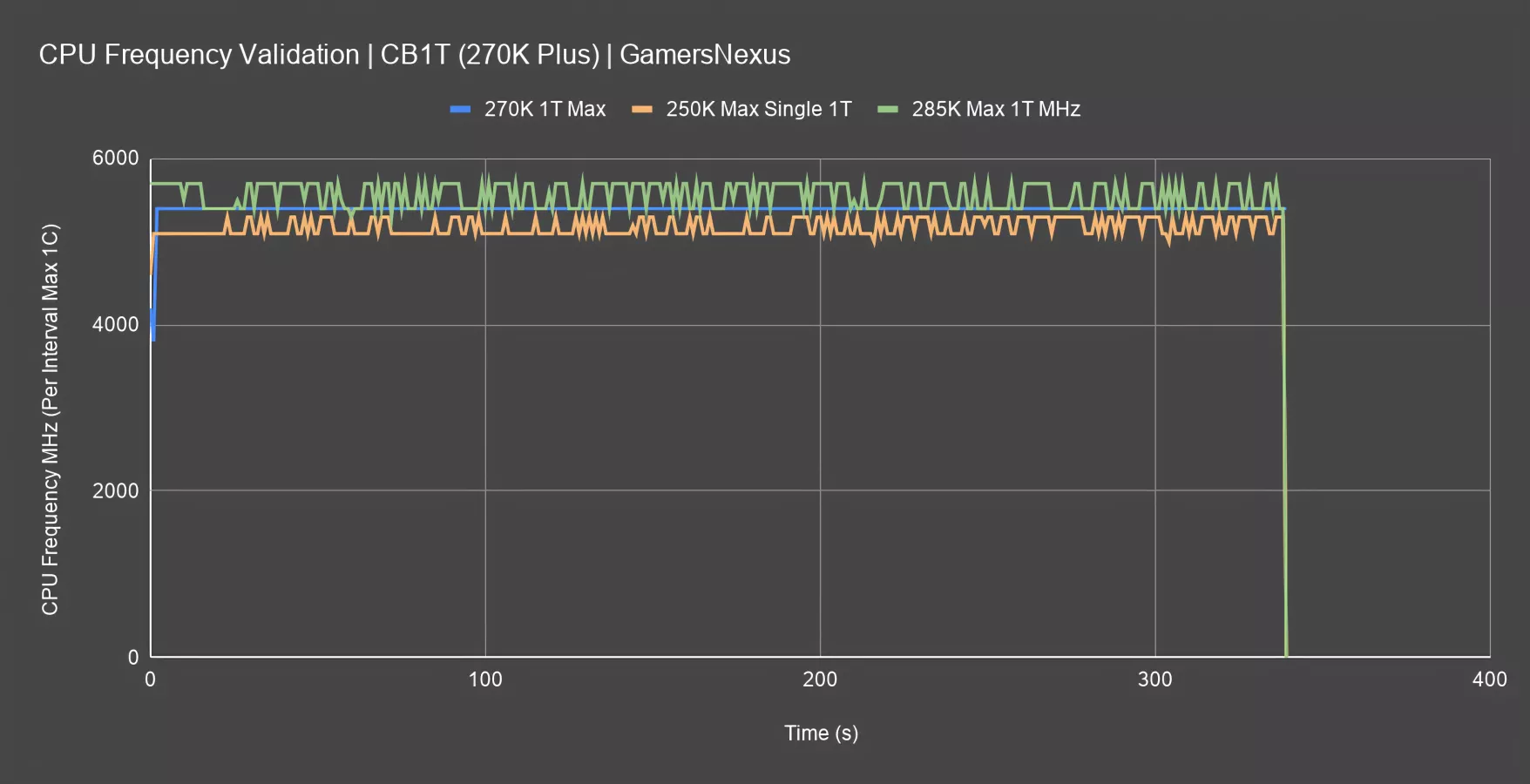
This chart validates the frequency in a single-threaded workload, where the CPUs will reach their maximum boost clocks.
Intel fails to achieve its maximum advertised boost here. This is the first objective failure we’ve seen in this test in a long time. We reran the test and the results were the same.
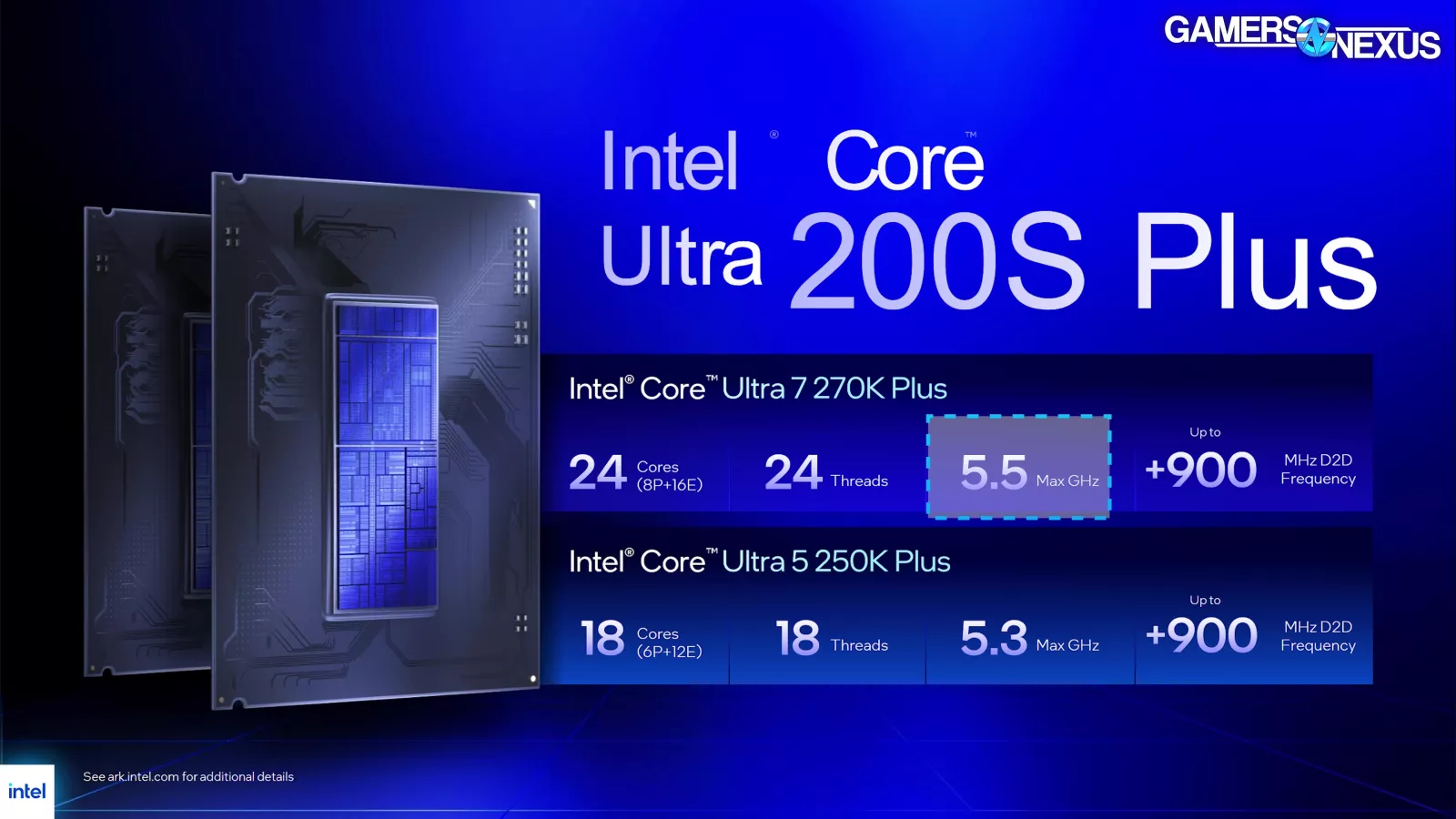
Intel’s CPU is hitting 5400 MHz max single thread per interval under a single-threaded workload, but its spec sheet states a maximum of 5.5 GHz. The CPU is not performing as advertised. Although 100 MHz off the maximum single-core or thread boost won’t impact results too much in most cases, it’s still not aligned with the product Intel is marketing.
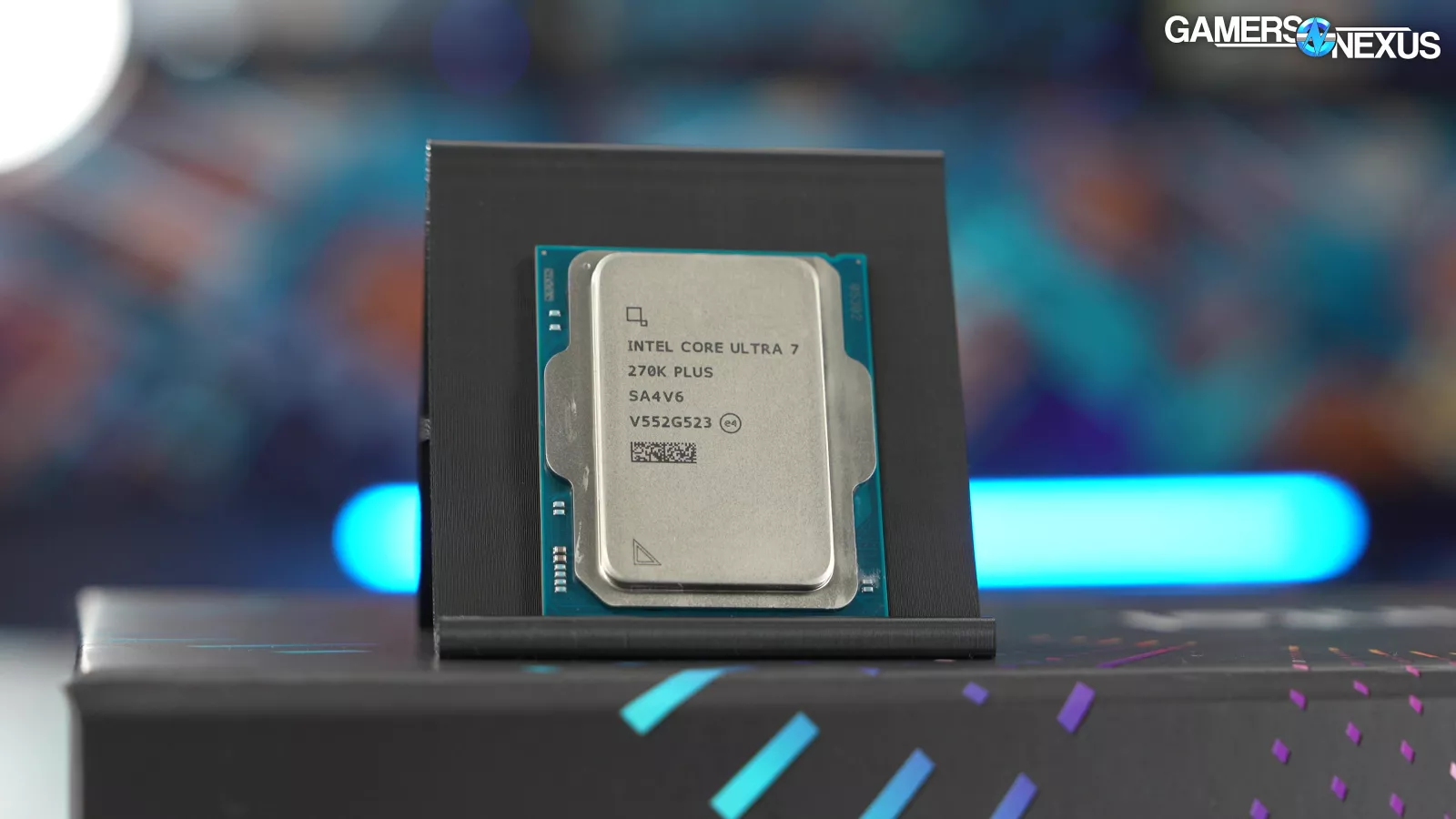
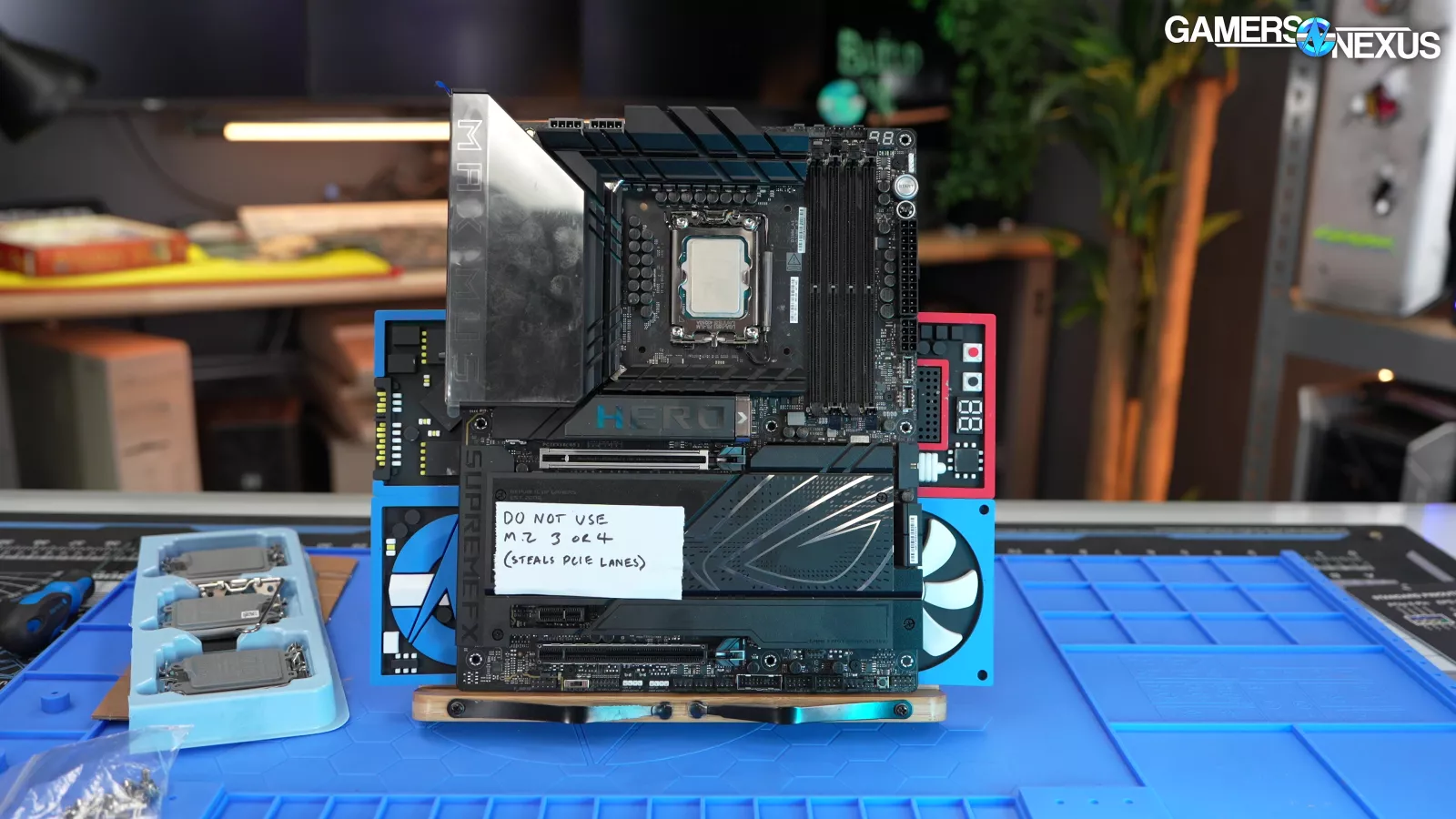
There is either an issue in the firmware or with the CPU. We are using the latest BIOS for the ASUS Z890 motherboards at the time of launch.
The 250KP managed to hit its advertised clocks, but struggled. We talked in the 250KP review about how the first 2/3 of the test saw it lower than the advertised max clock more often than at it, with only the remaining 1/3 more often at the advertised maximum. We’re not sure if the behavior persists with other 270KP CPUs or motherboards, but if it does, Intel would be overselling its CPU’s performance. If it doesn’t, then likely ASUS and Intel need to resolve this for their boards.
Just for reference, the 285K (read our review) was capable of hitting its 5700 MHz maximum advertised boost previously.
Game Benchmarks
Baldur’s Gate 3 - 1080p
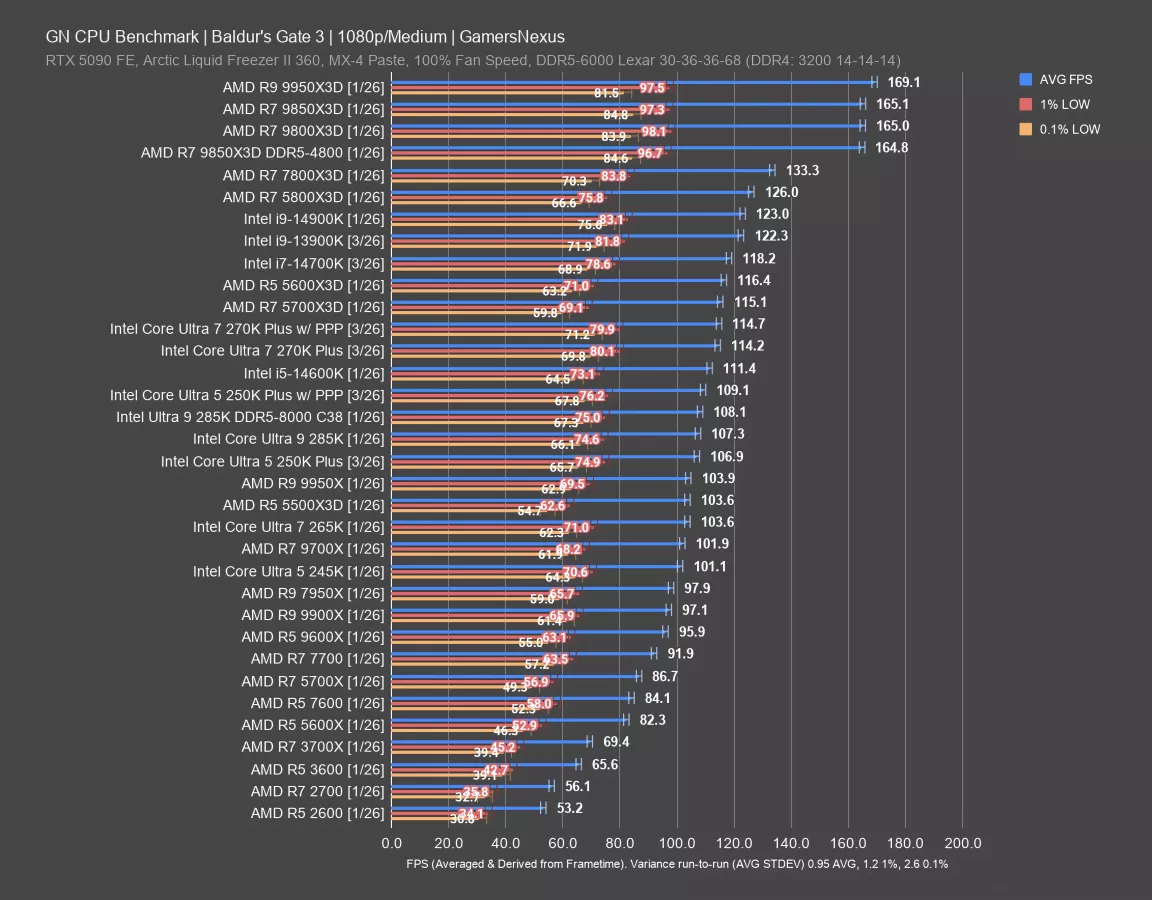
In Baldur’s Gate 3, the 270KP ran at 114 FPS AVG-115 FPS AVG. Enabling the Platform PP didn’t do anything for the 270KP-triple-P entry, here. The result has the 270KP tied with AMD’s 5700X3D and behind the 5600X3D by about 1 FPS AVG. Intel’s lows are technically better than these two AM4 X3D parts, but not in a perceptible way.
The 270KP PPP ran 5% higher framerate than the 250KP with PPP, meaning an extra $100 (or a 50% increase in price) gets just 5% more performance in this game. That should skew disproportionately in production workloads later, but it’s not a big jump for gaming so far.
The 270KP is also 10.7% ahead of the 265K’s 104 FPS AVG result, really more of a shame for Intel’s most recent 7-series predecessor than anything else. The 265K is currently $285, which softens that comparison, but it was around $400 previously. Intel has improved the price and performance of the Ultra 7 alongside its Ultra 5 series CPU we already reviewed.
Compared to AMD, other than the AM4 X3D entries that remain ahead, the 7800X3D is also worth considering. The CPU is currently around $350 from third-party sellers, putting it $50 over the 270KP and 16% ahead by average framerate with its 133 FPS result.
Outer Worlds 2 - 1080p
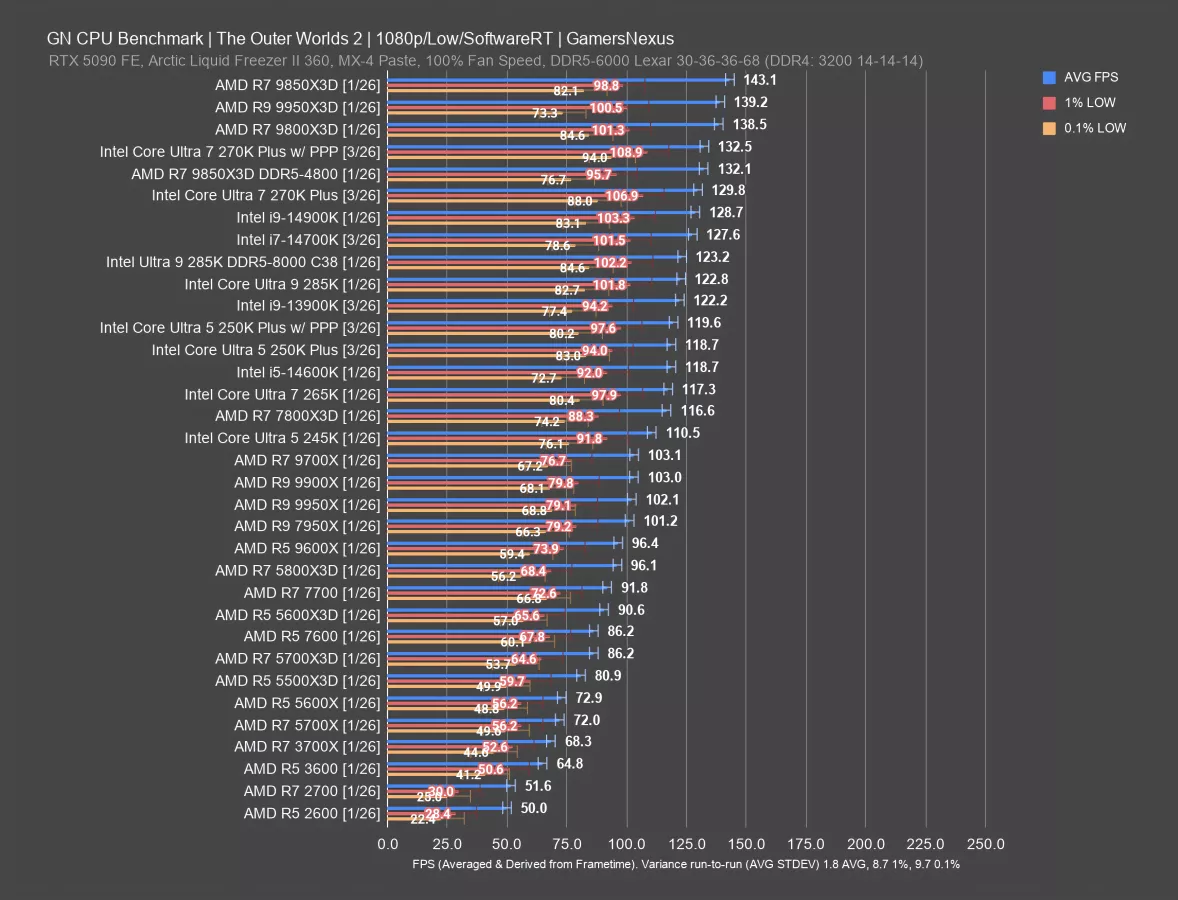
Outer Worlds 2 is next, which is one of our newer tests.
In this game and at 1080p, the 270KP ran at 133 FPS AVG with PPP and 130 FPS AVG without it, so about a 2% gain from enabling the PP Package.
The 270KP ends up behind the 9800X3D, which ran at 139 FPS AVG and was bested only by the 9850X3D (read our review). Because our 1440p results are also capped at this same framerate, we know that we’re not GPU-bound in this 1080p test.
This is one of the situations where Intel ends up a lot closer to the 9800X3D, which only has a 4.5% lead here with DDR5-6000, although they’re tied when the 9850X3D is on the cheaper and slower DDR5-4800.
The 270KP also finally outpaces Intel’s prior 14700K that the 265K sort of replaced, although regressed by pure performance metrics. It took Intel a half-generation, but they’re finally on the path back to increasing performance rather than decreasing it.
The 9700X (read our review) has never been particularly impressive for gaming and is down at 103 FPS AVG, so the 270KP has a lead of 28.5%.
Outer Worlds 2 - 1440p
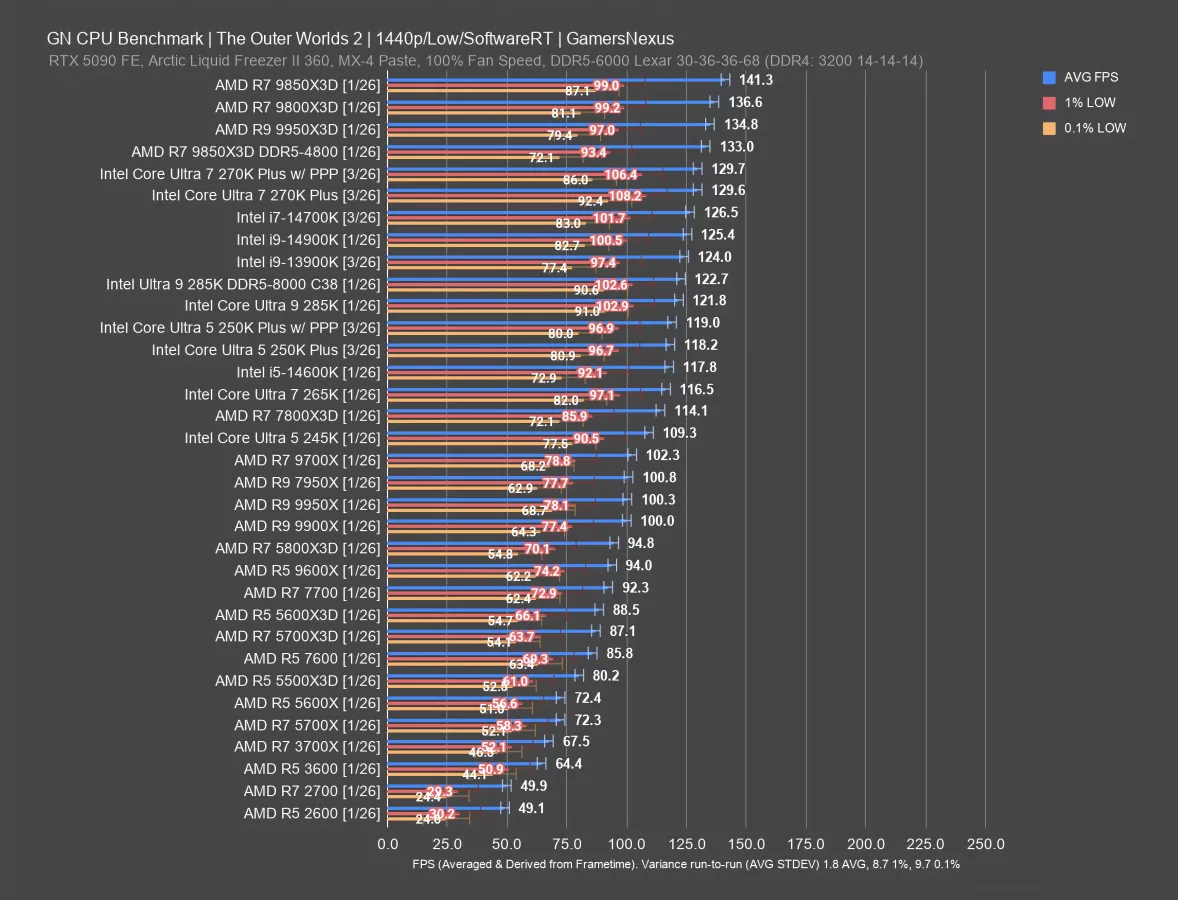
1440p is next for Outer Worlds 2.
In this test, the top results only lose 2 FPS, which could be variance. We’re not seeing the impact of a GPU bottleneck here yet, which is a good thing for showing CPU scaling.
As a result, not much has changed. The 270KP with and without PPP runs at 130 FPS AVG here, with nothing new to talk about from the 1080p version of this chart. Still, we wanted to at least show a higher resolution result to illustrate that, depending on the GPU performance, the results don’t necessarily get truncated.
Stellaris
Stellaris tests simulation time in the game rather than framerate, which gives us a better look at performance in a way that impacts real-world time and not just frame throughput.
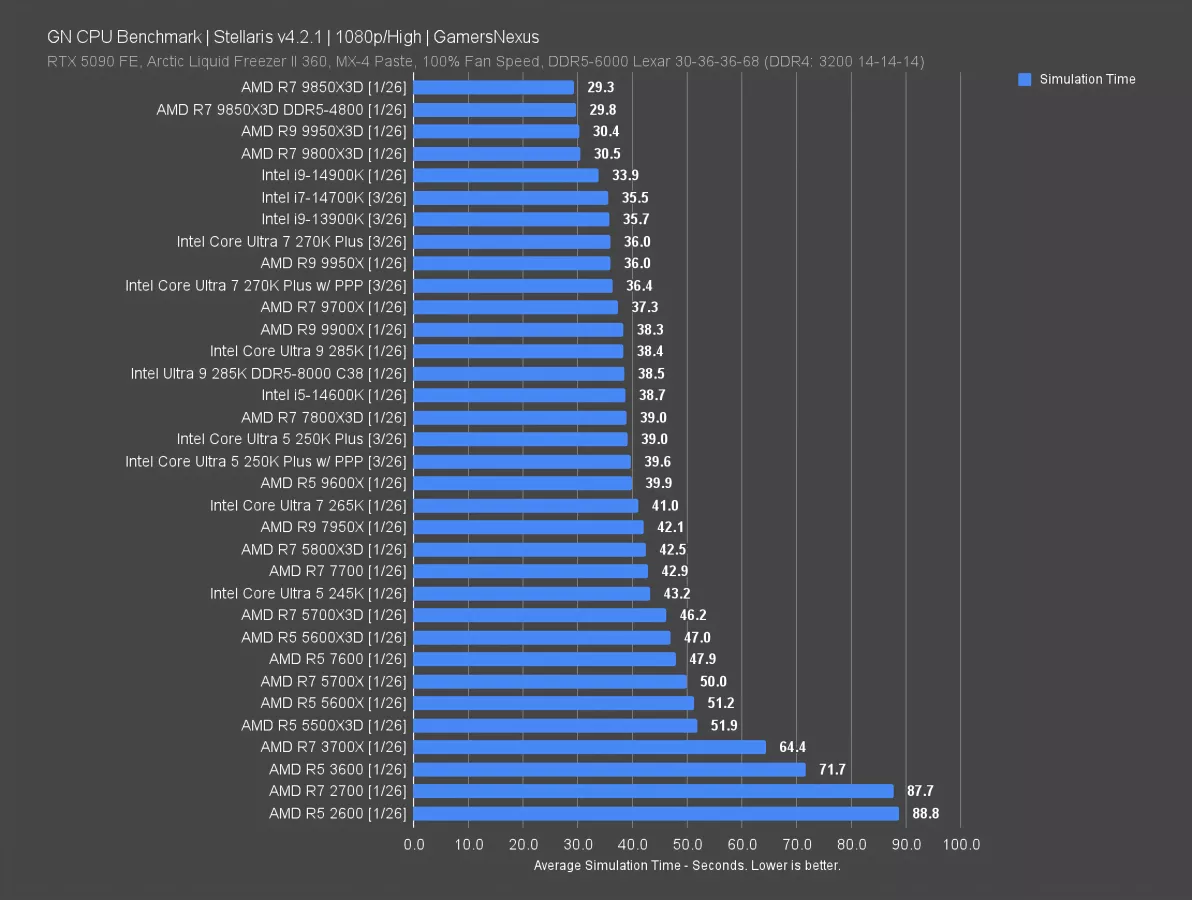
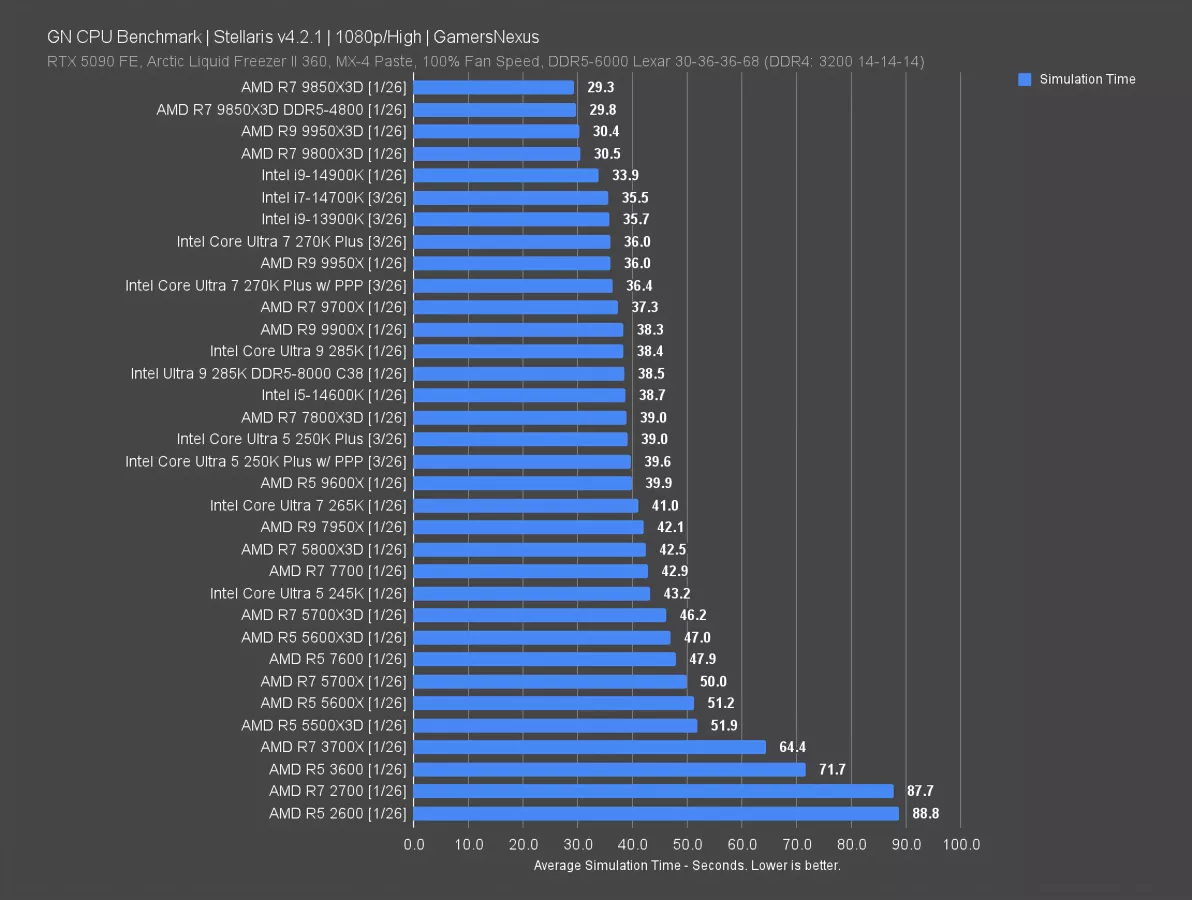
The 270KP required 36 seconds to complete the simulation both with and without PPP. There was no change. That has it at about the same level as Intel’s prior 13900K flagship, which launched in 2022 for $590-$600. It took Intel about 4 years, but they’ve now reached the same performance for about half the initial MSRP; however, the 270KP still hasn’t reached the performance levels of the 14700K. It’s getting closer, at least.
The 9800X3D outperforms the 270KP with a 15% reduction in simulation time required. The 9700X performs about the same as the 270KP. As for CPUs lower down, the 270KP is outperforming Intel’s recent 285K, AMD’s 7800X3D, and against the same-generation 250KP, it benefits from a simulation time reduction of 7.7%.
This is one of the games where AMD’s AM4 X3D CPUs (like the 5800X3D) are lower down the stack, giving Intel a better position than some other games.
Finally, against the 265K, the 270KP reduces simulation time by 12.2%.
Kingdom Come: Deliverance II - 1080p
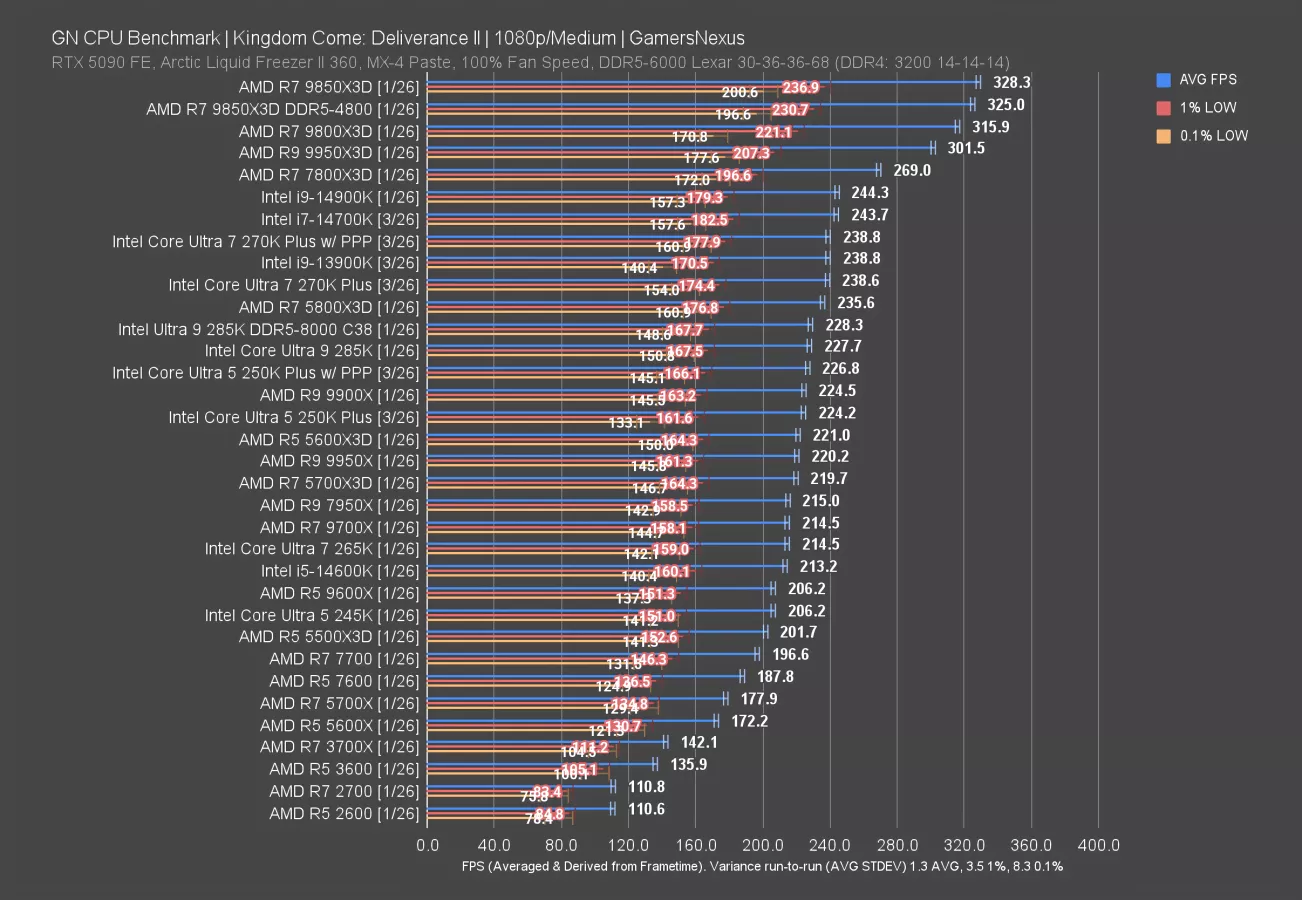
Kingdom Come: Deliverance II is also one of our newer tests. At 1080p, the 270KP ran at 238-239 FPS AVG under both test conditions. The 14700K still has a 2% lead over the new 7-class CPU, with the two basically indistinguishable from a user standpoint.
The 7800X3D leads at 269 FPS AVG, or 12.6% in average framerate. When it’s available, this is still a relatively direct price comparison. Lows are also improved. The 9800X3D pushes that further with a lead of 32%, although it’s also more expensive.
Faster memory didn’t really help the 285K here, and we don’t expect it’d change things notably for the 270KP either. The kit we’re using already has good timings, which tend to matter more for most games.
Against the 250KP, the 270KP is 5.3% improved for average framerate. AMD’s 9700X is around $300 lately and is beaten by the 270KP by 11%.
Kingdom Come: Deliverance II - 1440p
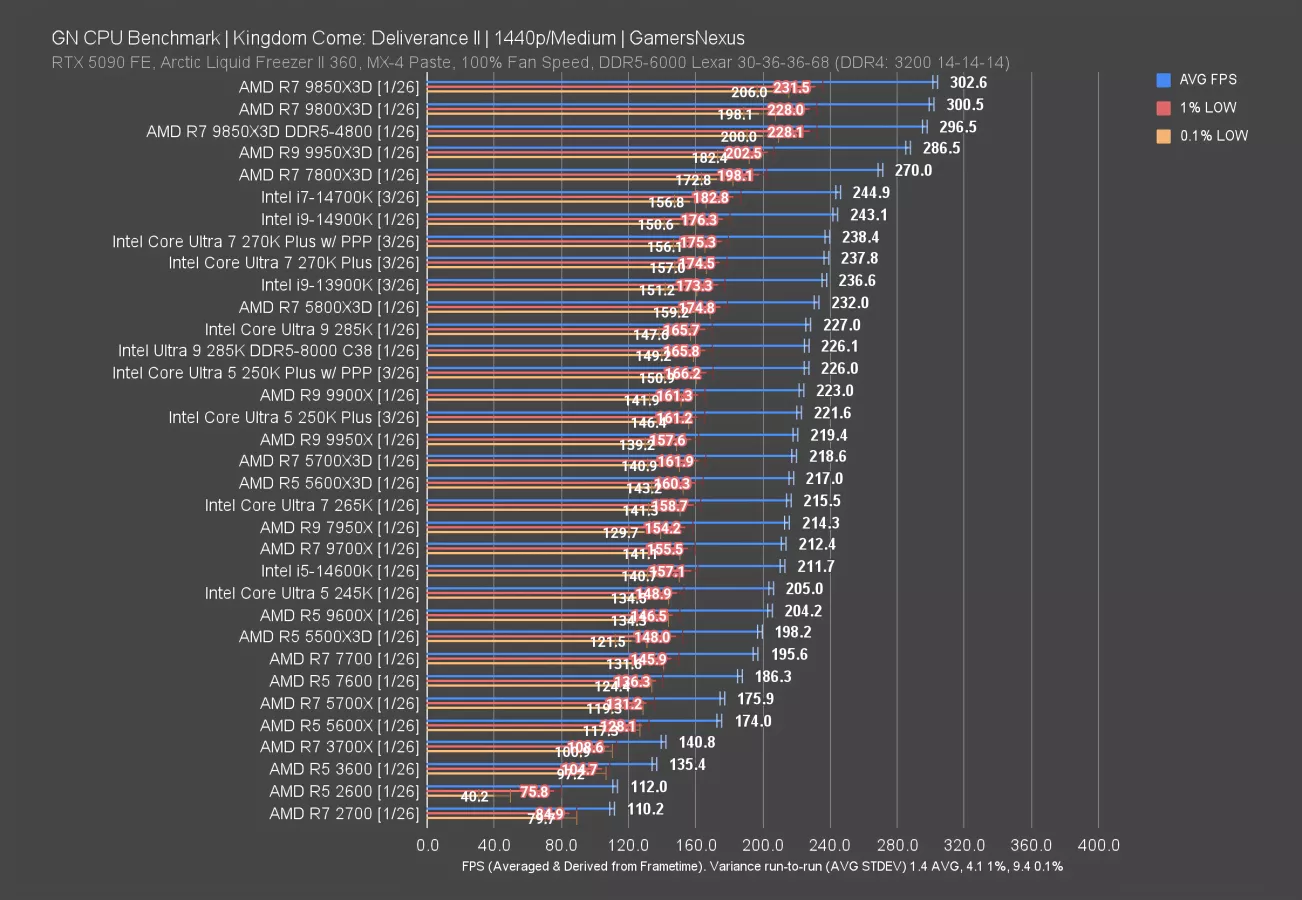
This next test moves to 1440p to increase the GPU load.
The 270KP ran at 238 FPS AVG here, so the same as the 1080p result. There’s enough distance from the GPU ceiling that it’s not affecting CPUs lower down the ranks. The GPU ceiling starts to truncate the 9850X3D and 9800X3D results, so those have come down closer to the 270KP with 1440p (even on the 5090).
The rest is the same, so we’ll move on.
Dragon’s Dogma 2
Dragon’s Dogma 2 is up next.
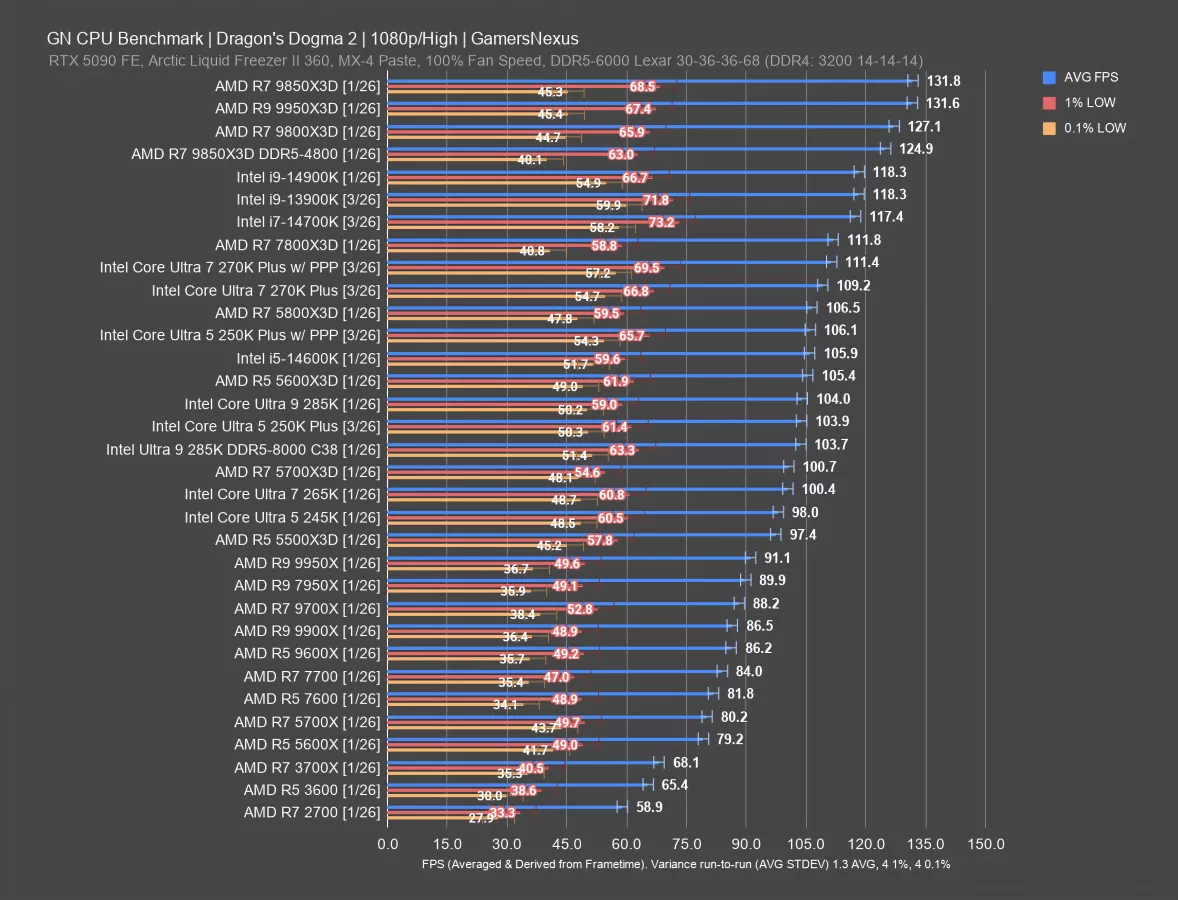
In this one, the 270KP with its PP Package performed the same as the 7800X3D. They’re within 1 FPS AVG of each other here, with Intel gaining a technical advantage in the lows between the two.
The 14700K still leads Intel’s 270KP, so the company is still regressive versus its 14-series CPUs. In this case, that lead is 5%. Ahead of that, the 9800X3D at 127 FPS AVG has a 14% improvement for AVG FPS on the 270KP with PPP, with lows improved from the 7800X3D but still worse than the 270KP.
AMD’s older 5800X3D isn’t far behind the 270KP, but it is behind, so Intel has at least climbed past AM4’s GOAT. The 270KP also outperforms the 9700X’s 88 FPS AVG by 26%.
Against the 250KP with PPP, the 270KP’s 111 FPS AVG gives it a 5% bump. That’s not really worth the extra money, but maybe production will change that.
As for the PP Package, it does seem to be technically doing something here. Both the 270KP and 250KP had gains of a few FPS from enabling it even though you wouldn’t feel that impact as an end user.
Cyberpunk 2077 - 1080p/Medium
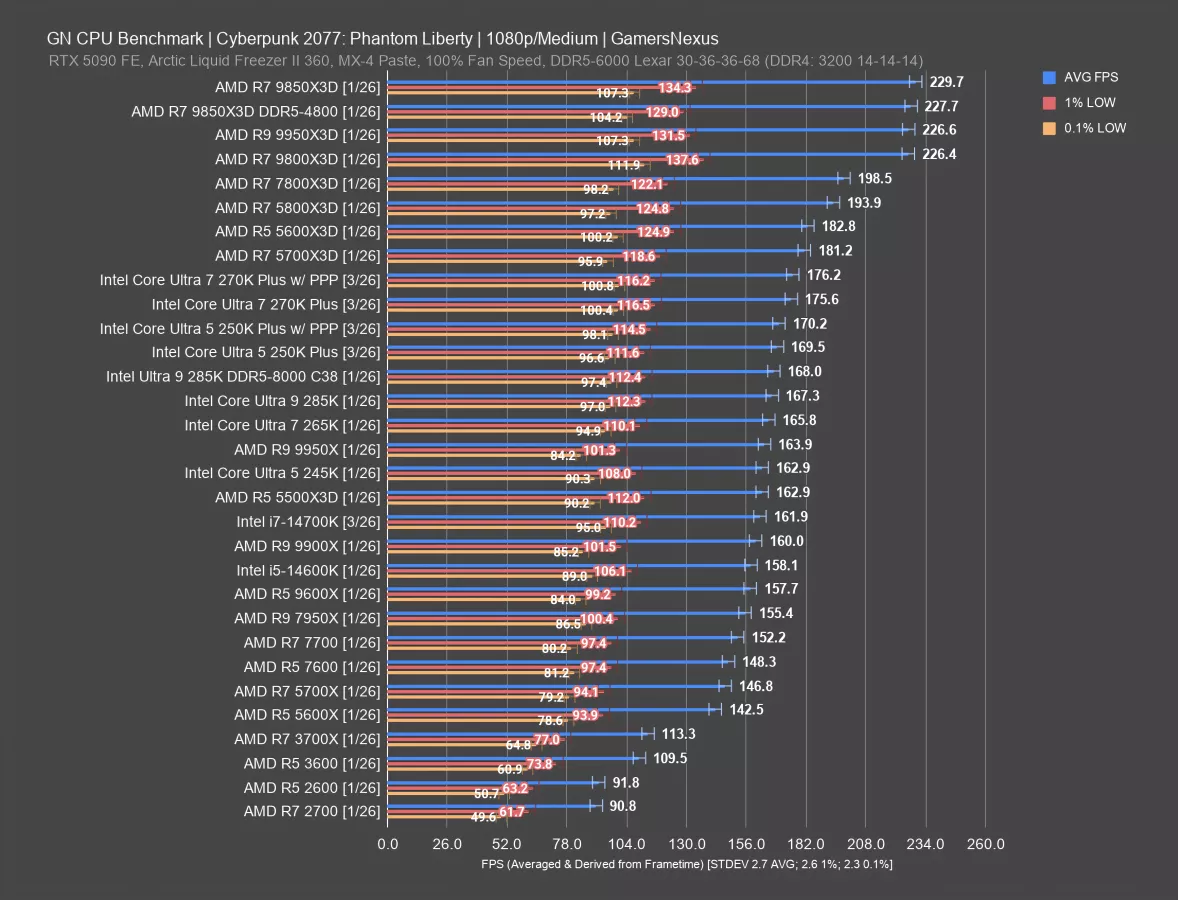
Cyberpunk 2077 is next, first with medium settings.
The 270KP’s 176 FPS AVG puts the CPU just behind the 5700X3D, which had a launch MSRP $50 lower than that of the 270KP. Intel is still playing catch-up with AMD’s older AM4 CPUs in this game, but has at least bested its own 14-series CPUs by a meaningful amount. The 270KP’s 176 FPS average puts it ahead of the 14700K’s 162 FPS by 9%. Although in this one, the 265K wasn’t regressive as in other benchmarks. The improvement over the 265K is 6.3%.
The chart is helmed by the 9850X3D at 230 FPS AVG, a 30% lead over the 270KP. Intel still has a lot of ground to gain on AMD’s high-end, but for now, they’re at least getting closer to the CPUs nearer in price. The 7800X3D is an example of that, which has a 12.7% advantage over the 270KP.
Cyberpunk 2077 - 1080p/High
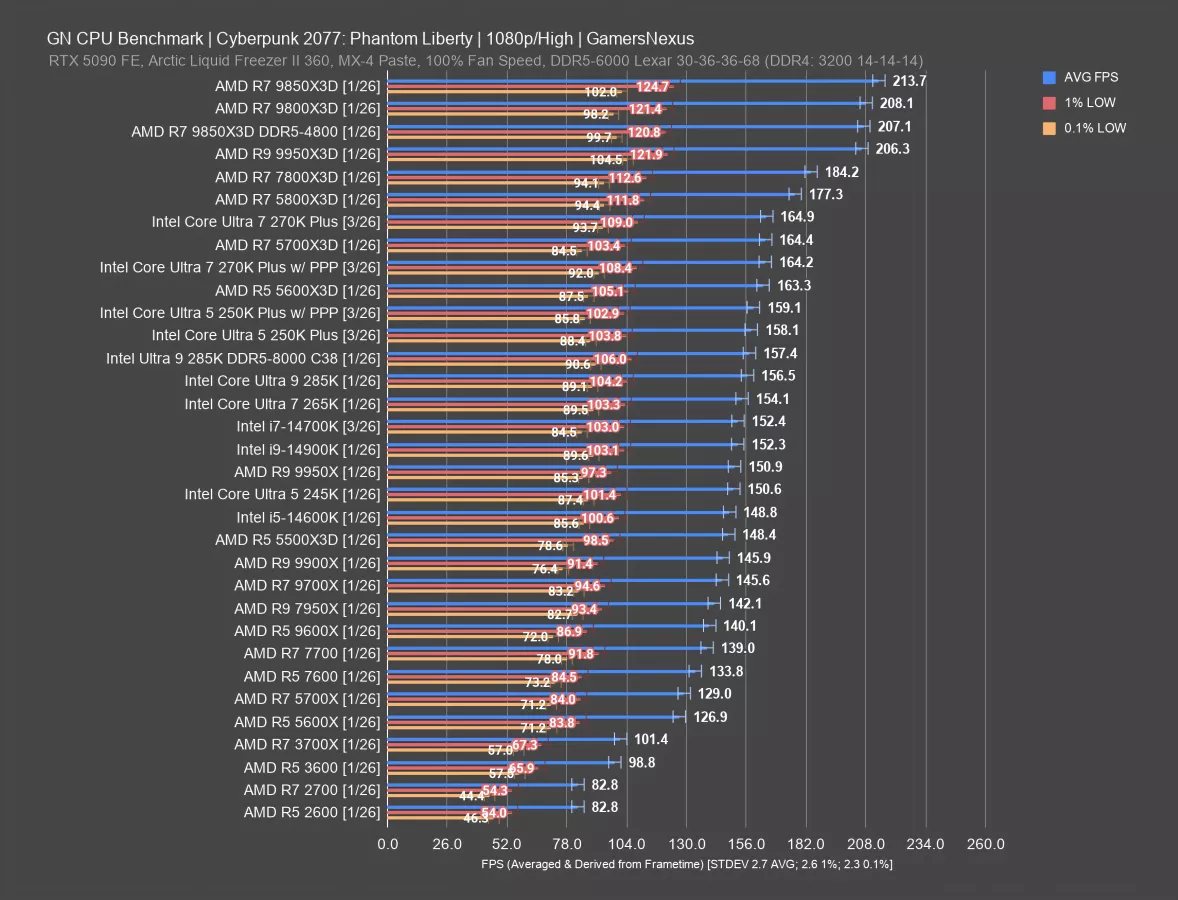
Now tested with high settings in Cyberpunk 2077, the 270KP held a 165 FPS AVG and lows at 109 and 94 FPS. This drops slightly from the Medium settings test. We didn’t see a difference from enabling PPP here. The depth of impact for the 250KP’s PP Package is also small, at a 1 FPS swing -- that’s basically margin of error and wouldn’t be noticed.
CPUs above the 270KP include the 5800X3D, which maintains about a 7-8% advantage, then the 7800X3D at about 11.7% versus the faster of the two 270KP results. After that, the 9800X3D chart-tops at 208 FPS AVG, for an improvement on the 270KP of 26%.
Below the 270KP, and fortunately for Intel, we find the prior generation i7-14700K. Previously, this CPU was about tied with the 265K, posting little improvement generationally for Intel’s 7-lineup. Now, we’re seeing an uplift of 8.2%. The improvement on the 265K is 7%.
AMD’s 9700X is pretty far down the charts. Without X3D, AMD just has trouble keeping up with any of the other CPUs here.
F1 25 - 1080p
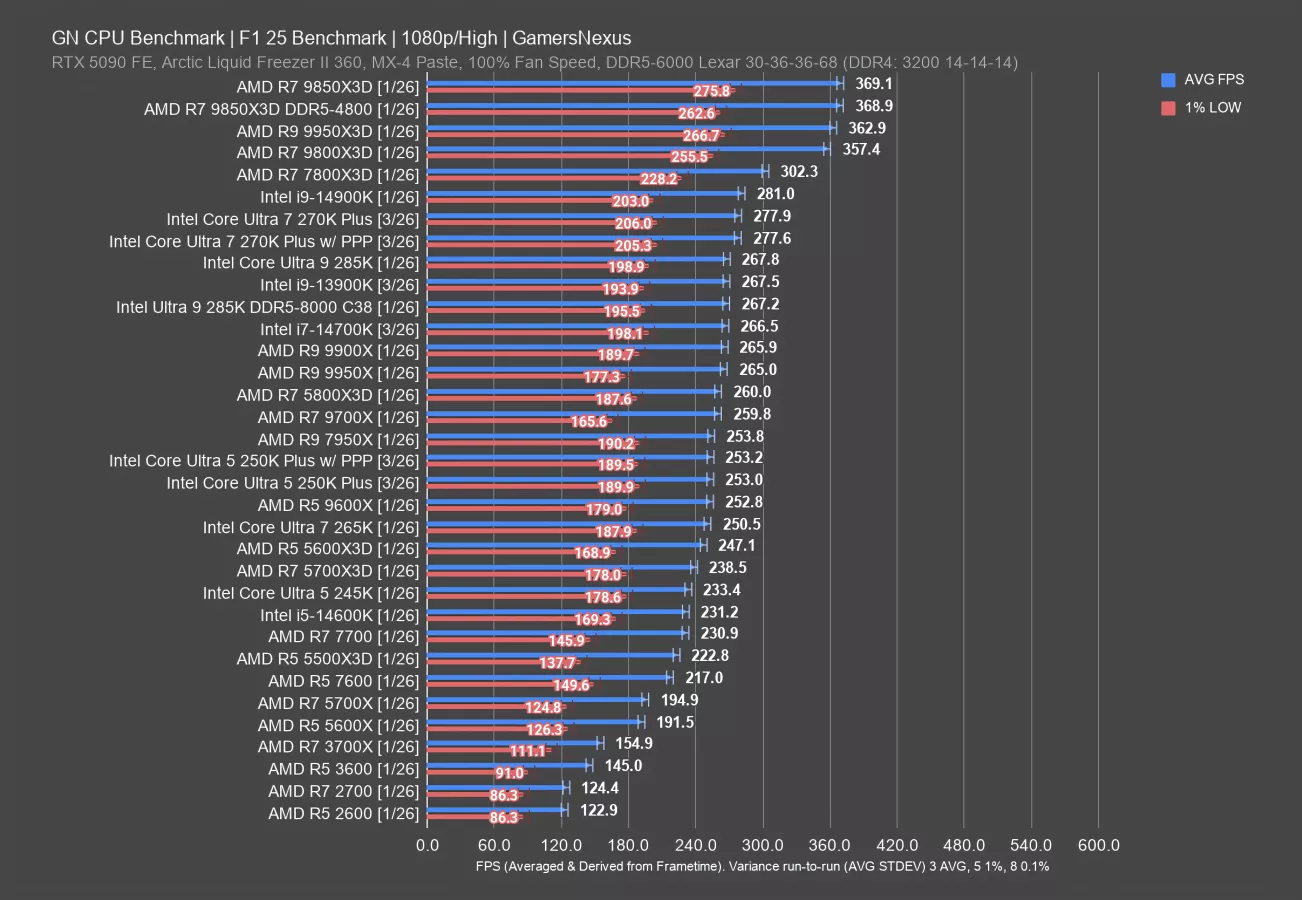
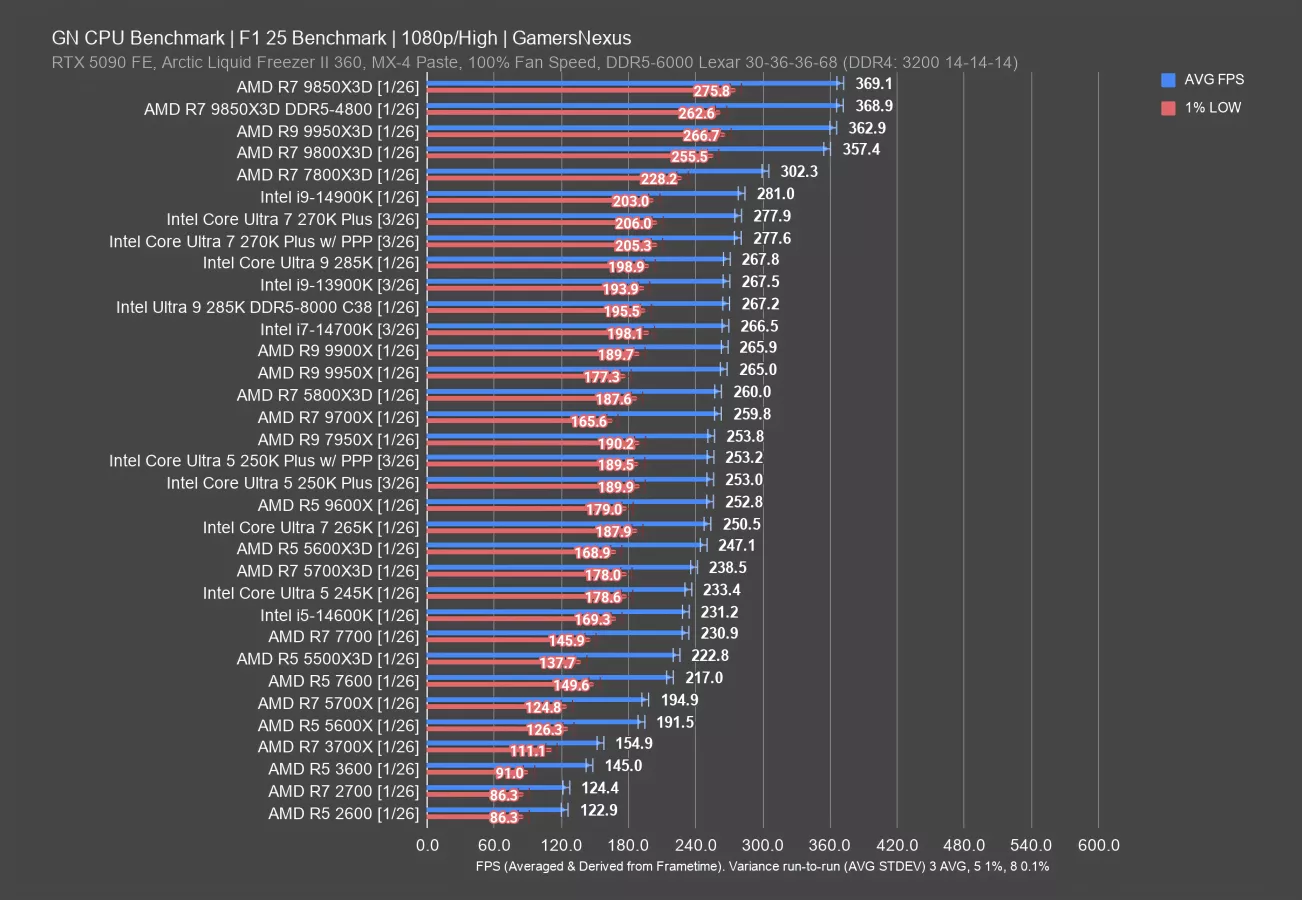
In F1 25 at 1080p, the 270KP ran at about 277-278 FPS AVG. We didn’t see any change from the Platform PP, true for both the 270KP and the 250KP. We’re within run-to-run variance for both. The higher of the two results puts AMD’s 7800X3D 8.8% ahead. The 9800X3D boosts that further, but also boosts price, and is 29% improved on the 270KP.
Against Intel’s prior CPUs, the 270KP outperforms the 285K, so that’s good, and also bests the former flagship 13900K (watch our review). Changing to faster memory had no impact on the 285K and we wouldn’t expect one on the 270KP in this test, either.
The 270KP also leads the 14700K by about 10 FPS AVG and the 5800X3D by about 18 FPS AVG. As for the 250KP, spending an extra $100 would boost from 253 FPS to about 278 FPS AVG, or 9.8%.
Starfield
Starfield is last for games, with production next.
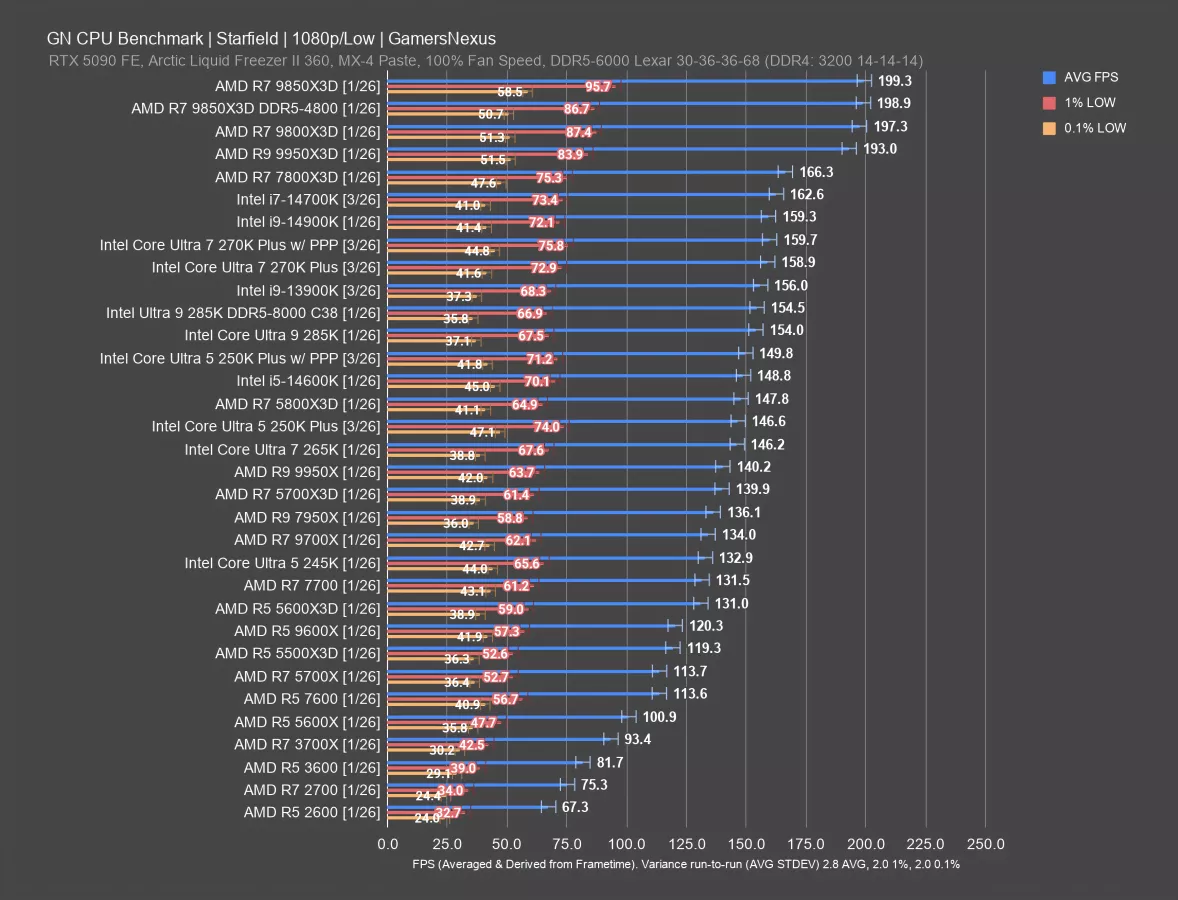
In Starfield, the 270KP ran at 160 FPS AVG. The PP Package is impotent here for the 270KP, with its change within run-to-run variance and error. The 250KP saw slightly more of a change, so is either more receptive due to its lower spec configuration or just landed on the outer bounds of variance.
The 14700K still leads the 270KP, so Intel hasn’t beaten its predecessor yet by raw performance. They’re close, though, and we’d expect the next generation should surpass it. Intel is also driving down power consumption at the same time, so they’re at least gaining in efficiency.
The AMD 7800X3D manages about a 6-7 FPS lead over the 270K, with the 9800X3D more meaningfully ahead at 197 FPS AVG. Against the 250KP, the 270KP is 6.6% ahead.
Production Benchmarks
Chromium
We’re moving on to production testing now, where the 270KP should show more of an improvement over the 250KP. Intel has established itself something of a foothold in retaking some of the non-gaming workload top ranks and that’s something that we’ll see here.
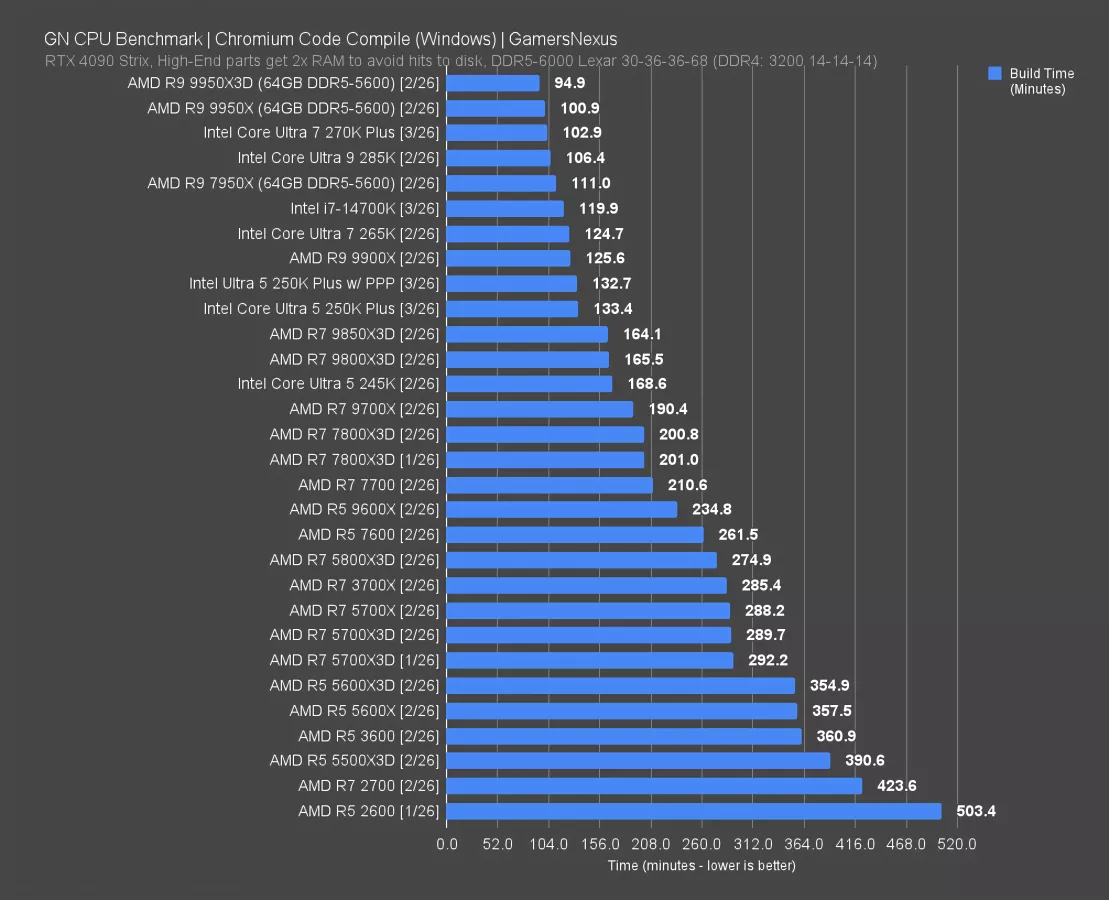
Chromium code compile in Windows is next. Although not plotted here just to save space for the next round of CPUs, we also didn’t see a difference with PPP enabled in this one for the 270KP. That mirrors the 250KP testing, where the two entries were about 133 minutes.
This test looks at the time required to complete the compile, with the 270KP completing the Chromium compile as we test it in 103 minutes. That has it slower than the 9950X (read our review) by only about 2 minutes, meaning the 9950X completes the work in 1.9% less time, which isn’t as big of an advantage for its price. This is a great result for the 270KP, and actually one of the best out of all of the testing we’ve done so far for these new parts.
The 270KP outdoes the 285K by a couple minutes and shortens the compile time on the 14700K’s 120 minute result by about 17 minutes, for a reduction in time required of 14%.
Compared to the 250KP’s 133-minute result, the 270KP completes the compile in 22.6% less time.
AMD’s 9700X is pretty far down in this one, at 190 minutes. This allows the 270KP to complete the compile in 46% less time required. AMD’s 9800X3D and 9850X3D utilize their higher frequencies to outperform the 9700X, but otherwise, they don’t gain their value back in this test (as expected) because the extra cache is really more of a gaming benefit.
Blender
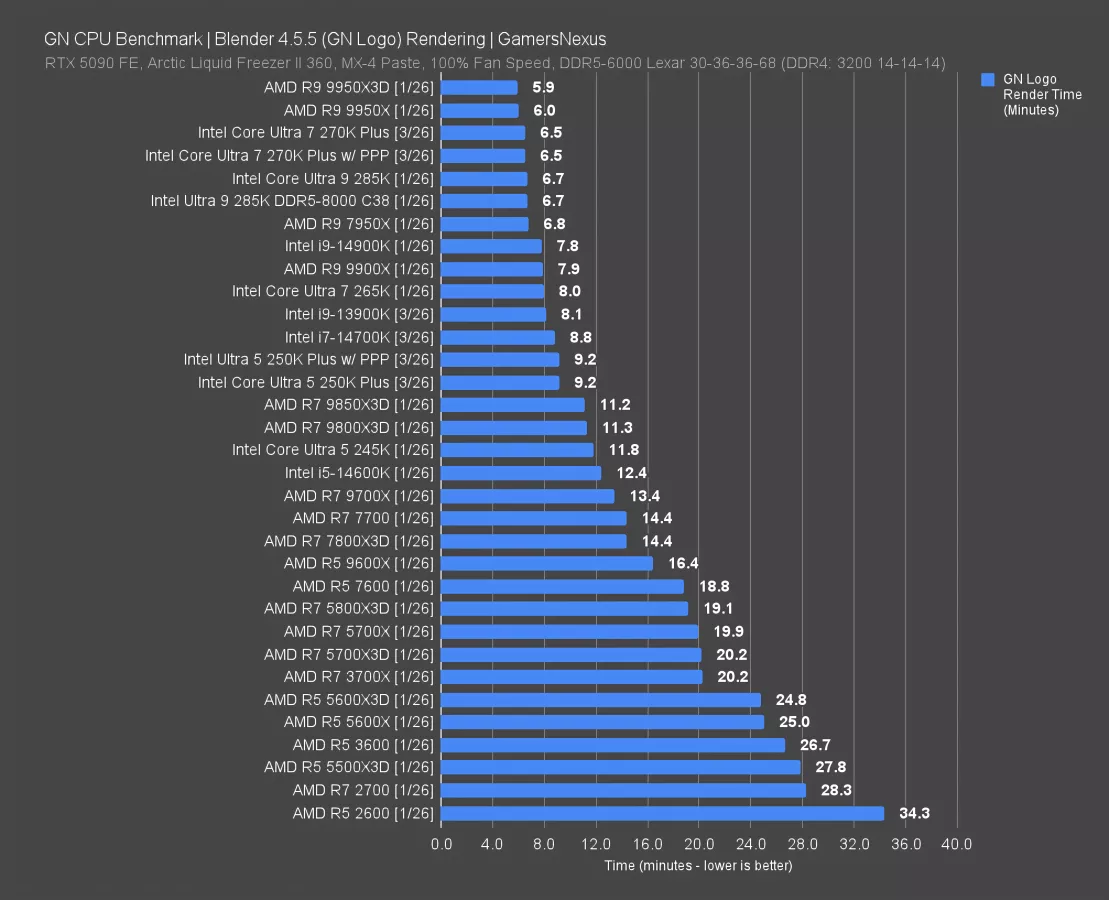
In Blender rendering with the CPU, where 1 tile is spawned per thread available, the 270KP performed equally with and without PPP once again. Both the 270KP with its PP Package equipped and unequipped required 6.5 minutes to complete the render of one frame from our intro animation. The 9950X did this work in 6 minutes, as did the 9950X3D (read our review). Intel is getting close to AMD’s 16-core CPUs in these workloads, which is mostly just exciting because we might finally have competition again.
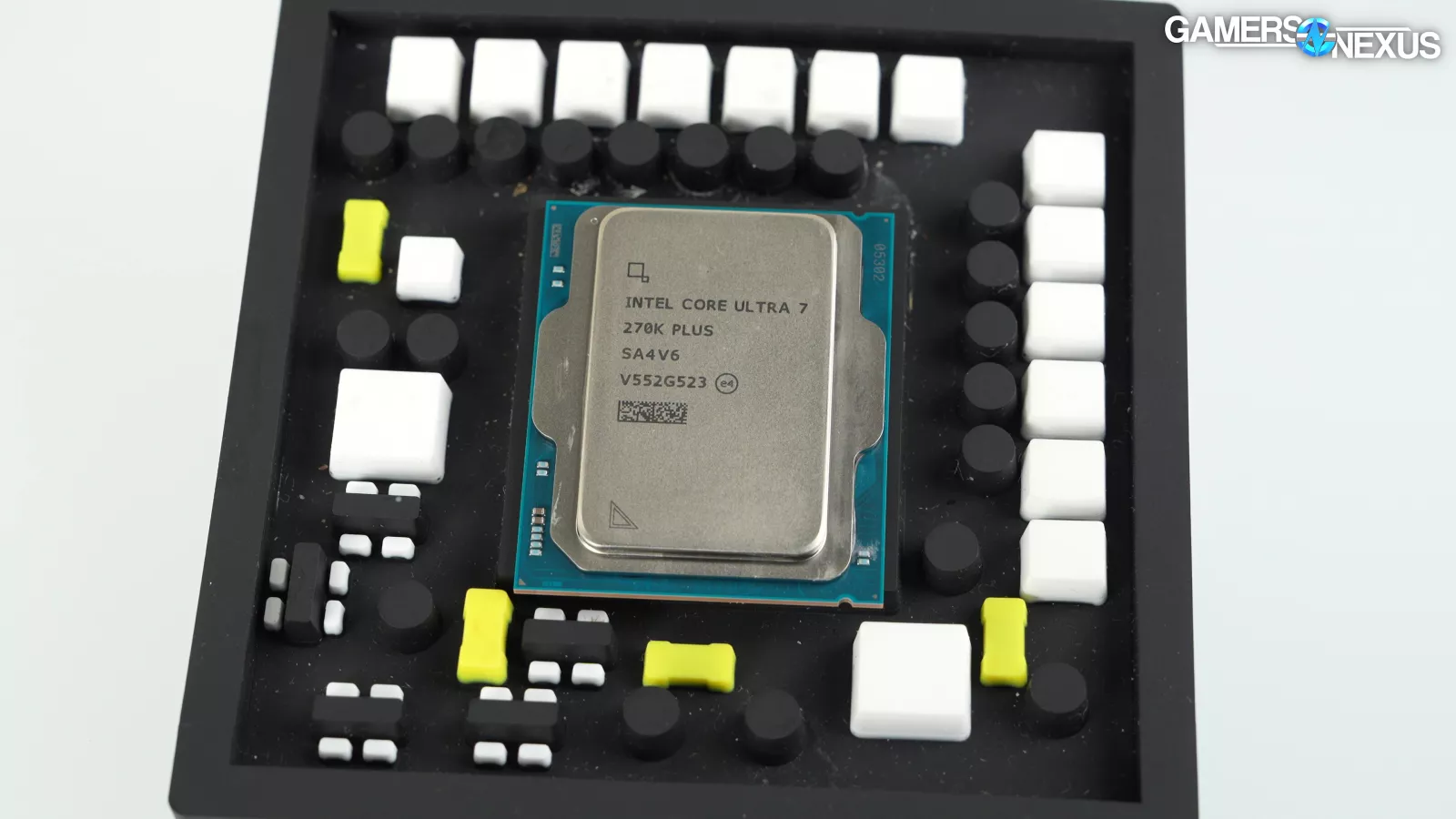
The 285K did the work in 6.7 minutes, so in terms of actual performance, it’s really not that different; however, the 285K has been $530 to $600 since launch, lately $530 to $560, and the 270KP should be $300. That’s a massive improvement on the 285K’s value proposition and is actually a threat to AMD’s 9950X, with the one exception that you can actually put another CPU in the 9950X’s motherboard in the future, whereas the 270KP will be in a dead platform and that is a big advantage for AMD.
Either way, as we said in the 250KP review, it looks like Intel is starting to establish a foothold in non-gaming work, just like AMD did back in the Ryzen 1000 and 2000 era. If Intel takes platform longevity more seriously in its next round, then they would be taking away one of their key criticisms.
As for other results, the 270KP outdoes the 265K’s 8-minute render time, completing the work in about 19% less time required. The 14700K is at 8.8 minutes, so this is a decent improvement after the prior relatively stagnant launch.
7-Zip Compression
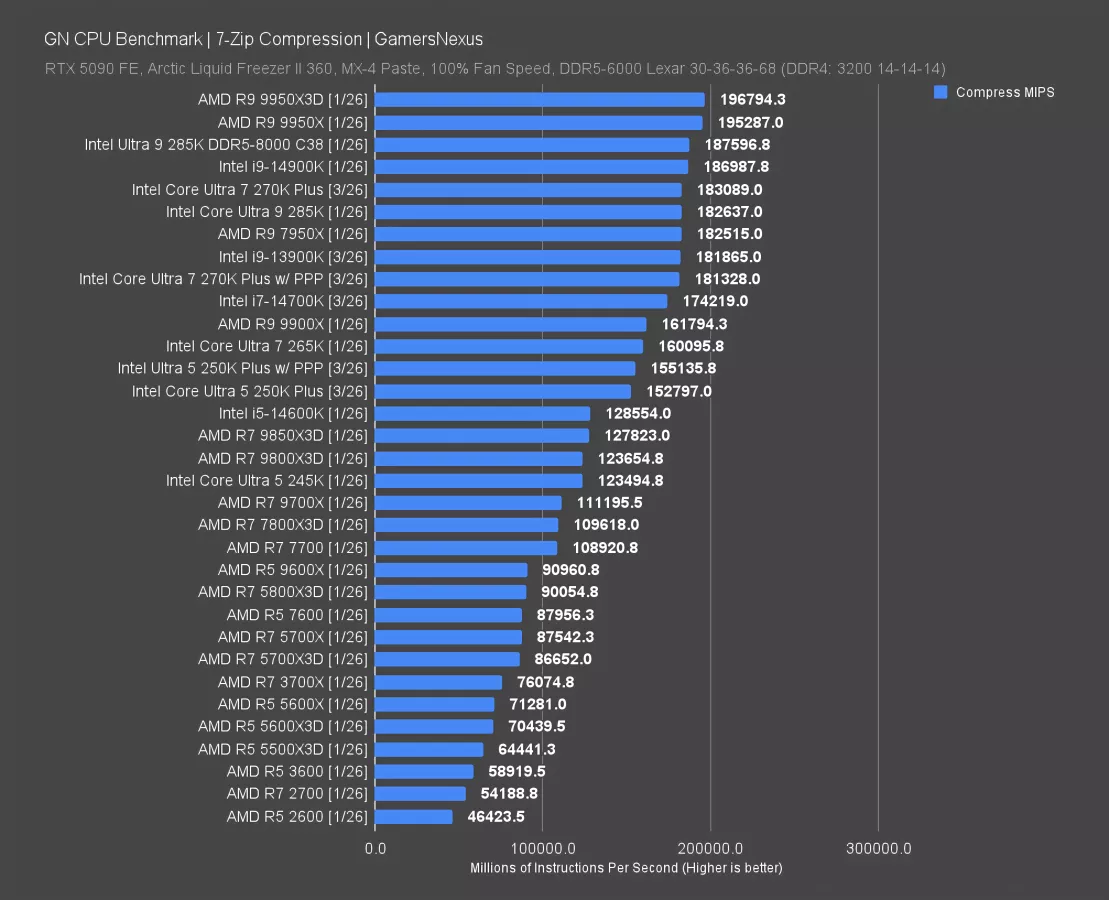
In 7-Zip file compression testing, the 270KP completed 183K MIPS. Enabling PPP had a 181K MIPS result, meaning the higher result is only 0.9% higher. The differences we’re seeing are just run-to-run variance.
Taking the higher of the two, the 270KP ends up just behind Intel’s 14900K (read our review) former flagship. The 285K actually benefitted from the faster memory here, showing a 2.7% improvement from its baseline result. That’s not a big difference, but more than we’ve seen in a lot of cases.
AMD’s 9950X CPUs both take the top of the chart.
As for relevant comparisons, the 270KP outdoes the 14700K’s 174K MIPS by 5% and the 265K by 14%. Against the 250KP, the 270KP completes 18% higher MIPS. That’s a larger gain than the 3-8% improvements we saw in most games, but still not a ton for the price increase.
AMD’s 9700X falls pretty far down the charts here, giving the 270KP a 65% lead over it. The 9900X is about $370 commonly, so about $70 over MSRP for the 270KP, and the 270KP outperforms it by 13%.
7-Zip Decompression
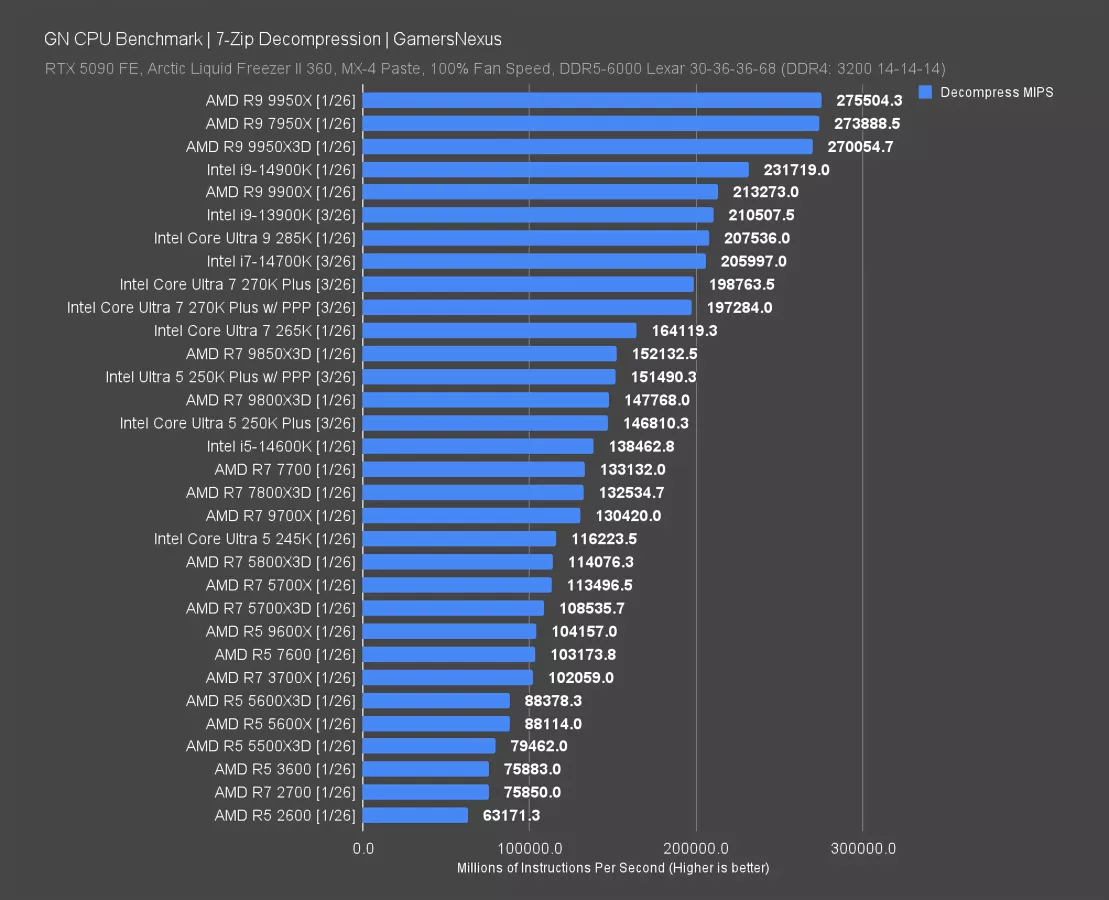
In decompression testing, the 270KP completed 198.7K MIPS without PPP and 197.3K MIPS with it, so again, these are within variance of each other.
Taking the higher of the two, the 14700K takes back the lead with a 206K MIPS result, or an improvement of 3.6%. Intel is still showing regression in decompression testing.
The 270KP is getting close to the 285K, at least, and is significantly cheaper.
AMD’s 16-core CPUs lead these charts, followed by Intel’s former 14900K and 13900K flagships -- which somehow end up accidentally being their current flagships.
The 9800X3D and 9850X3D aren’t competitive here, and especially not at the price. The CPUs are fine, but the extra cache has never really benefitted the production workloads that we benchmark. These show more in gaming than here.
Against the 250KP PPP, the 270KP is showing a 31% improvement. That’s getting more worthwhile. Over the 9700X, the 270KP posts a 52% improvement.
Adobe Photoshop
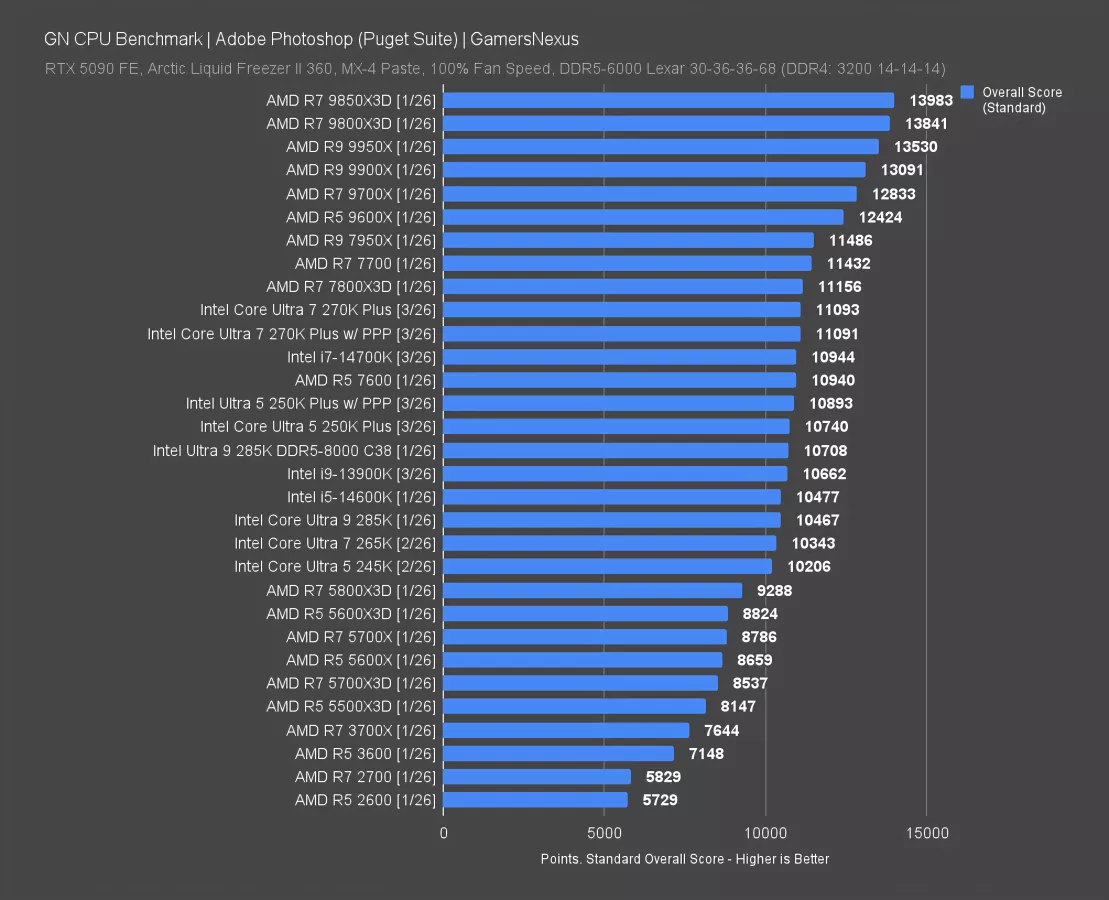
Adobe Photoshop tested with the Puget Suite is next.
In this one, the 270KP doesn’t do as comparatively well as in some of the earlier tests. It’s still fine, but it’s not as impressive. The 270KP with and without PPP performed the same. In both situations, it’s just behind the 7800X3D and ahead of the 14700K. The 9700X leads the 270KP this time, with a 15.7% lead against the 270KP. The 265K, 285K, and 245K were all unimpressive in this test, down below even the 14600K. At least with the 270KP, Intel has surpassed its prior generation 14700K.
AM4 X3D CPUs are all at the bottom here, seeing no real benefit from the extra cache.
DaVinci Resolve
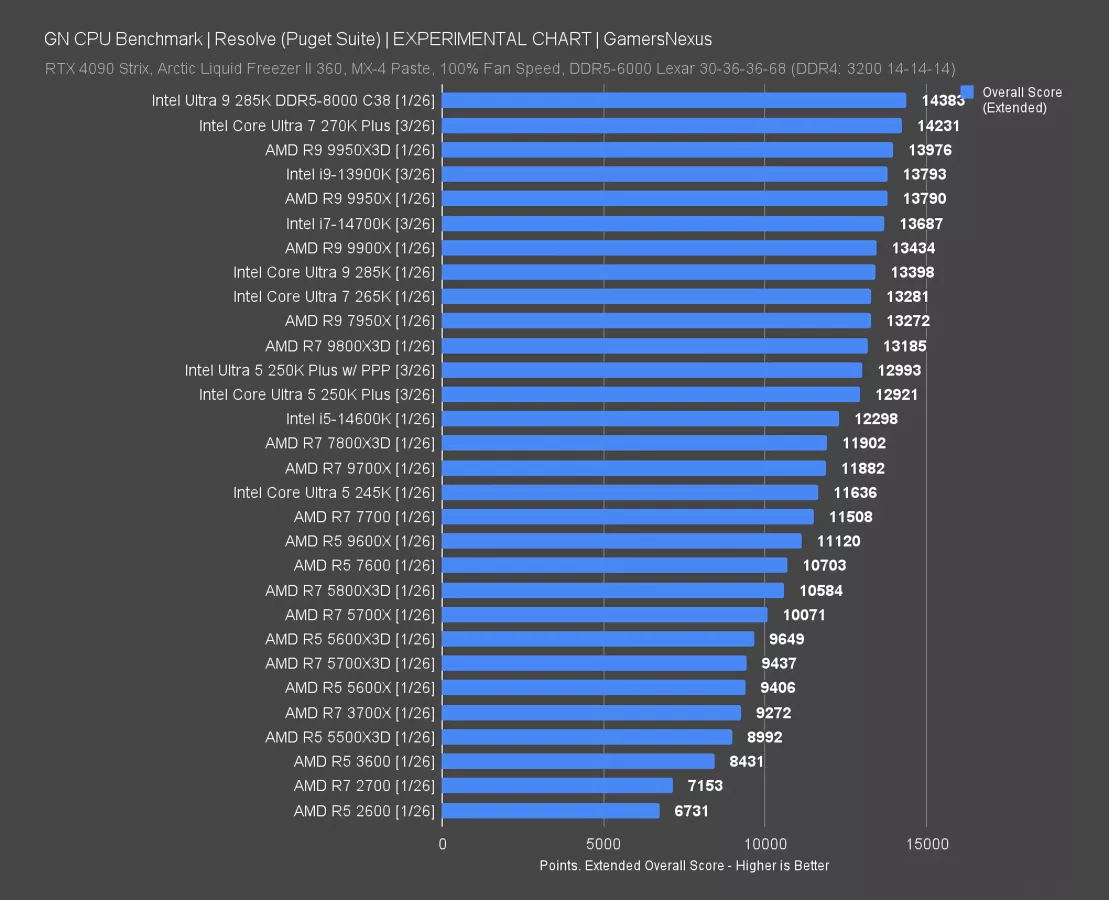
In DaVinci Resolve video editing testing, we saw the 270KP at over 14,000 points for the extended testing with the Puget Suite. This has it just behind the 285K with expensive RAM, which is a good result considering the price of the 285K with DDR5-8000 and the fact that these scores are functionally identical in performance.
The 270KP ends up ahead of the 9950X3D and 9950X this time. The gain against the 9950X-non-3D is 3%. That’s not a huge advantage, but considering the price difference, it matters. Again, our only real complaint against this CPU is that it’s on a dead-end platform. If Intel can do a repeat of this launch but on a platform with some life left in it, they’d be taking away our main criticisms.
Improvements over the 265K are also notable, with the prior 7-class CPU down in the 13000s.
Power Consumption Testing
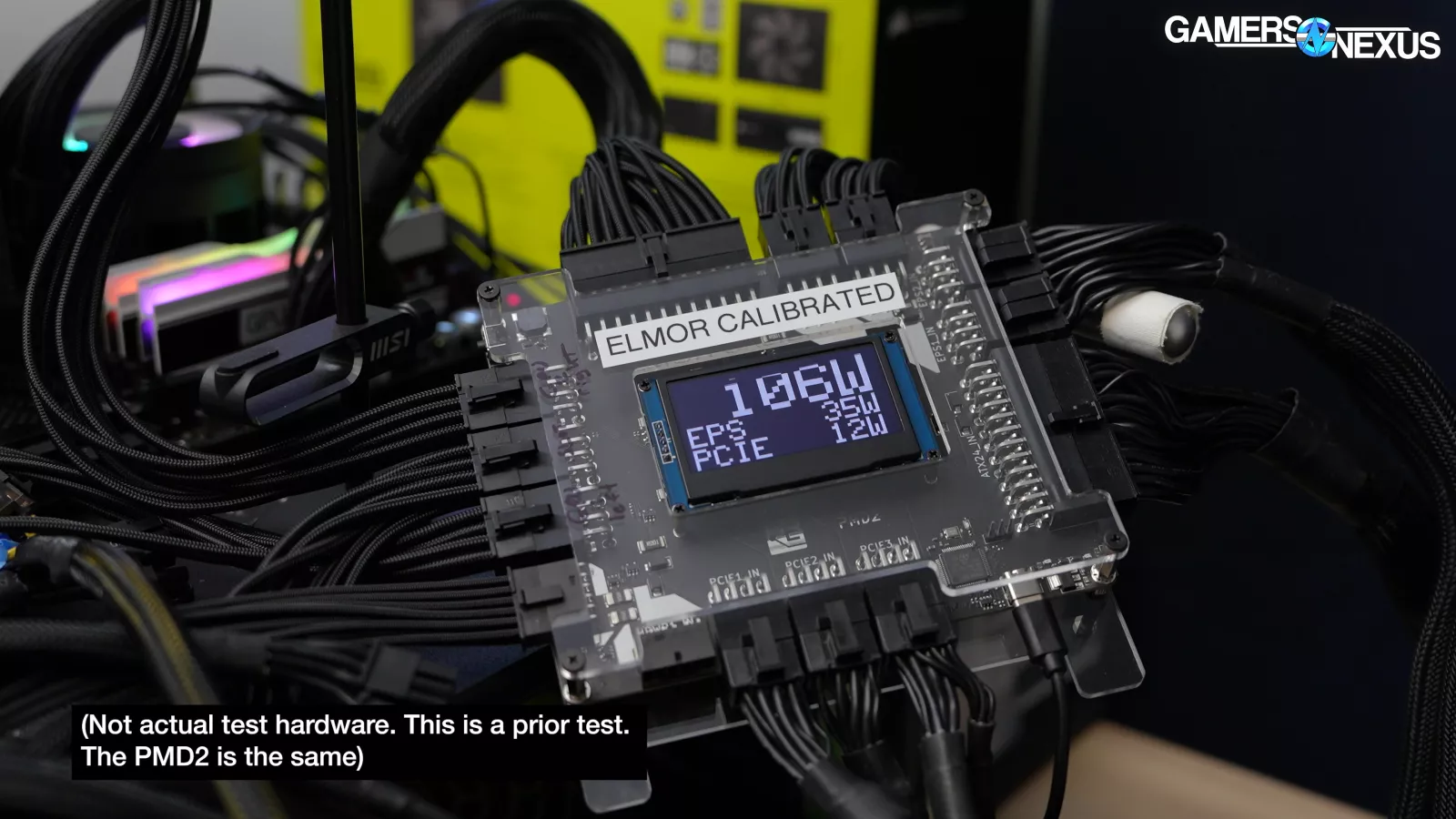
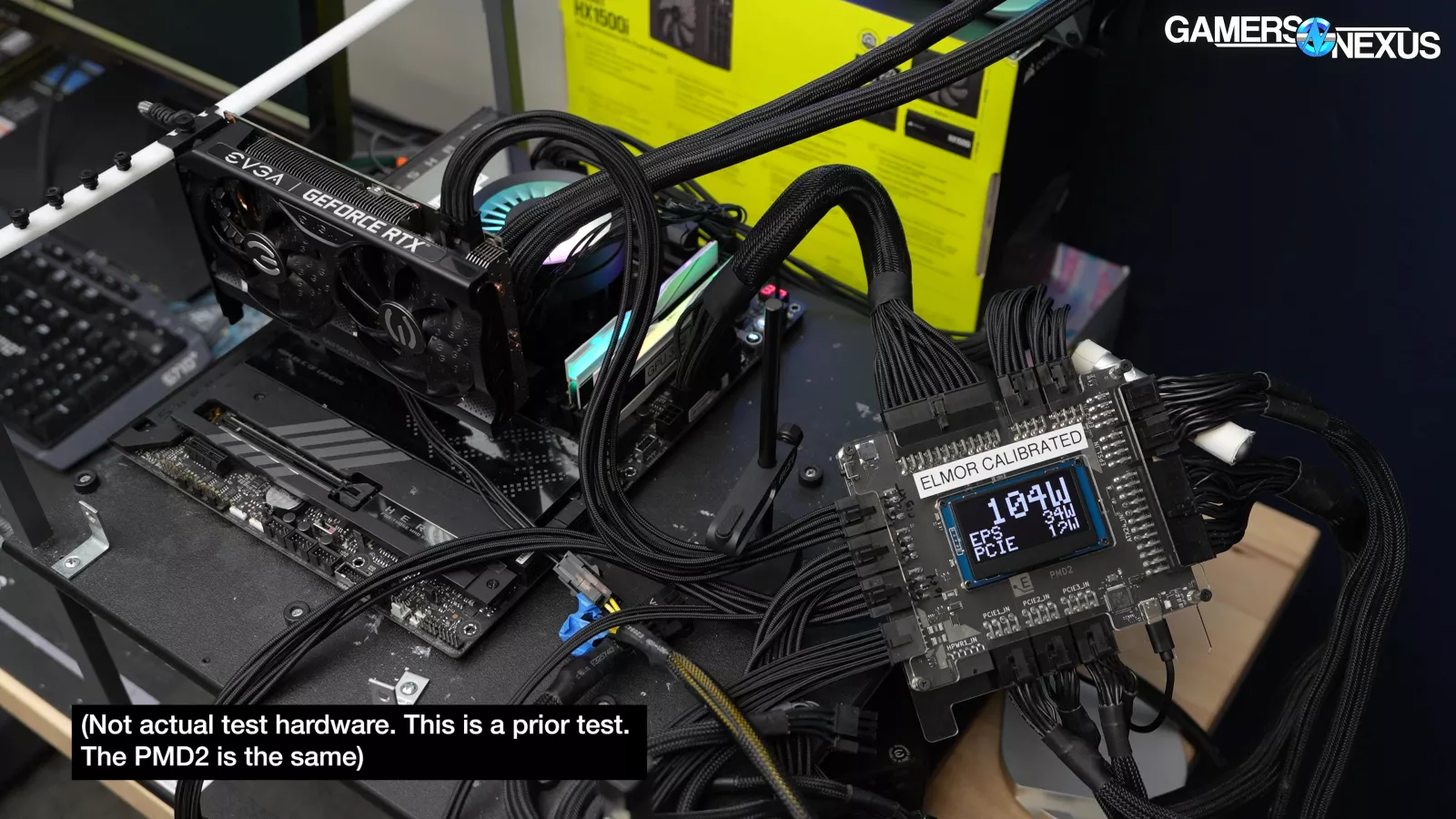
As with our 250KP review, we’re keeping our power consumption testing relatively straight-forward for these reviews. For power testing, we’re using an external capture device to serve as an interposer between the power supply and motherboard. The PMD2 is measuring ATX12V and EPS12V power, as this board unconventionally splits some of its 24-pin power over to the CPU. We then subtract the GPU slot power via a PCIe slot riser, which intercepts it at the source and pulls from a 4-pin connector instead of ATX12V.
Power Consumption - Blender All-Core
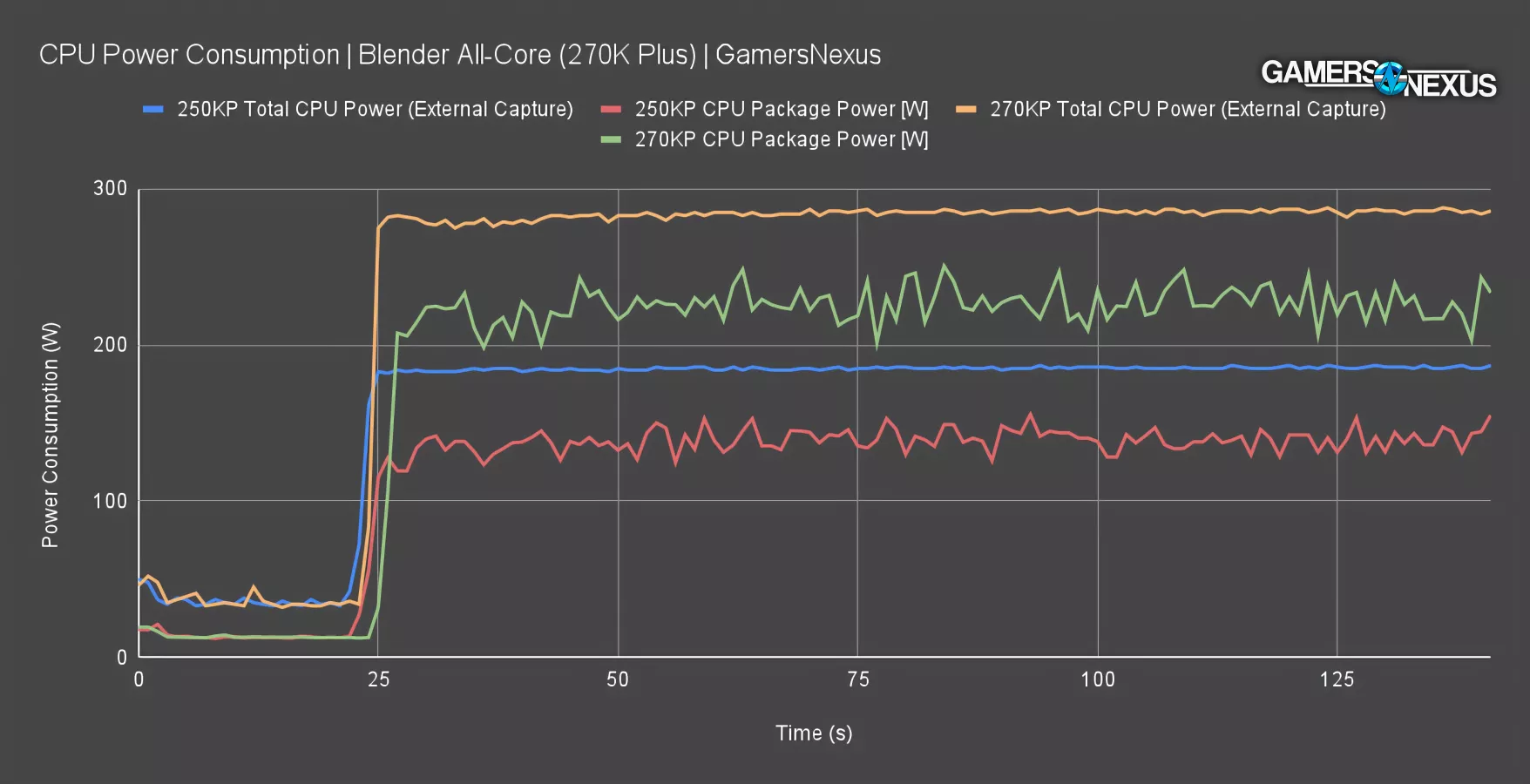
In a Blender all-core workload worst-case scenario, we measured the 270KP at about 284W when factoring in the EPS12V cables and the ATX12V line. That means we’ll have VRM efficiency losses and other miscellaneous ATX12V components factored-in. The CPU Package Power measurement via HWINFO is at 230W to 251W, which matches the advertised TDP of the CPU.
For reference, the 250KP pulls significantly lower power, at 186W via external capture and 130-150W via software logging.
Power Consumption - F1 25
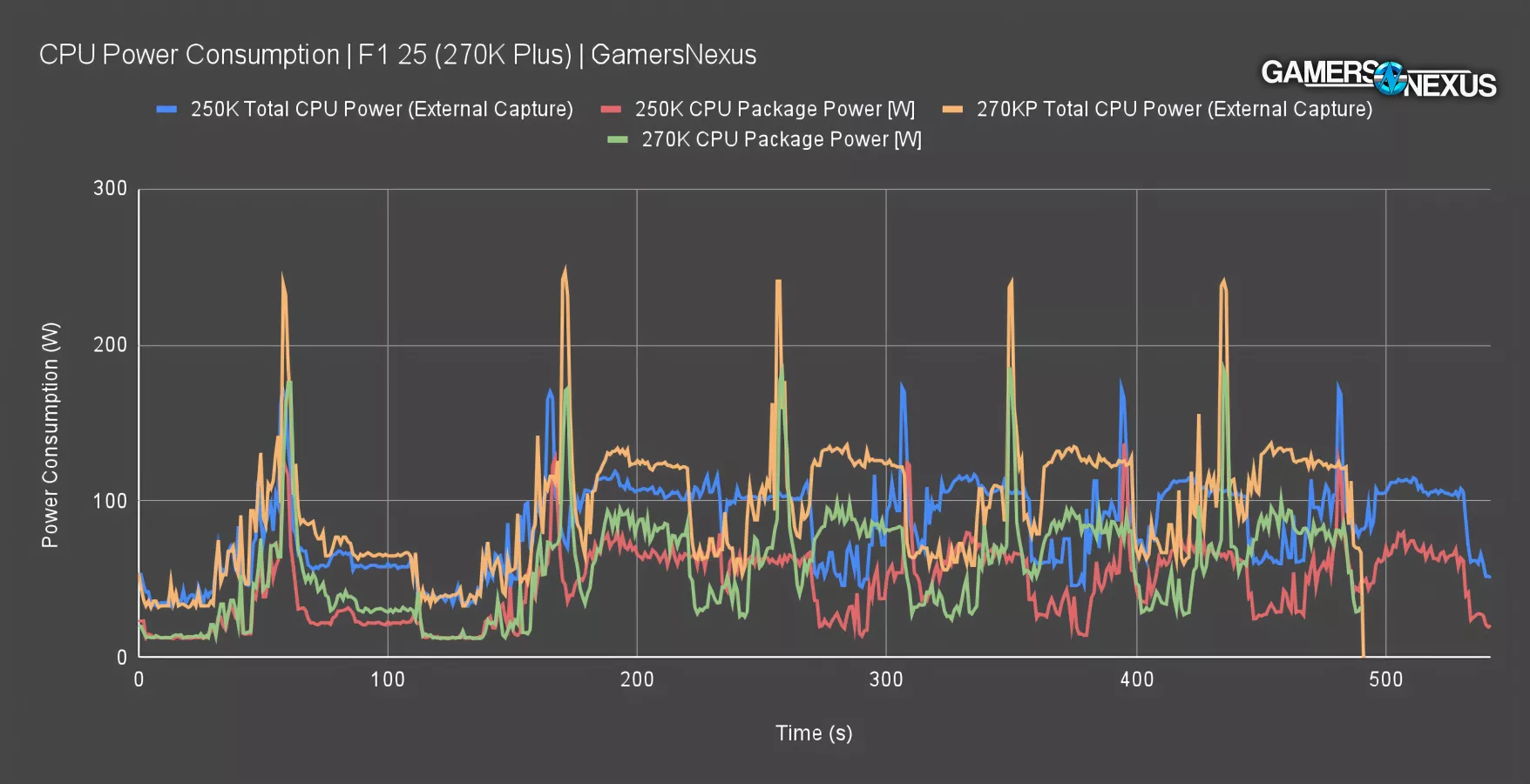
In F1 25 power consumption testing, we measured peaks for the 270KP at 250W during loading sequences to prep the test run. The 270KP measured at 125W to 140W during the game itself, with HWINFO CPU Package Power logging the PP Package-enhanced 270KP at 176W during loading and about 90-100W during the game.
Conclusion

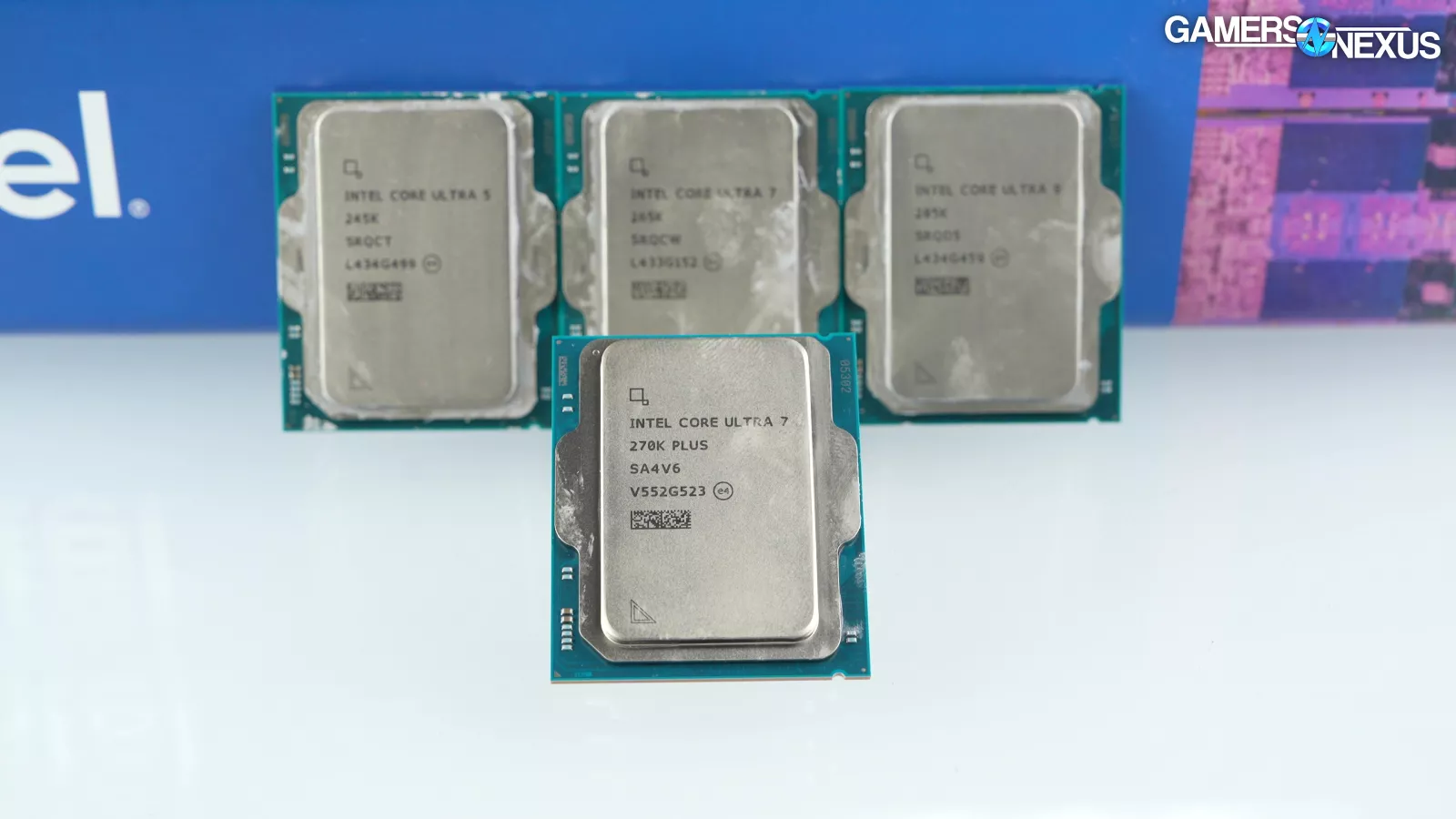
Overall, it’s pretty good. Right now, Intel is celebrating. At $300, the 270K Plus is pretty competitive with the 9950X. It's way better than the 285K, which was a nightmare. Intel’s 200 series launch was just awful. The CPUs were regressive versus the 14 series before it and the prices were pretty high, too. Intel is heading in a much better direction.
The 250K Plus, as a $200 CPU, is good. We don't have a lot of $200 computer parts these days that are actually competitive and have silicon in them. This is a good direction.
Unfortunately, as you all know, the RAM pricing is astronomical right now. And so if you want to build a computer, the RAM is taking up probably like 30% of the budget for the computer or more depending on how much you need.
For the performance you get, the price is relatively good on the $200 250K Plus. It's just that you lose a lot of that momentum as soon as you hit the memory and as soon as you hit the single-use motherboard basically that you'd be buying to put it in. Same goes with the 270 KP. But in a vacuum, ignoring the memory pricing right now, at least this is the right direction for Intel, and they're looking competitive.
We really hope the company does a repeat of this with a new platform that they will keep. Intel really needs to do that so we can take away our main complaint.
But as far as the 270K Plus is concerned, it’s pretty good in production and it’s much better in gaming than Intel’s CPUs used to be. X3D is still the best in gaming in most cases, though.
Regarding the 270K Plus, we’re just happy that it’s not another $400 i7-class CPU. And we’re especially happy that it's outperforming Intel’s prior $520 to $600 285K. This is the most signs of life and market awareness that we've seen from Intel in years now outside of its GPU division.