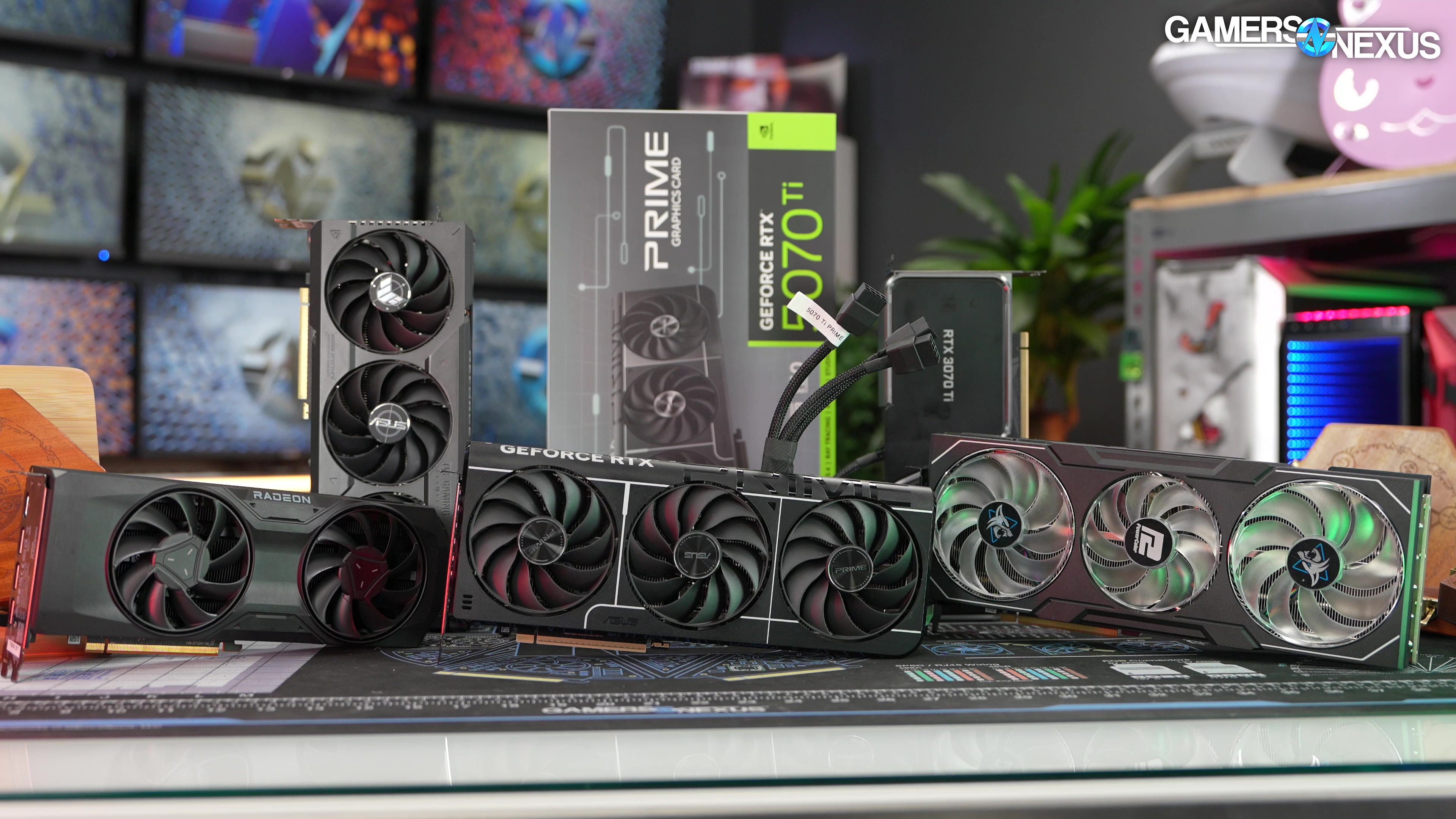
GPU prices have become a meme, with NVIDIA leading the pack at (on average) 70% over listed MSRP for its consumer and gaming video cards
The Highlights
- NVIDIA, AMD, and Intel are running higher prices than previously, reaching new highs for GPU prices in our year-long series tracking them
- This continues to get worse thanks to the ongoing DRAM availability crisis
- November of 2025 seems like it was the best time to buy, with prices now climbing even past what we saw in February of 2026
Table of Contents
- AutoTOC
Intro
NVIDIA GPUs are currently on average 70% over MSRP, but NVIDIA and AMD get to hide behind their board partners and pretend that they're not the ones in control.
We’ve been tracking GPU prices directly for over a year now, and it’s been six months since our last GPU pricing update. Things have gotten worse since then.
Editor's note: This was originally published on September 19, 2026 as a video. This content has been adapted to written format for this article and is unchanged from the original publication.
Credits
Host, Writing
Steve Burke
Editing
Tim Phetdara
Writing
Tannen Williams
Writing, Web Editing
Jimmy Thang
To quickly recap the findings from our latest GPU pricing update – since collecting prices 6 months ago:
- Aside from the 8GB 9060 XT, in-stock AVG price has increased for all current-gen GPUs.
- The RTX 5090’s in-stock AVG price is now an absurd $4,880, an increase of $900 in the last 6 months, making it nearly $3,000, or 144%, greater than its MSRP.
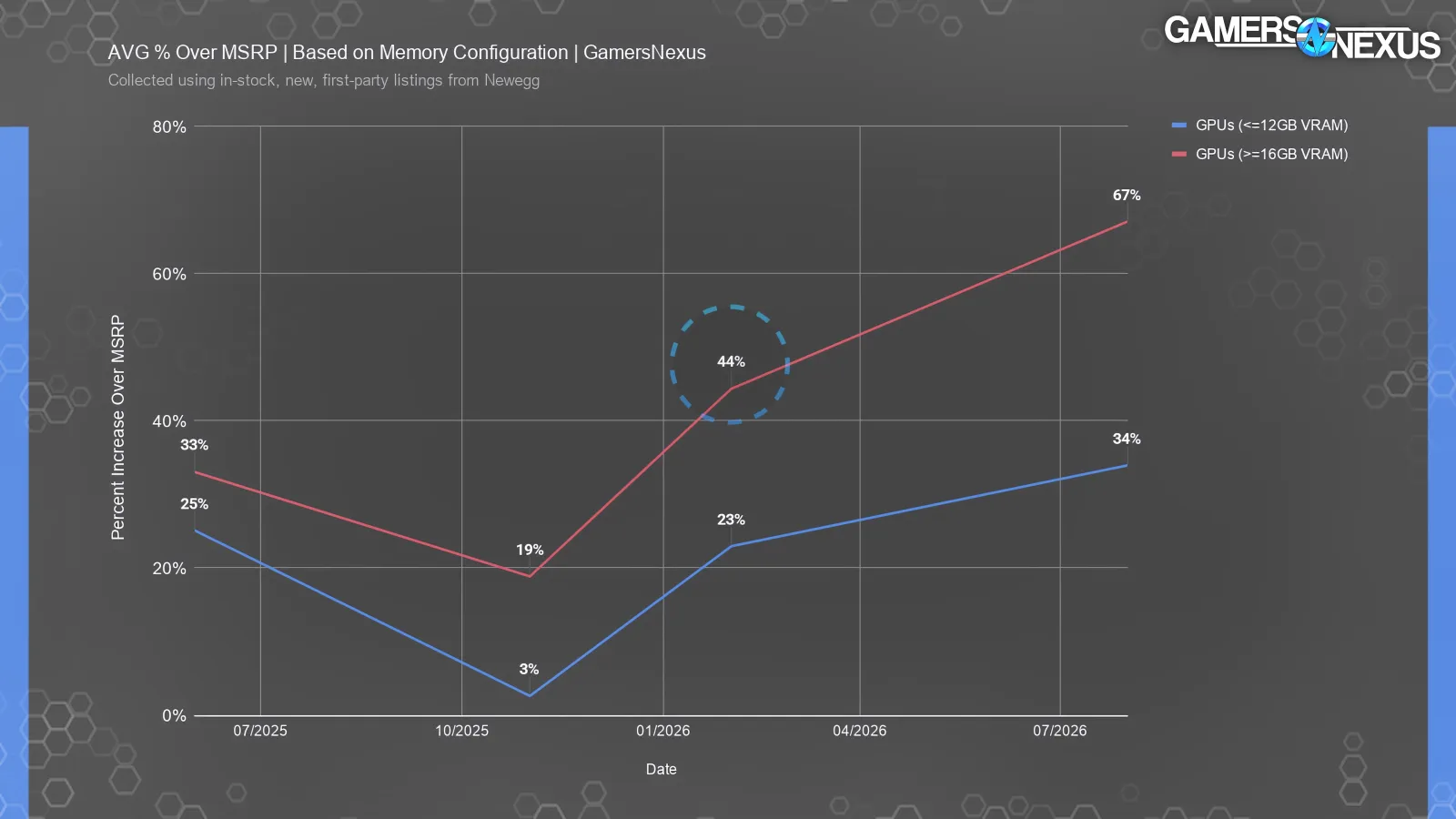
- AVG % over MSRP increased from 44% to 67% for GPUs with 16GB or more VRAM, and increased from 23% to 34% for GPUs with 12GB or less VRAM.
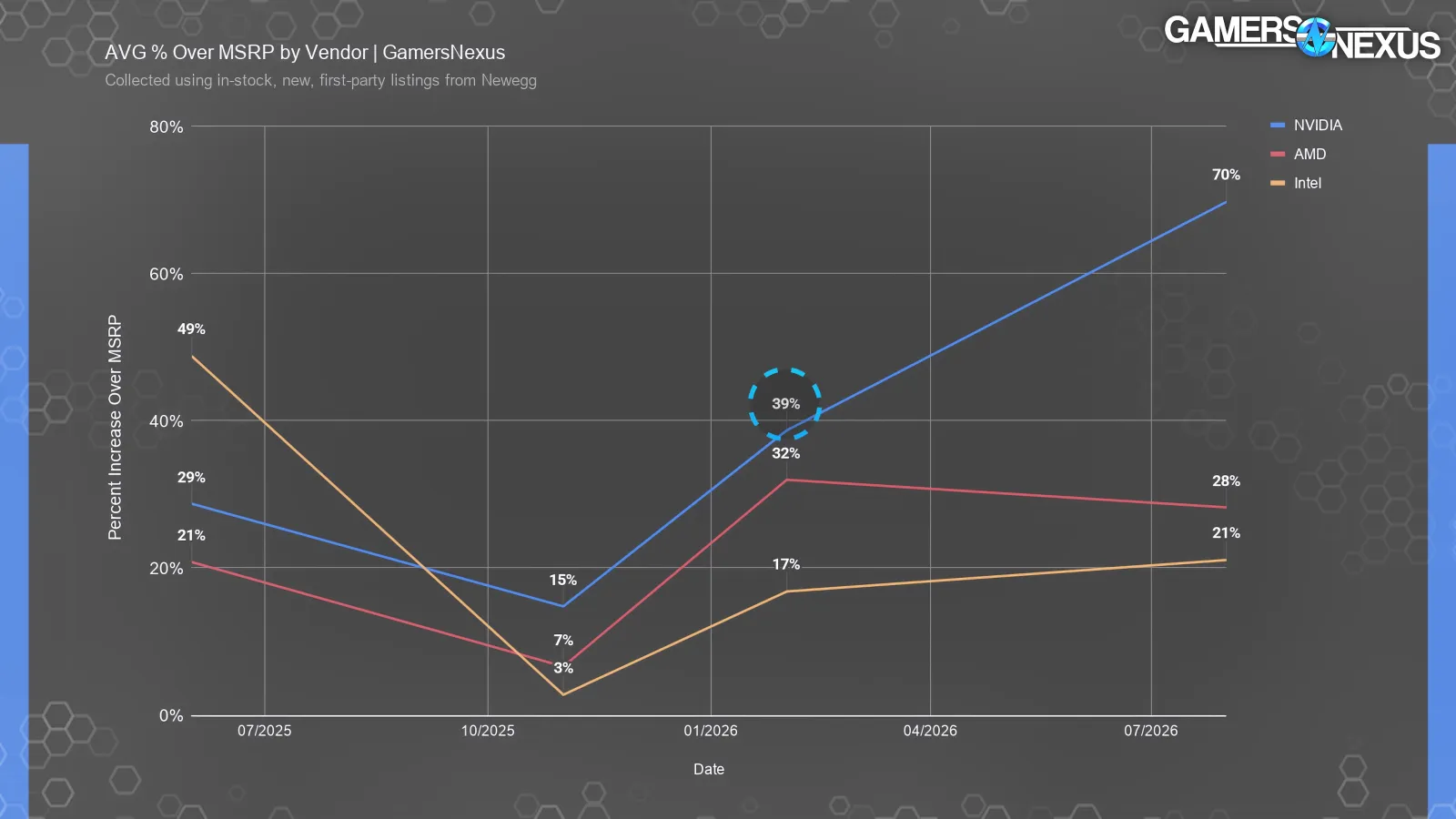
- And, AVG % over MSRP for NVIDIA GPUs skyrocketed from 39% in February to 70% over MSRP currently.
- Of all the increases, NVIDIA GPUs are the worst offender: The company has an average 70% over MSRP, with AMD at 28% and Intel at 21%.
For perspective on how this has changed over the last year, here’s what we had to say about the market situation back in November of 2025: “My guess is that the GPU prices will probably trend up, not down going forward.”
Things did, in fact, get worse.
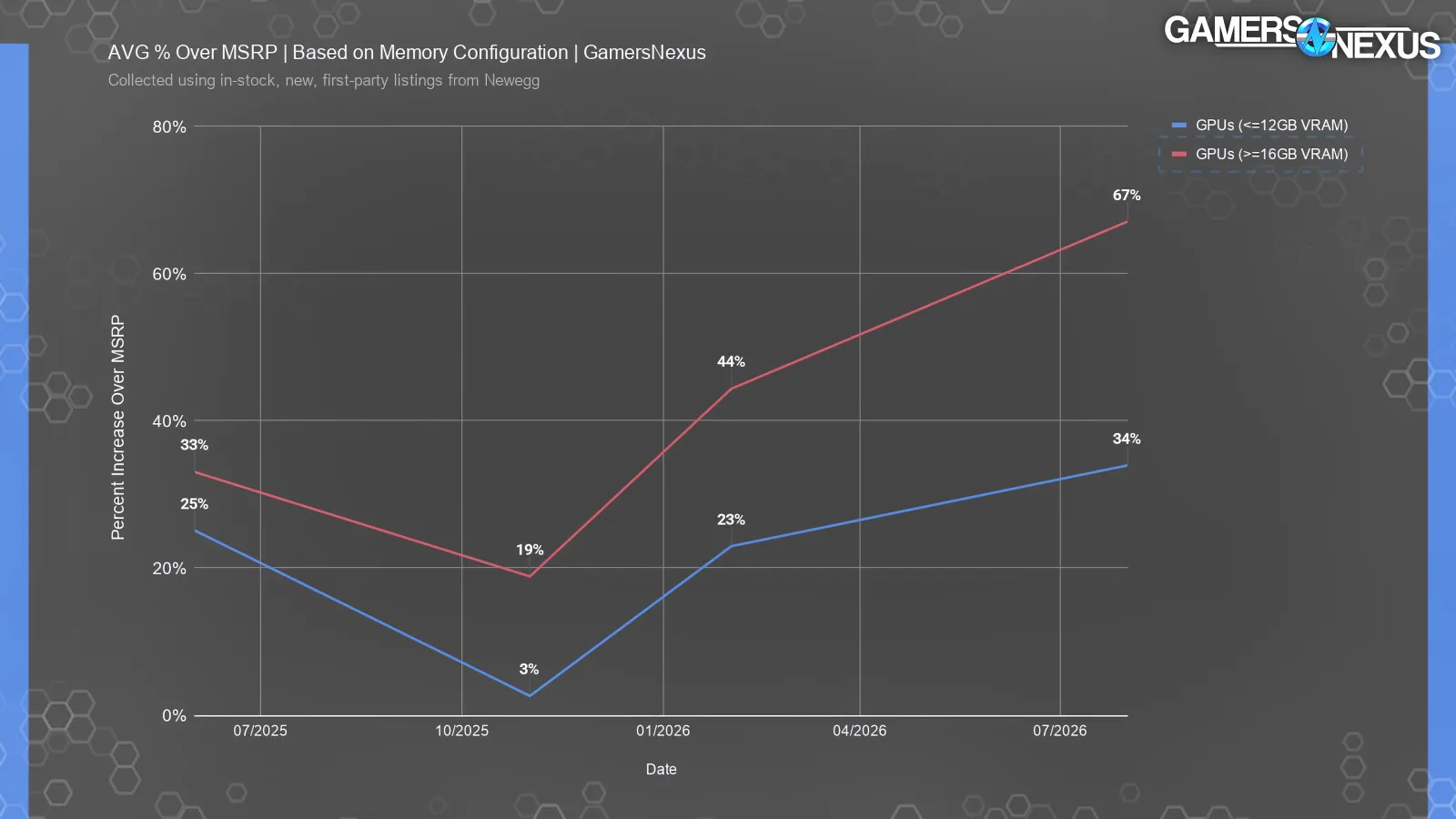
The fact that GPUs with greater than or equal to 16GB of VRAM have seen the biggest tracked average percent increase over MSRP illustrates the core issue.
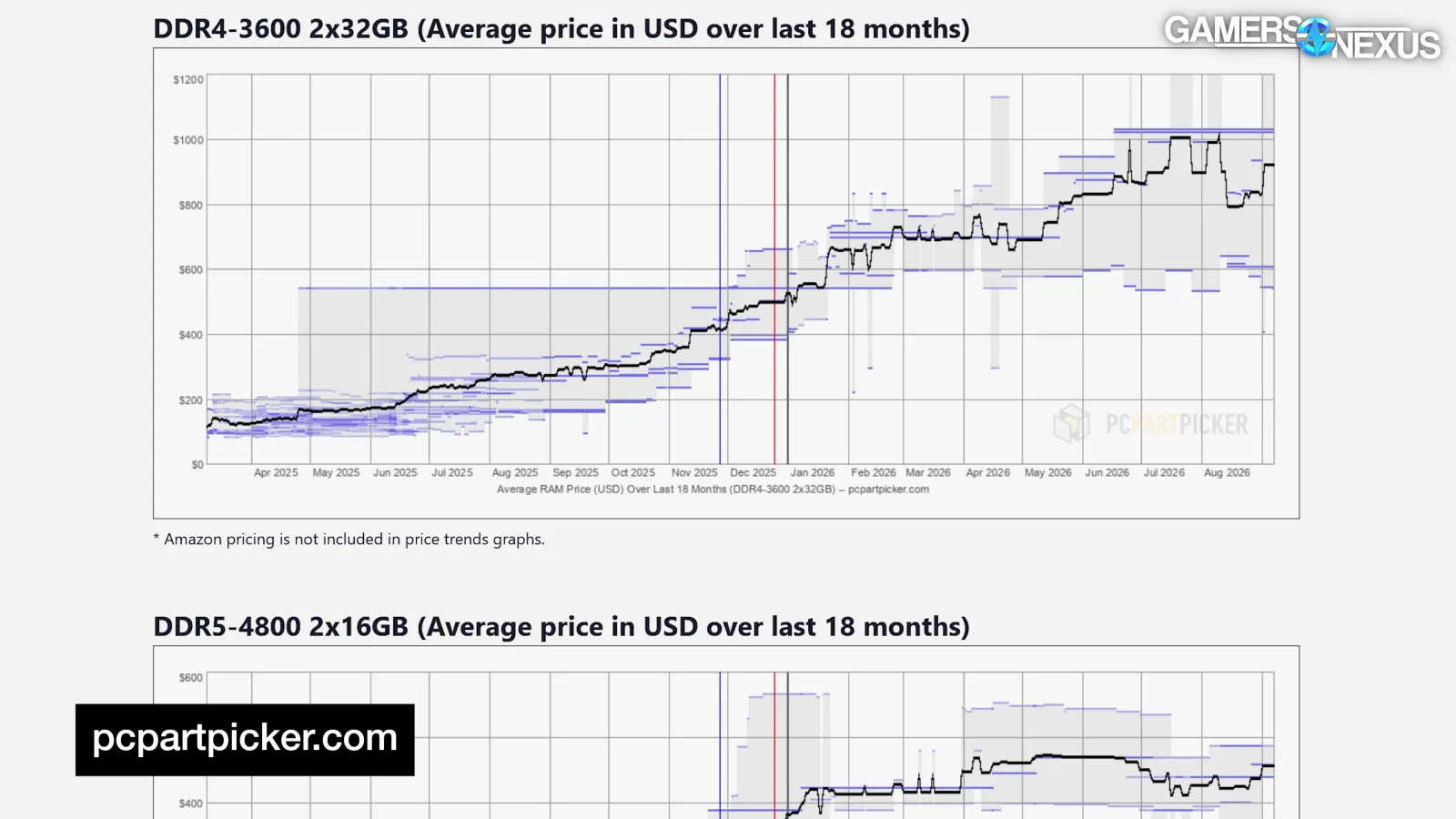
Ultimately, most of these price increases come down to the memory shortage that continues to plague the rest of the industry.
Within the past two months:
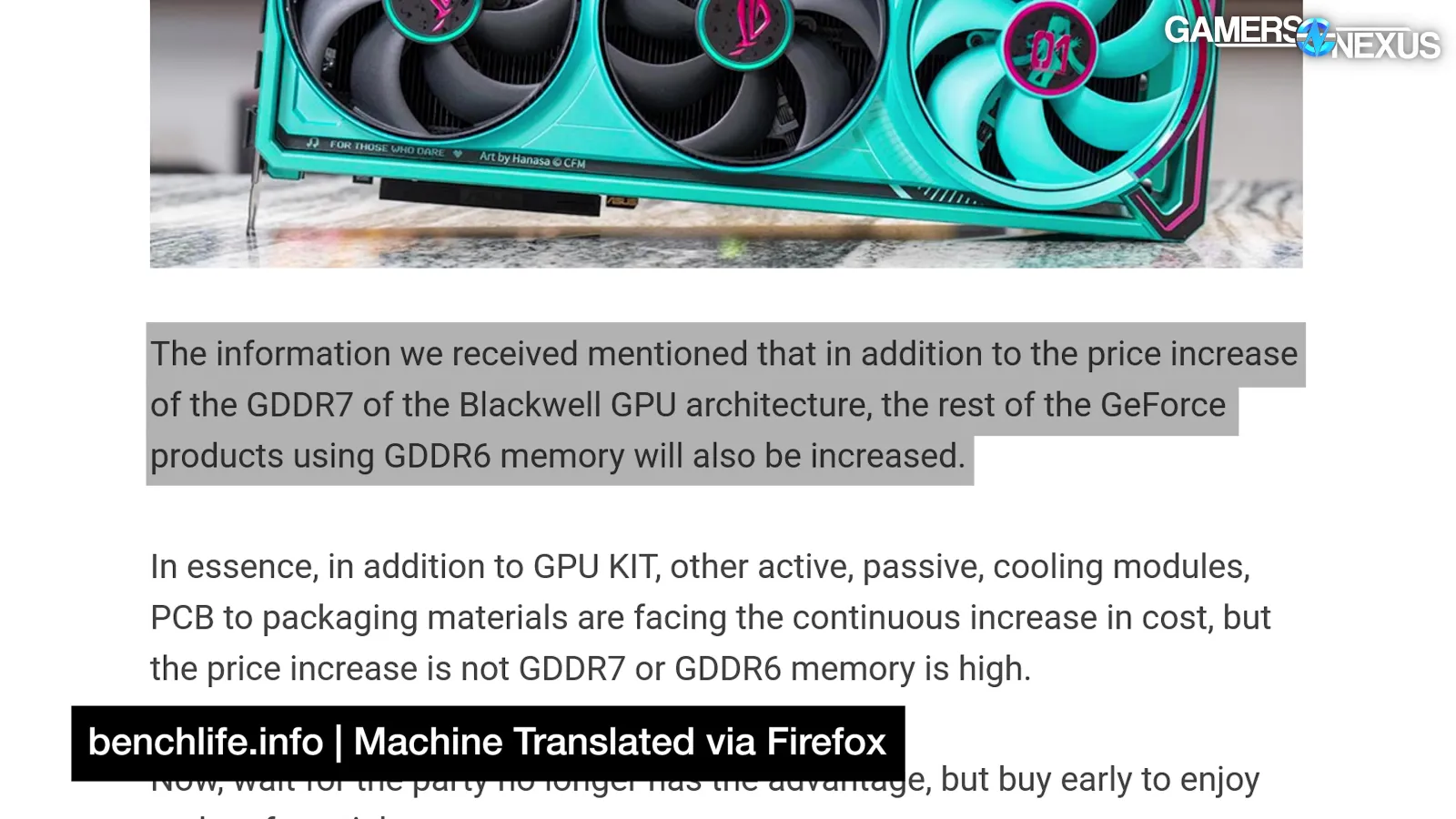
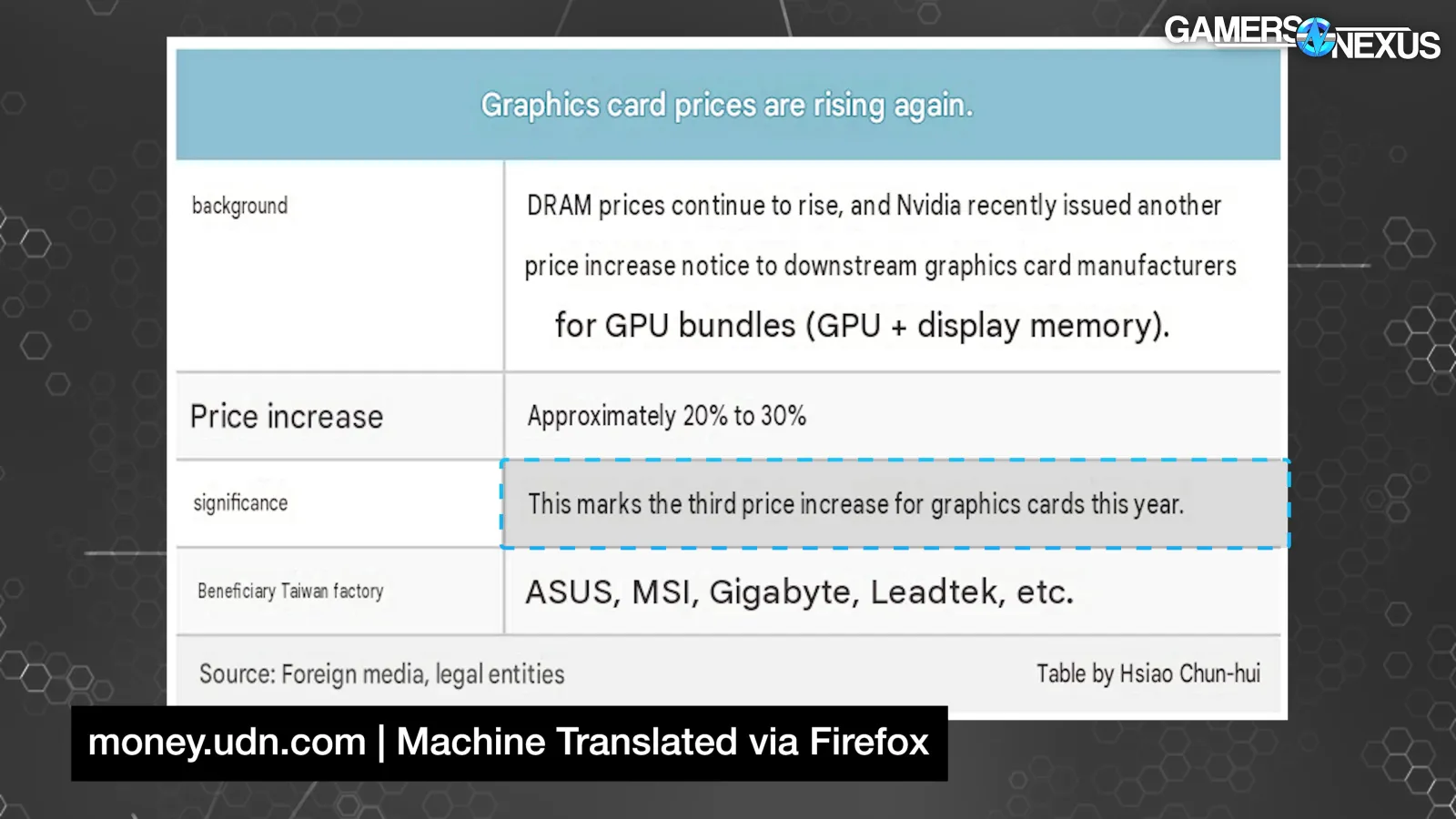
BenchLife reported that NVIDIA raised the price of GDDR6 VRAM passed on to AIB partners in addition to the GDDR7 modules that it’d already increased prices for, which UDN claims is “the third price increase for graphics cards this year.”
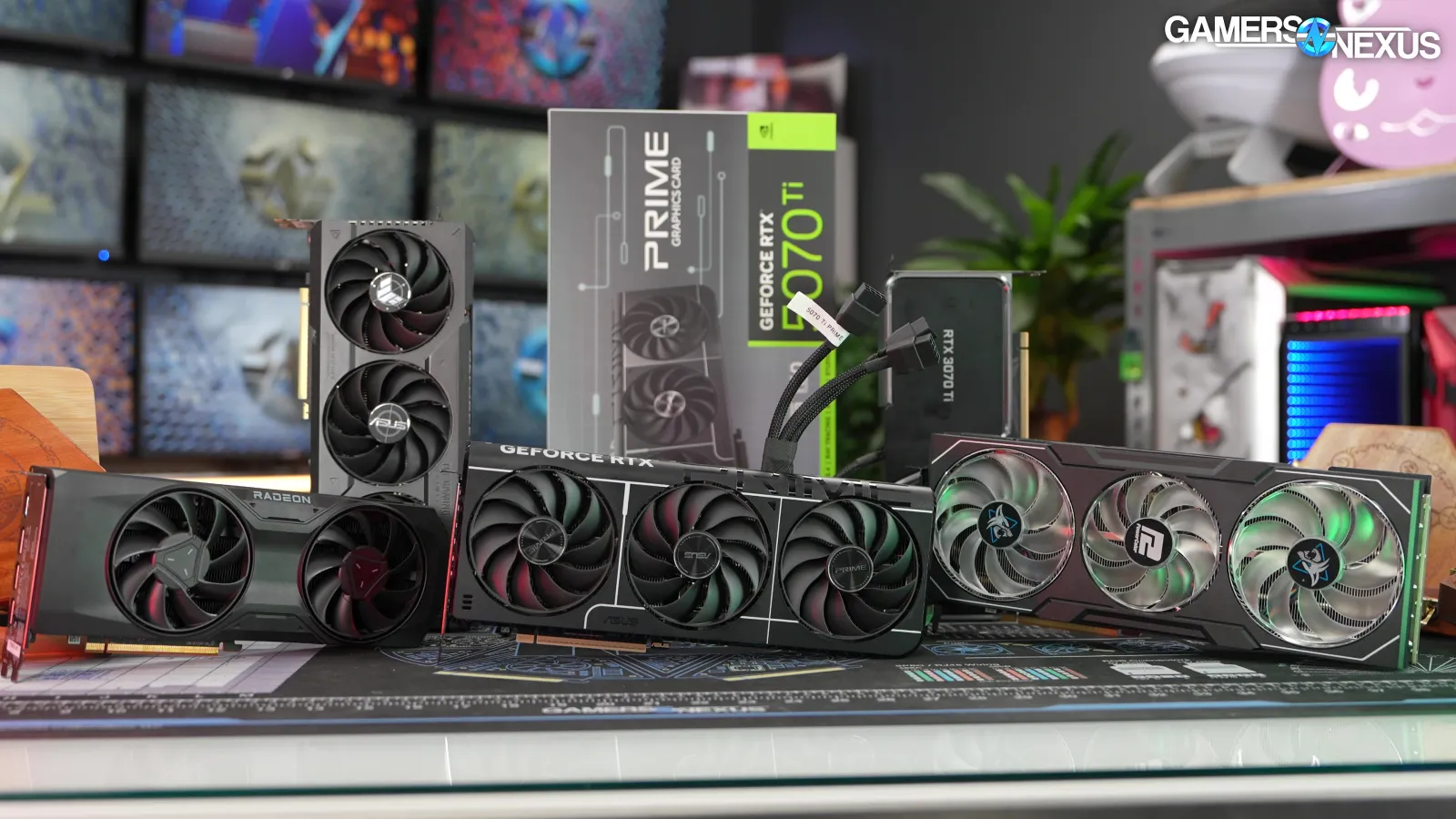
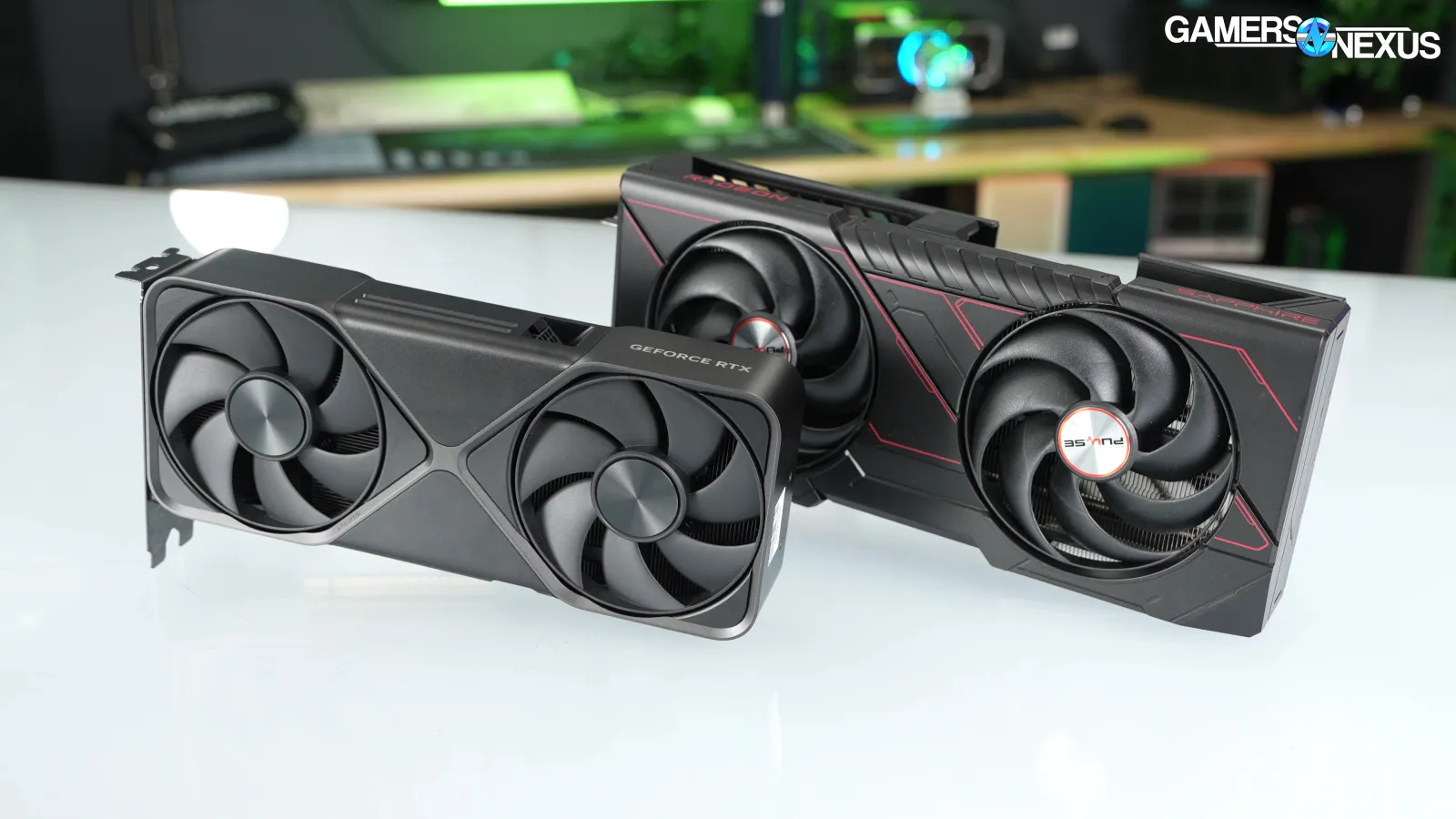
For context: NVIDIA and AMD source the VRAM and then package that with the GPUs it sells to its AIB partners, like ASUS, MSI, Gigabyte, and so on, giving the GPU vendors even greater control over AIB pricing. GN has confirmed this with some of NVIDIA’s board partners.
UDN notes, “At present, the price of a 3GB GDDR7 chip has risen to between $60 and $70, while the standard 2GB GDDR7 chip is temporarily priced at $20,” making the cost per GB around $20 for the 3GB module and $10 for the 2GB module. Of course, consumers will pay a multiplier on that when buying the completed product.
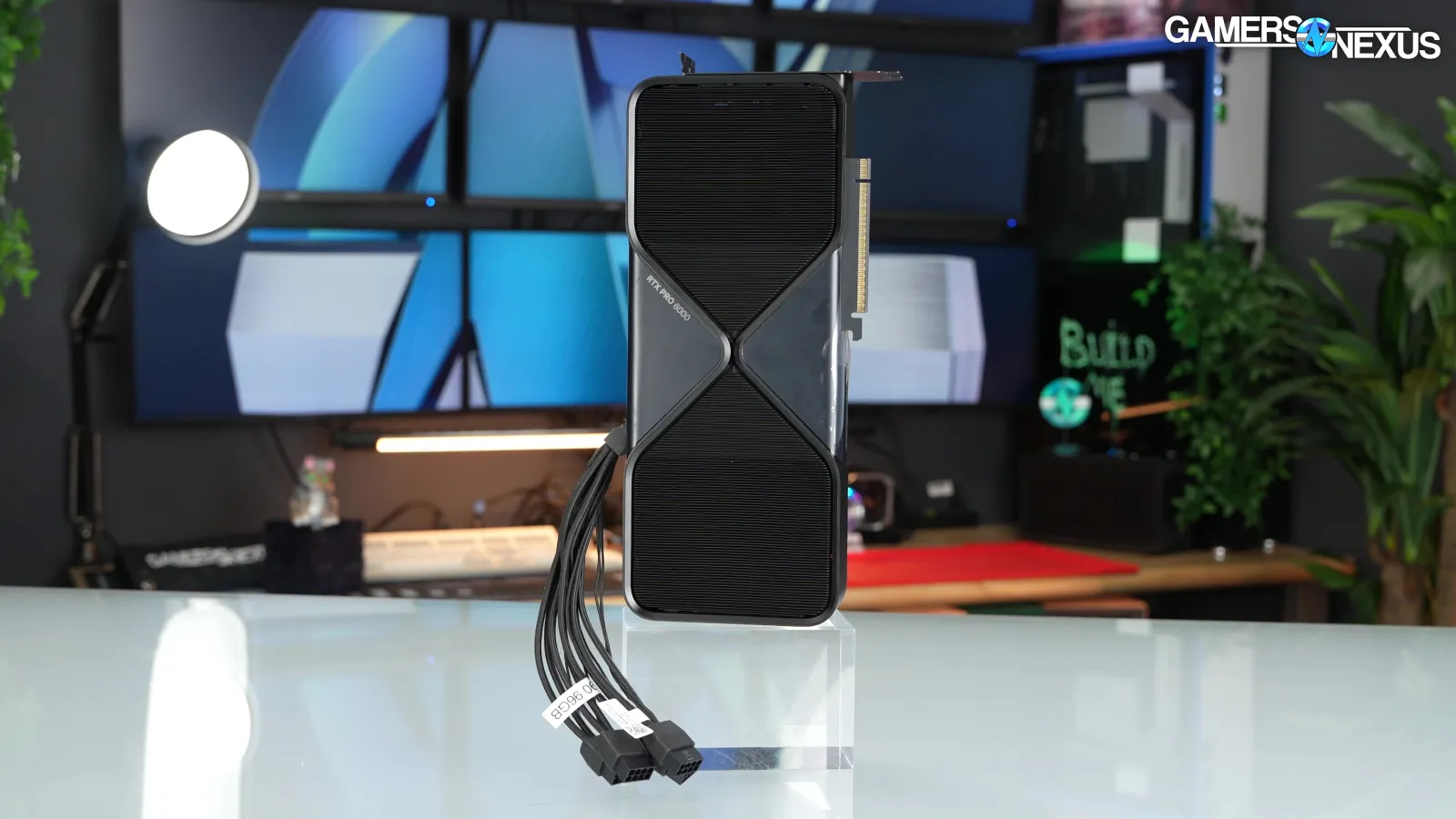
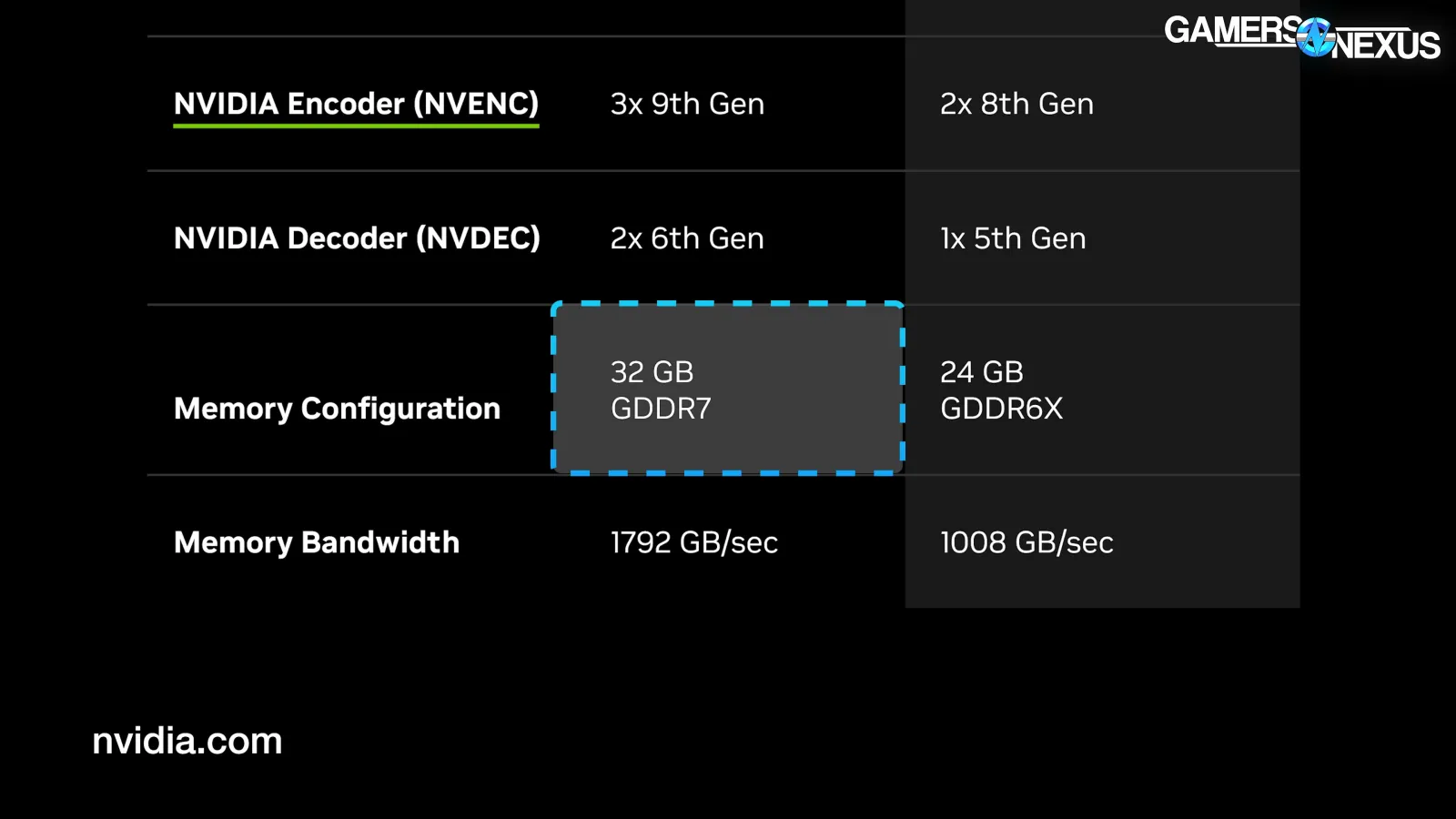
Higher density modules are used in devices like the 5090 (read our review) and RTX 6000 Pro, and likewise what NVIDIA traditionally likely would have used in a Super series refresh, if the pricing hadn’t ballooned.
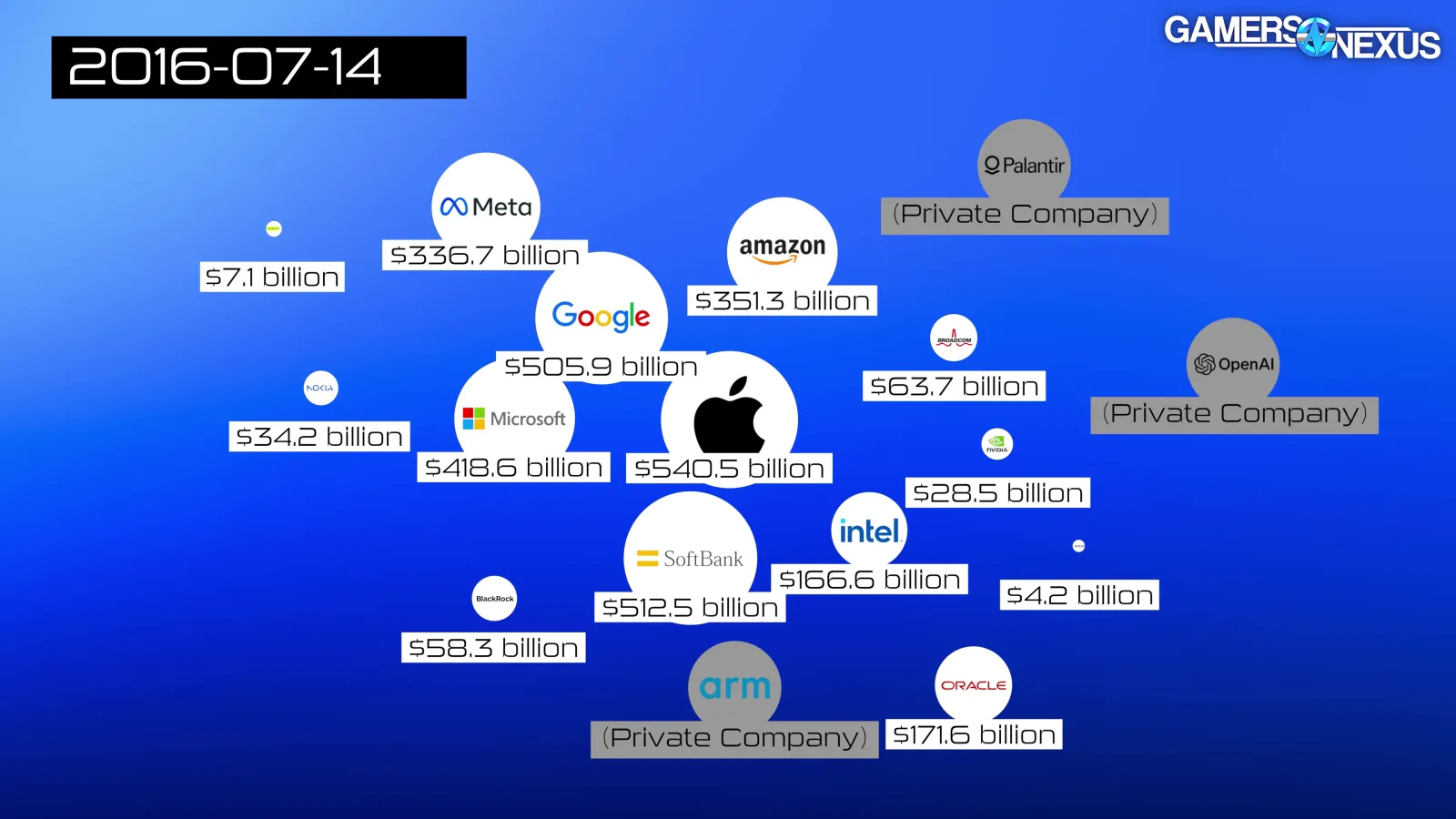
Of course, NVIDIA is largely to blame for the memory price increases; despite not making memory directly, it is the largest driver of the AI bubble and the consumption of that memory.
UDN also reported that MSI Chairman “Xu Xiang said that the shipments of consumer market products will decline by 10 to 20% this year, but the unit price will increase.” And that’s why the Super series hasn’t shown up yet, as they’re heavily rumored to use the disproportionately expensive 3GB modules.
Let’s go over the GPU pricing situation.
Super Series
Let’s start with the lingering Super series, since those would be the usual mechanism that NVIDIA resets prices. Here’s the timeline:
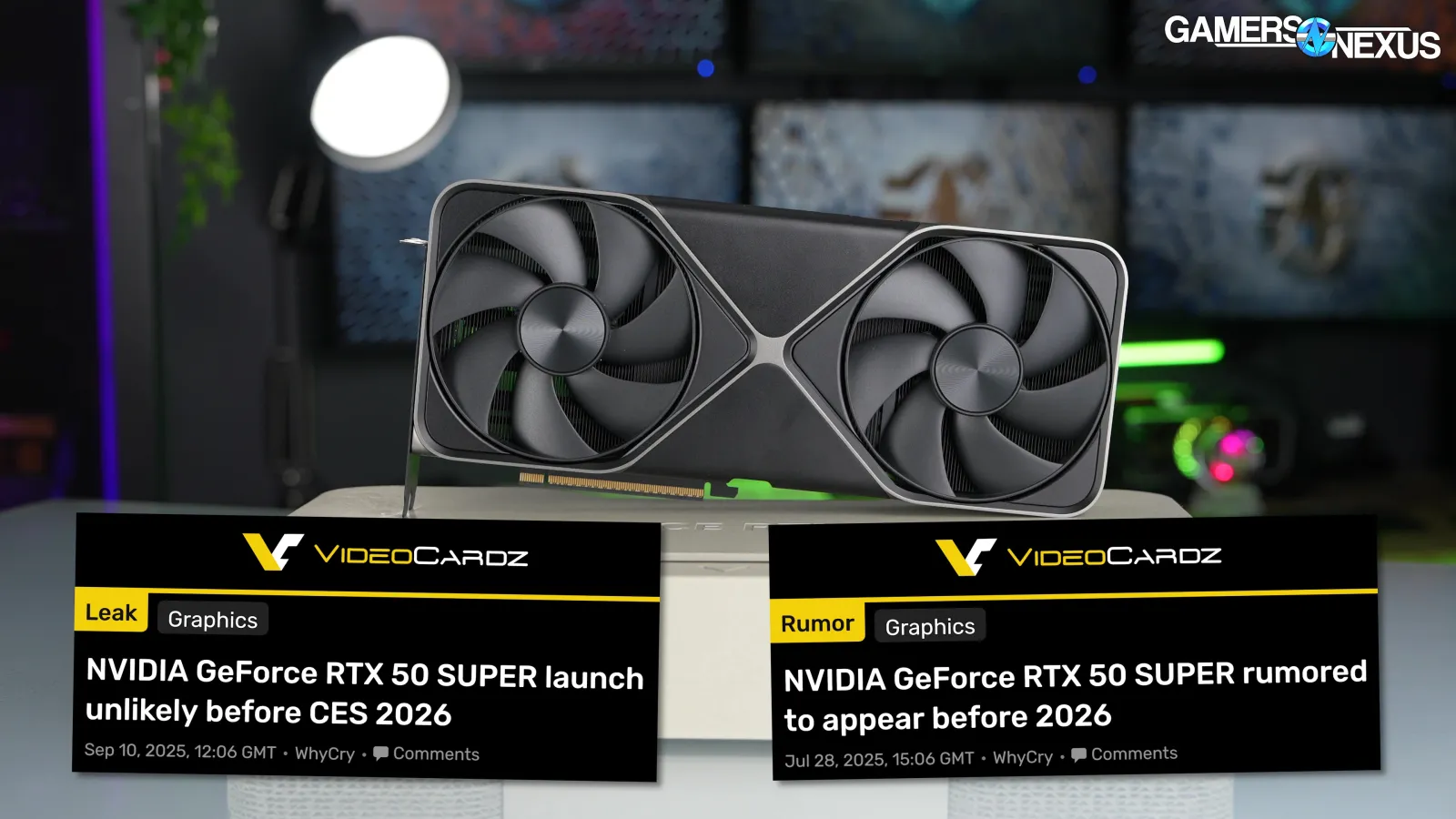
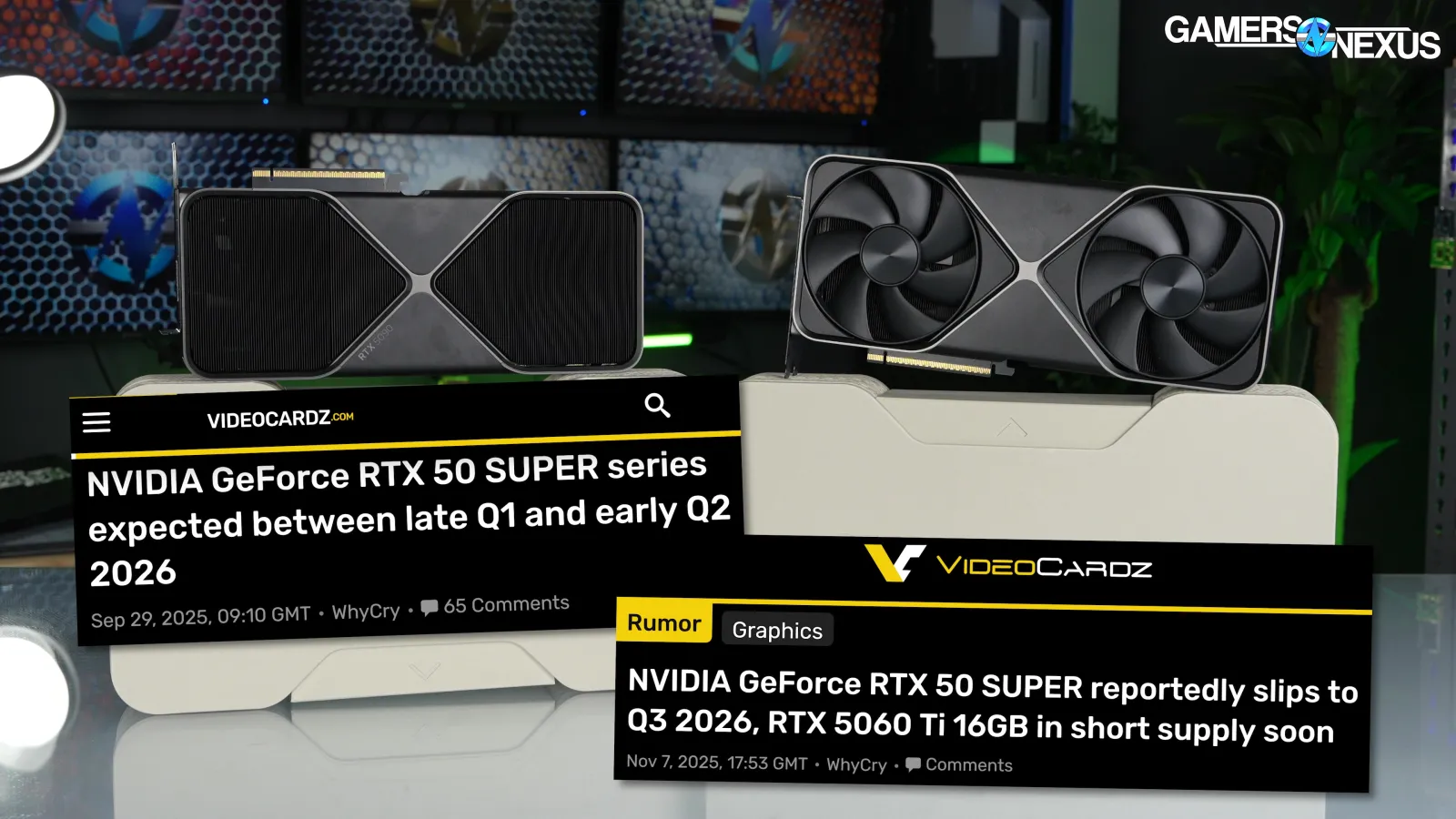
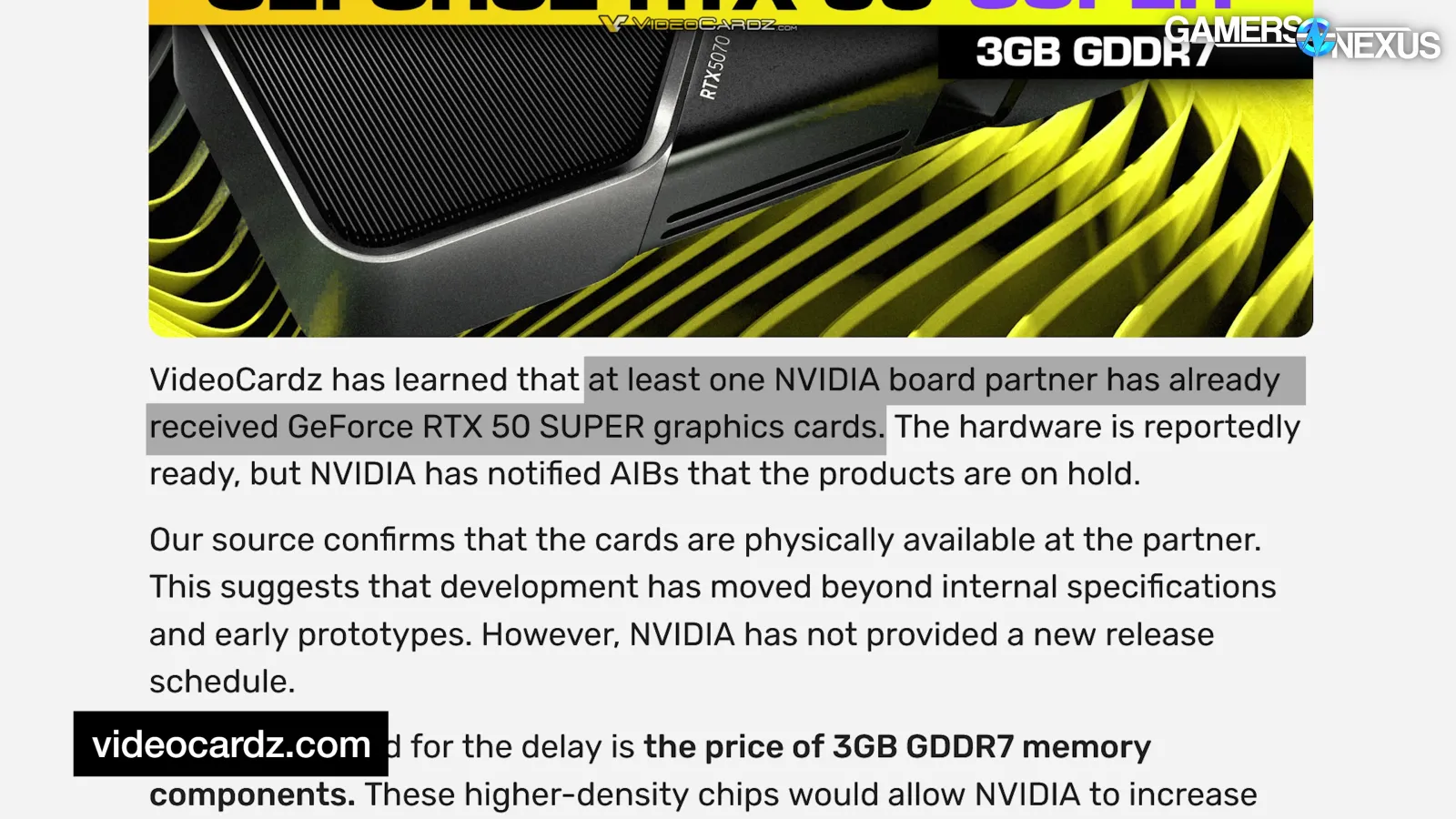
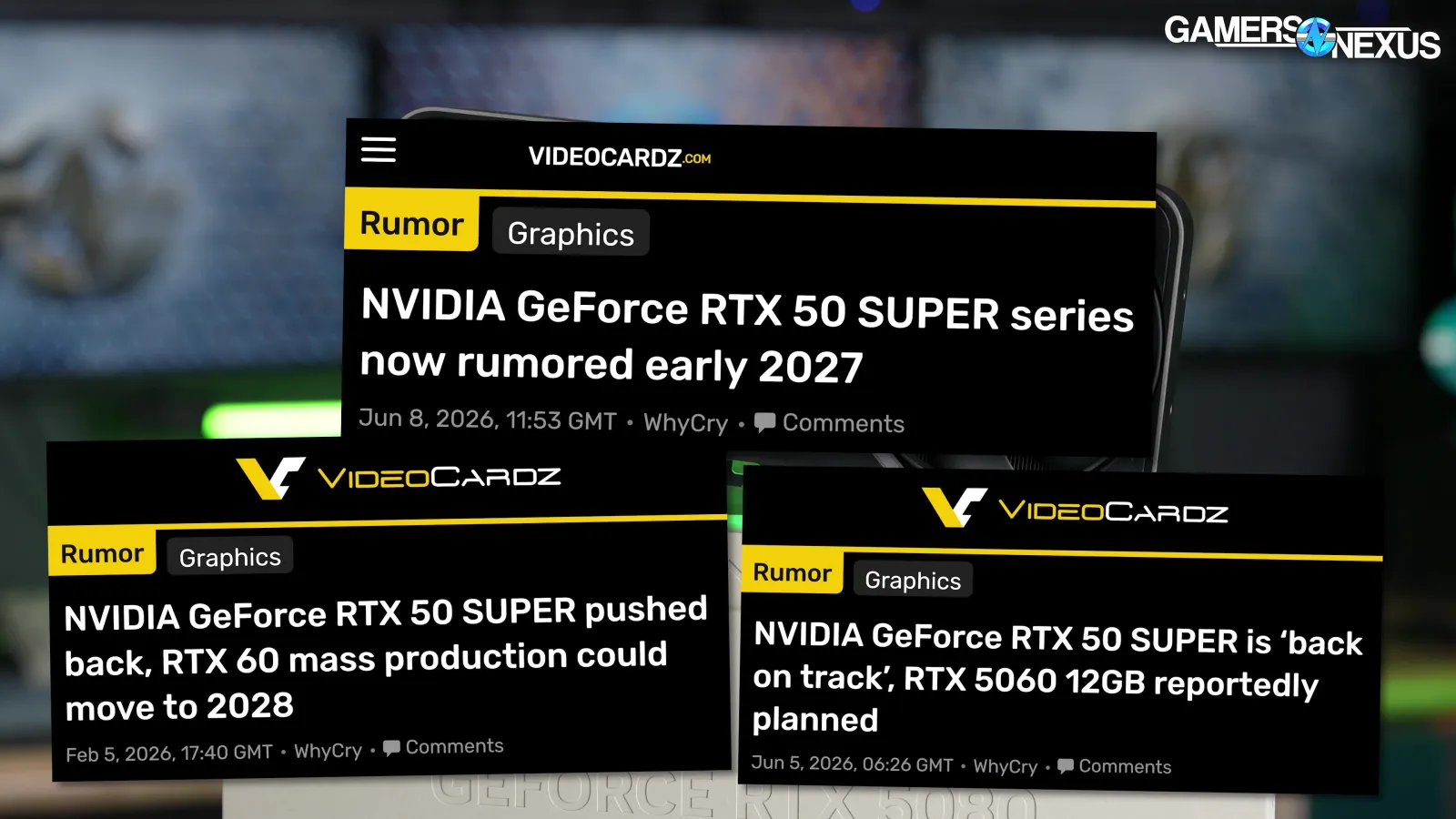
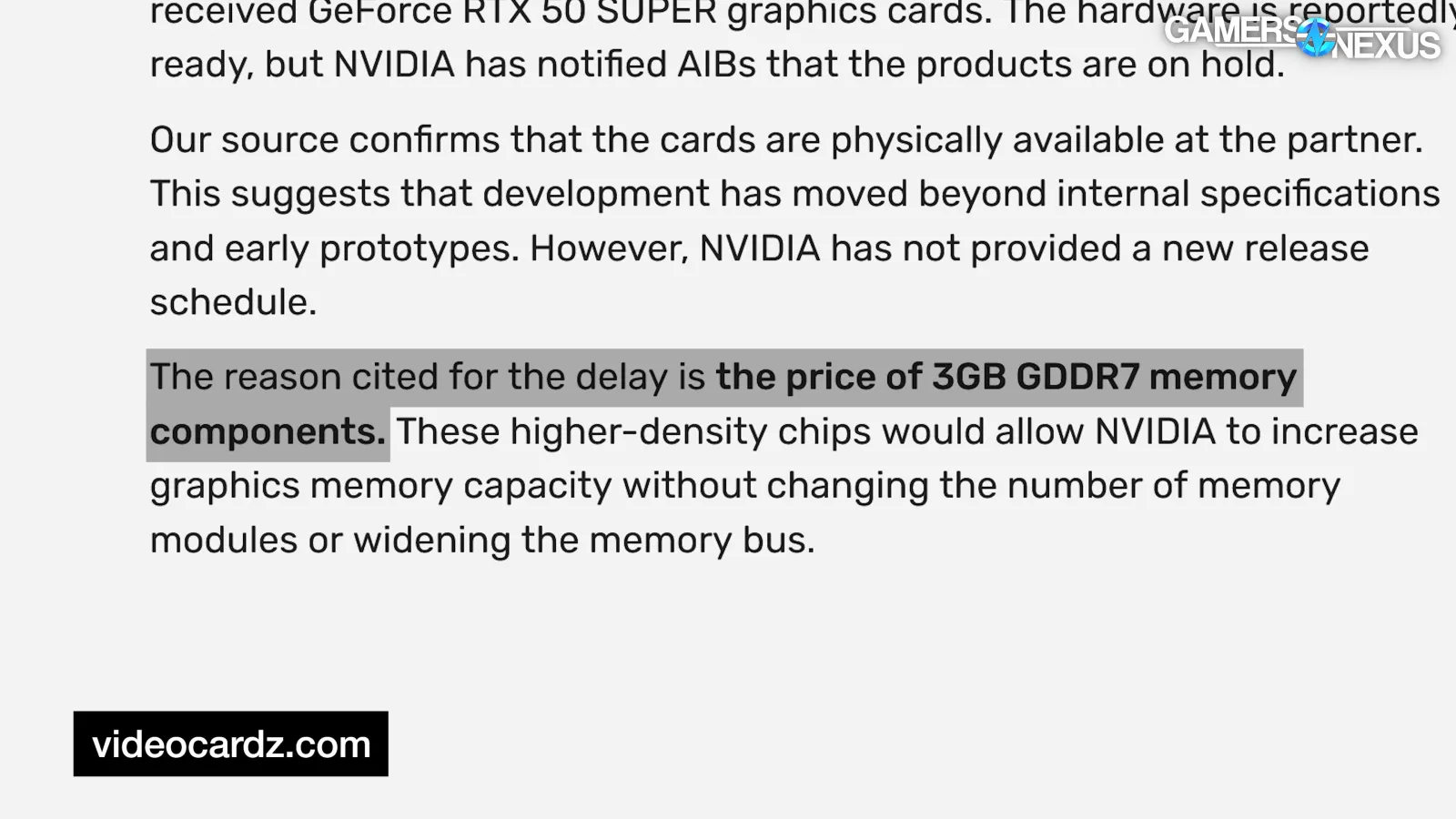
Initially, NVIDIA’s 50-series SUPER GPUs were “rumored to appear before 2026.” Then unlikely to appear by CES 2026, Then “expected between late Q1 and early Q2 2026.” Then, release was reportedly delayed to third quarter 2026, then simply “pushed back,” then release was “back on track” with a “rumored early 2027” launch. And now, VideoCardz reports that “at least one NVIDIA board partner has already received GeForce RTX 50 SUPER graphics cards,” but claims that NVIDIA is once again delaying the release due to VRAM prices.
Videocardz has a good track record with rumors. We don’t think they were wrong -- likely it really was just changing that often and in real-time.
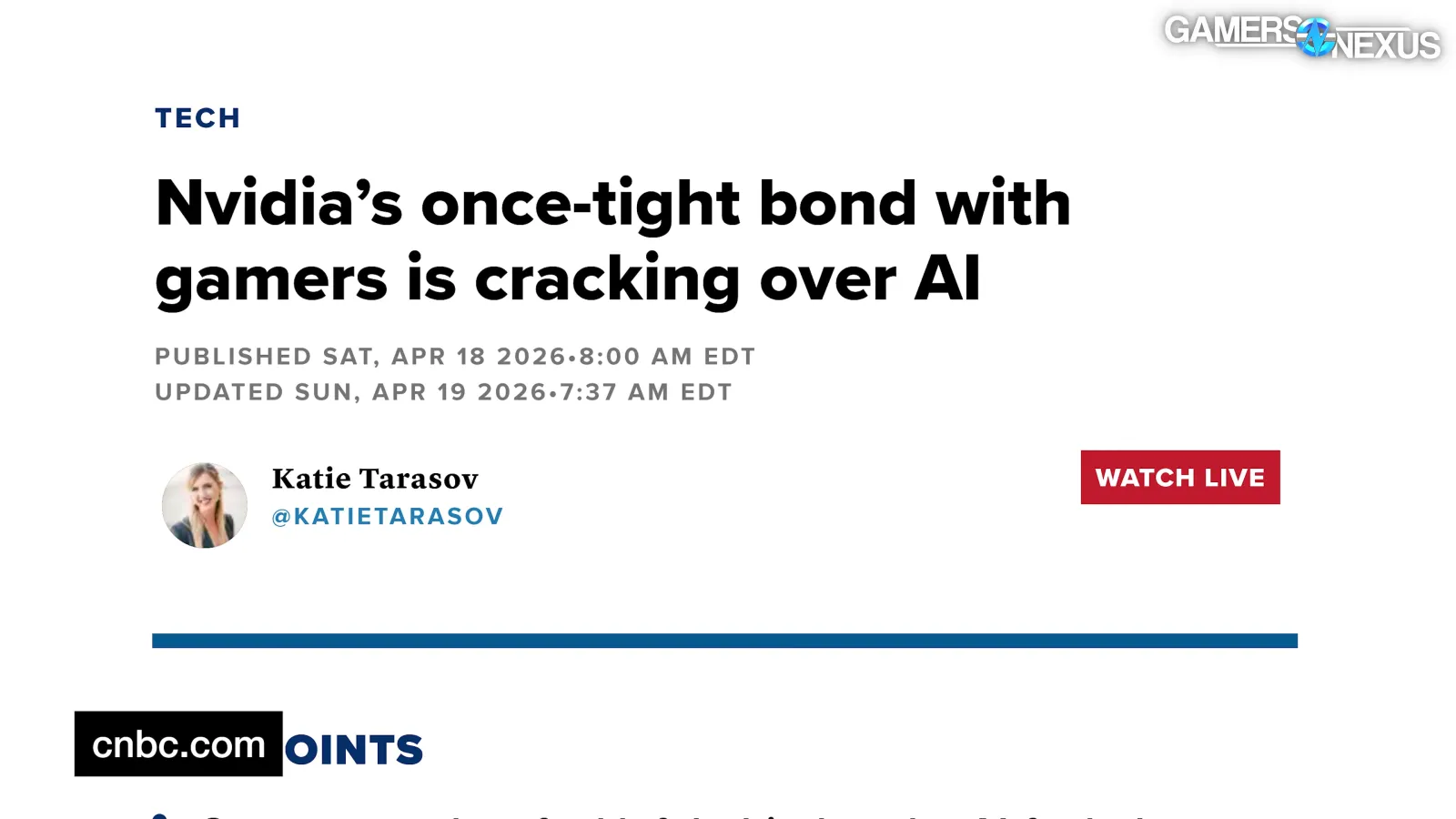
Interestingly, CNBC commented back in April, “If analyst predictions are correct, 2026 will be the first year in three decades that Nvidia doesn’t release a new generation of its consumer-facing GeForce line of graphics processing units.”
There are some caveats to that: NVIDIA doesn’t release new generations every single year for consumers, but it has historically at least had something on the consumer side. This time, it hasn’t.
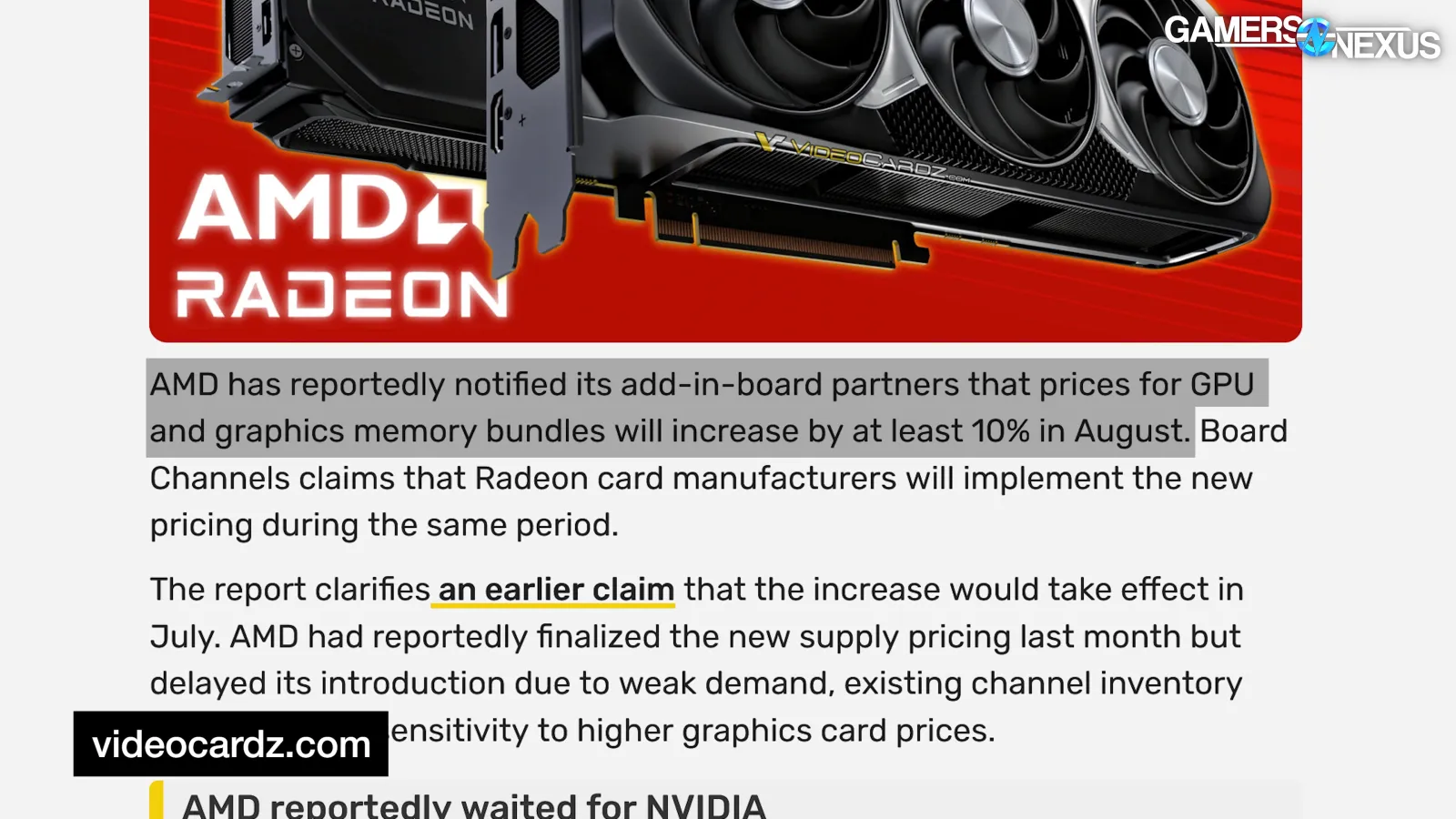
VideoCardz also disclosed that AMD informed its board partners “that prices for GPU and graphics memory bundles will increase by at least 10% in August,” adding that the company reportedly waited for NVIDIA to raise its prices first.

Lisa Su has stated on camera, "In some sense we are probably more aligned than we've ever been which is actually a really good thing." and “Everyone is so friendly. Everyone loves each other. Even if they're competitors, it doesn't matter.”
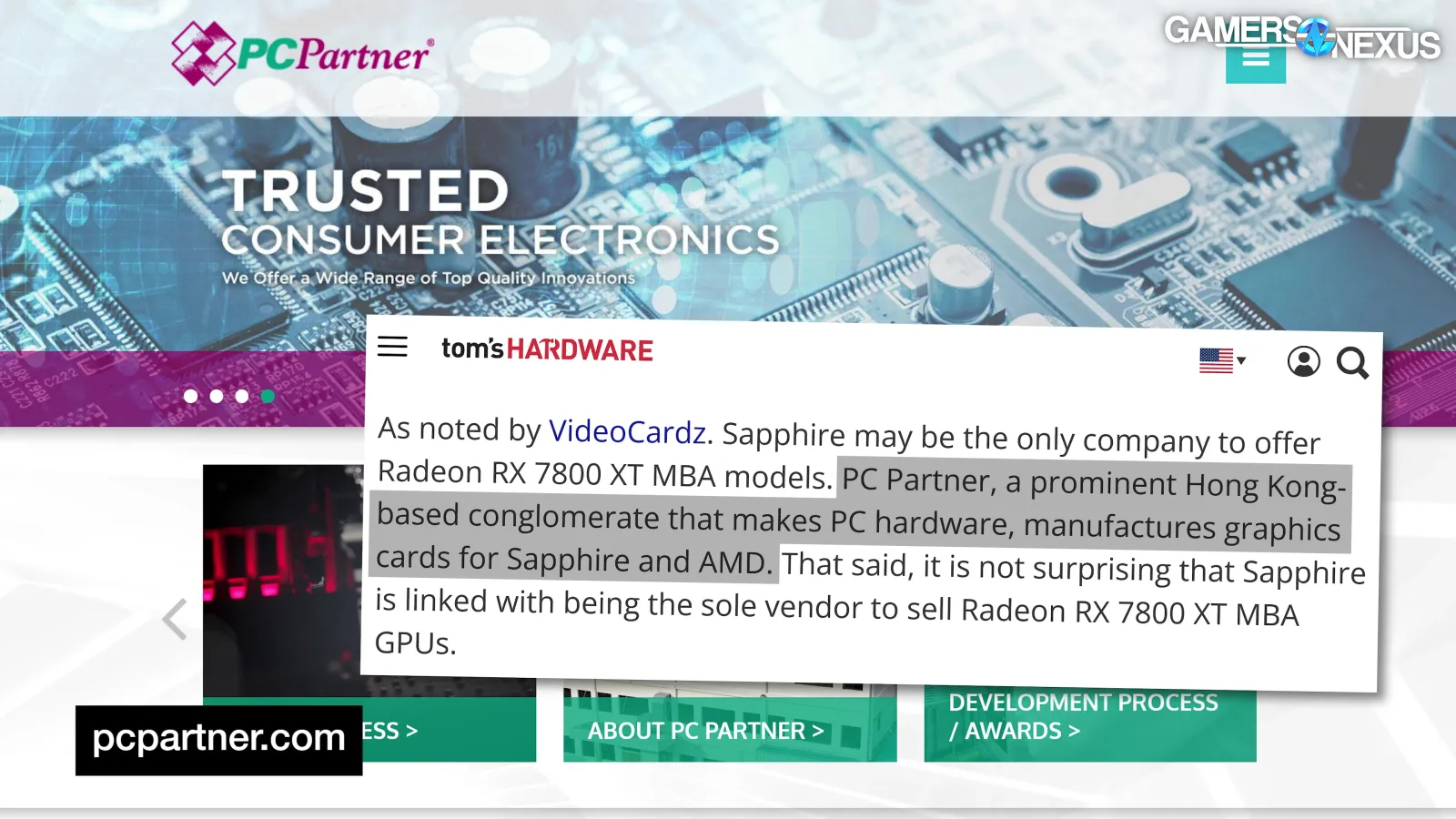
Most recently: PC Partner, owner of Zotac, Manli, and Inno3D, and manufacturer of AMD and Sapphire GPUs, warned about GPU price increases coming in the second half of 2026, disclosing in a recent financial statement:
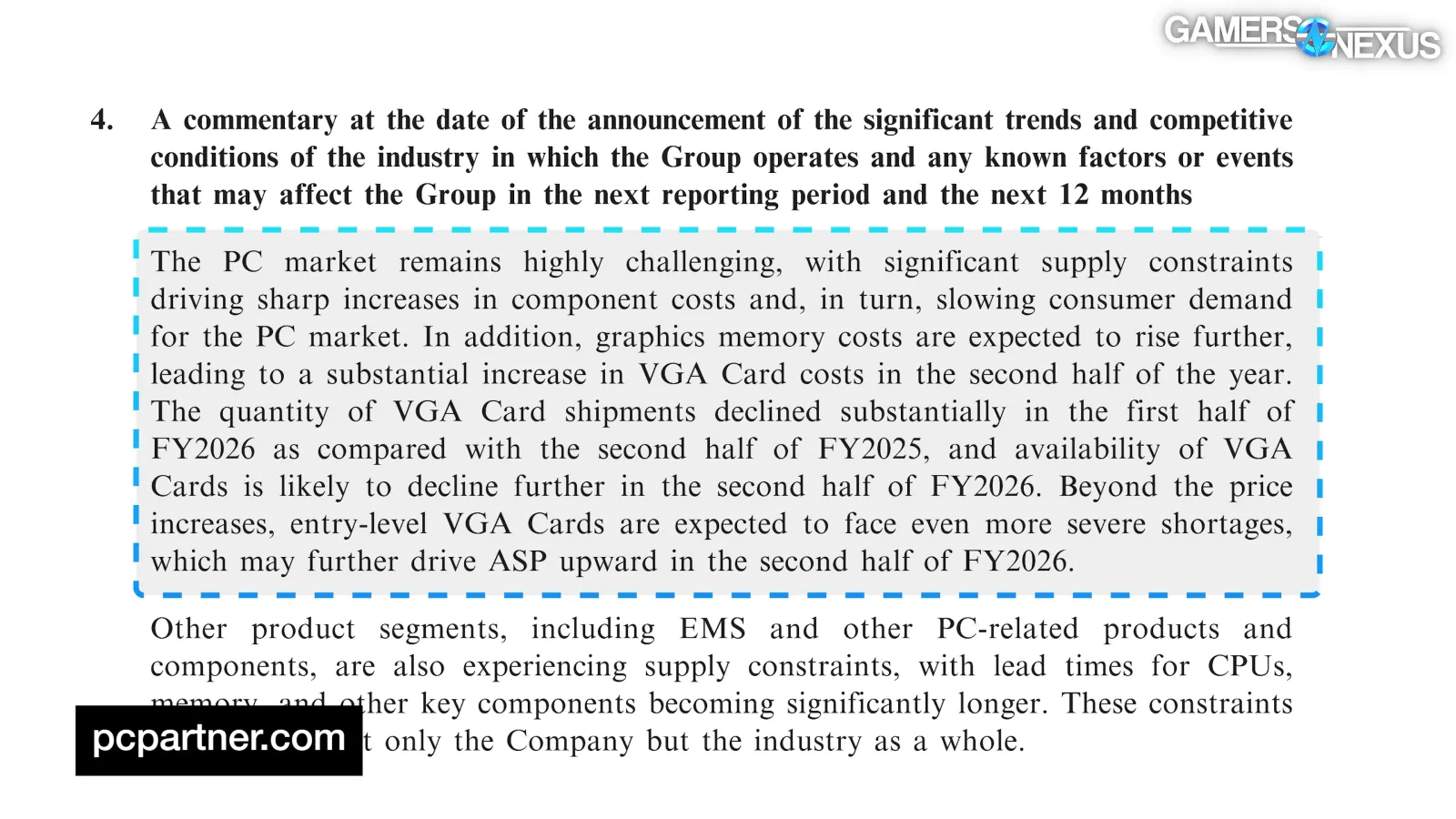
“The PC market remains highly challenging, with significant supply constraints driving sharp increases in component costs and, in turn, slowing consumer demand for the PC market. In addition, graphics memory costs are expected to rise further, leading to a substantial increase in VGA Card costs in the second half of the year. The quantity of VGA Card shipments declined substantially in the first half of FY2026 as compared with the second half of FY2025, and availability of VGA Cards is likely to decline further in the second half of FY2026. Beyond the price increases, entry-level VGA Cards are expected to face even more severe shortages, which may further drive [average selling price] upward in the second half of FY2026.”
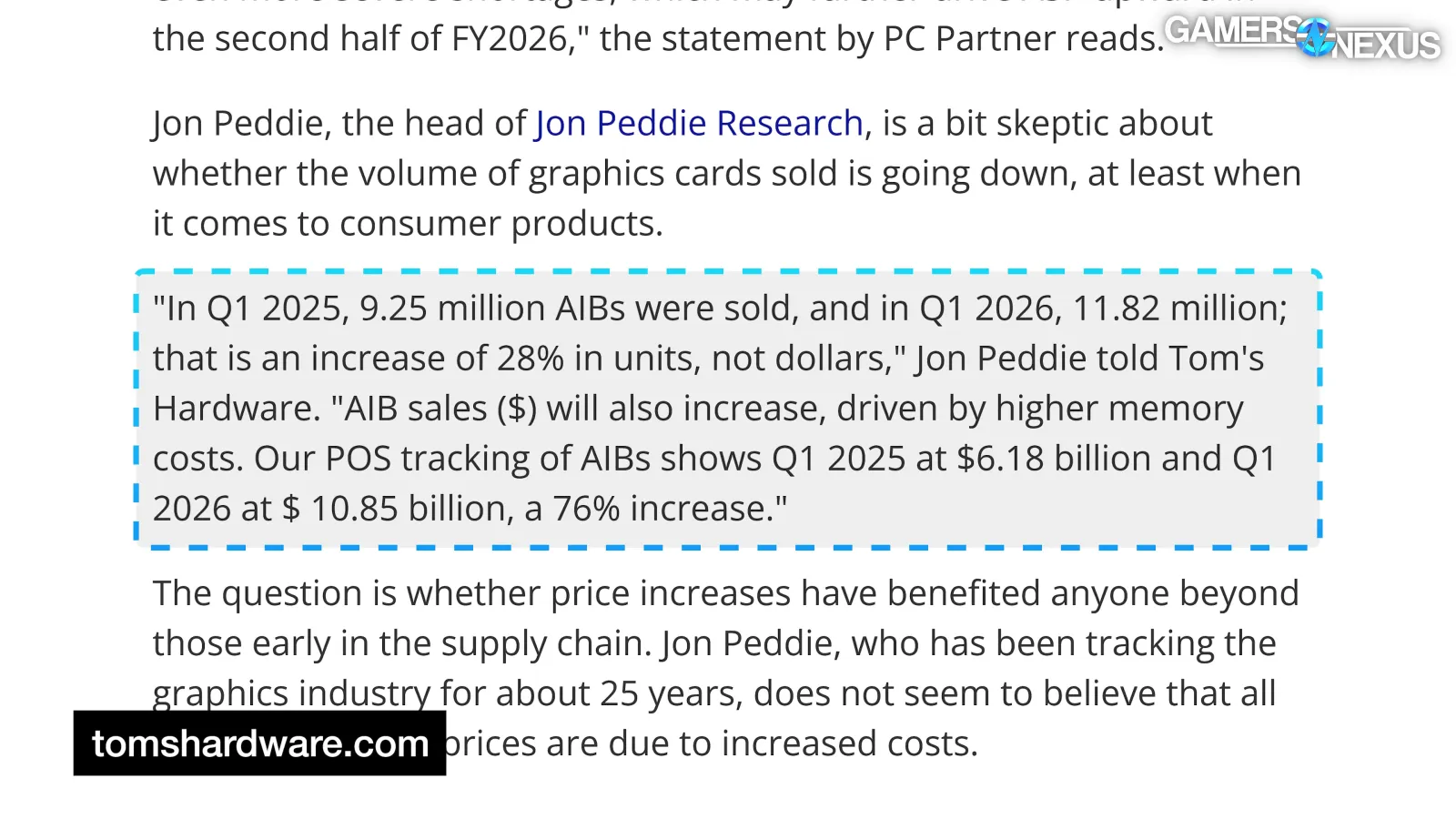
Jon Peddie Research also commented on the situation, noting that from 1Q 2025 to 1Q 2026, AIB units sold increased by roughly 28% year-over-year while sales increased by nearly 76%, which he clarifies, stating, "[This all does] not necessarily equal an increase in profits, although I suspect it does, and the AIB suppliers are taking advantage of all of the press reports on higher memory prices and shortages to raise AIB prices more than the delta in memory costs."
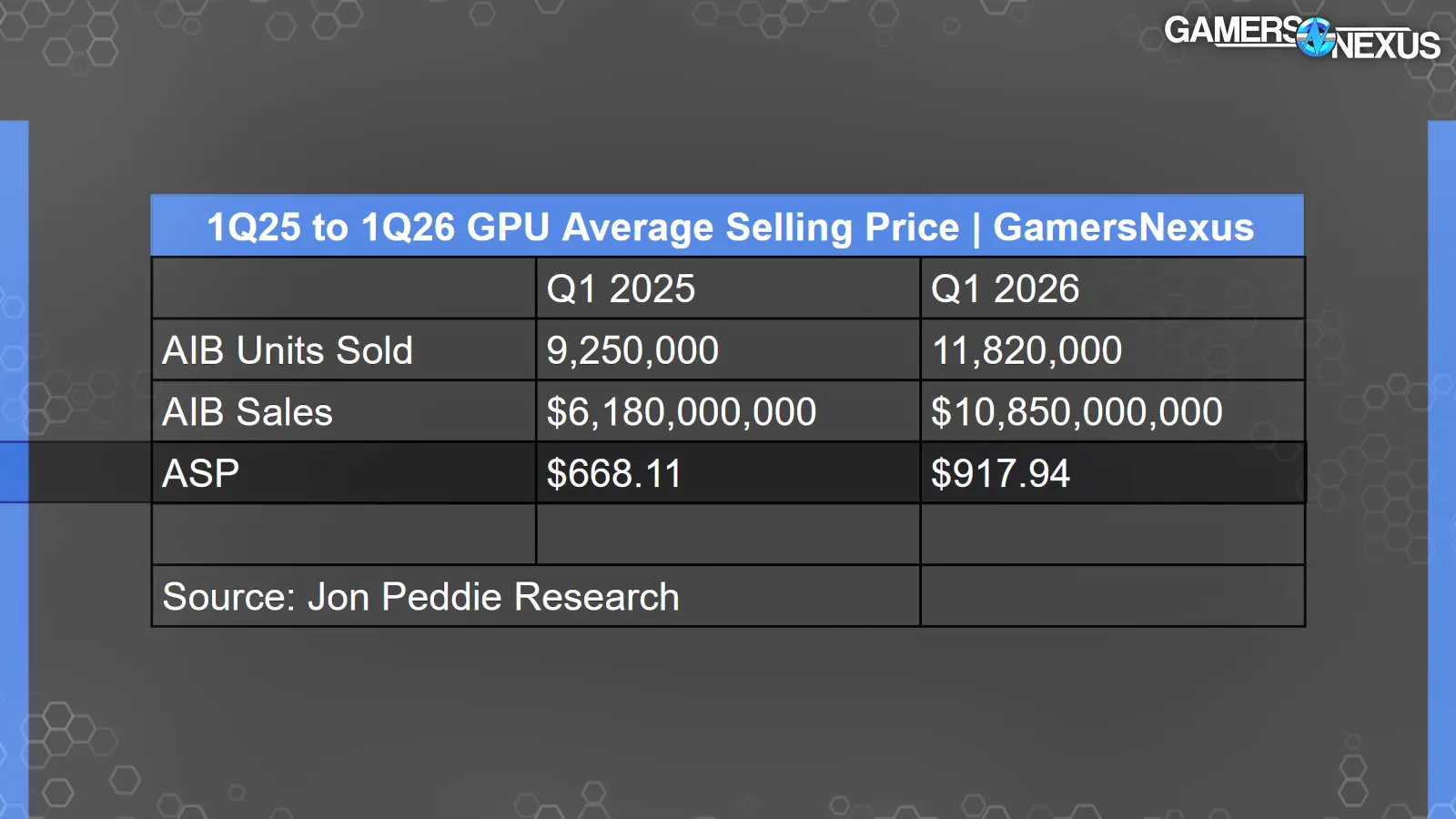
Using Jon Peddie Research’s units sold and sales figures, we calculated AIB AVG selling price, which comes out to $668 in 1Q 2025 and $918 in 1Q 2026, a nearly $250 increase year-over-year, but we have numbers for actual cards sold as completed.
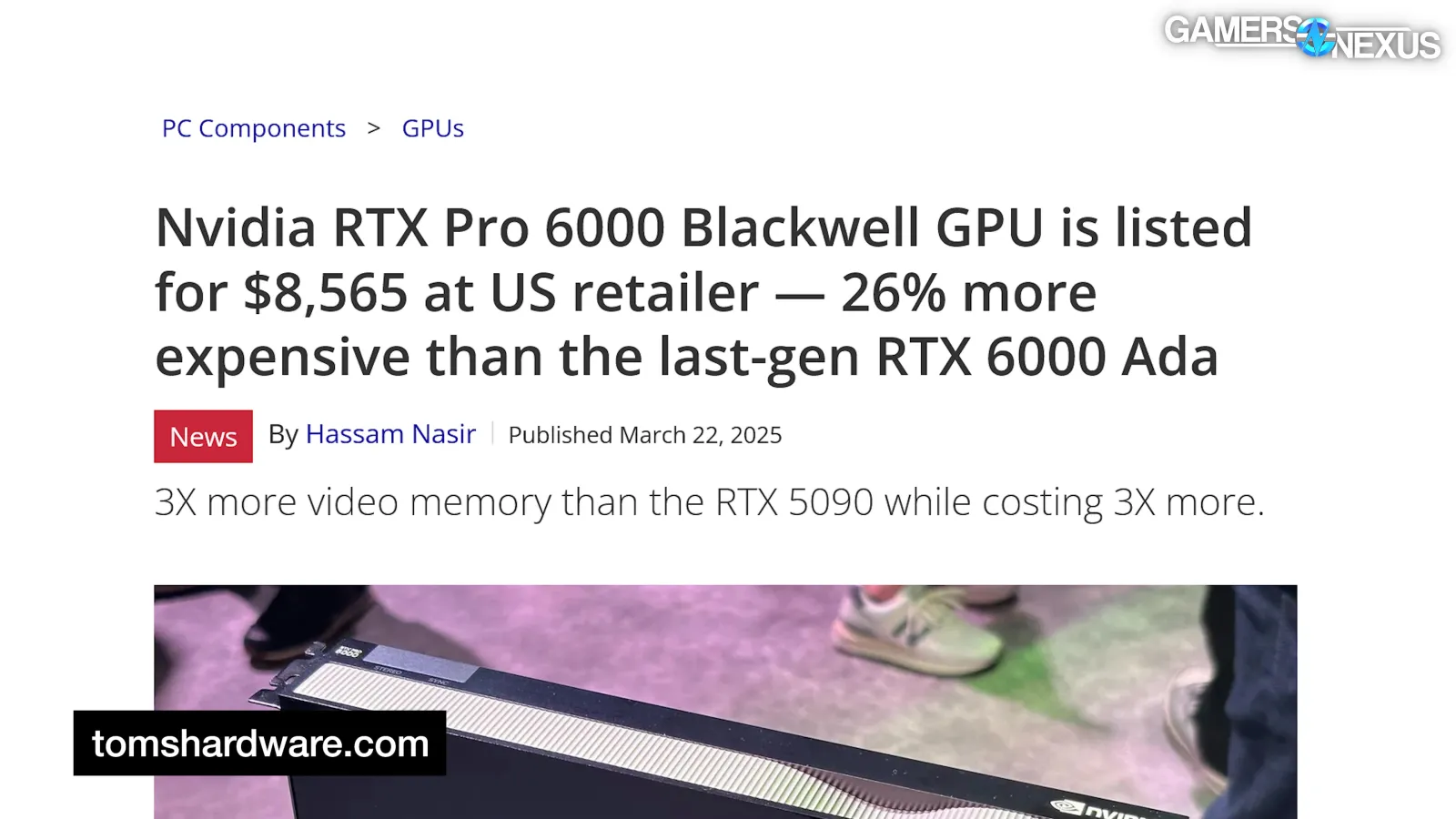
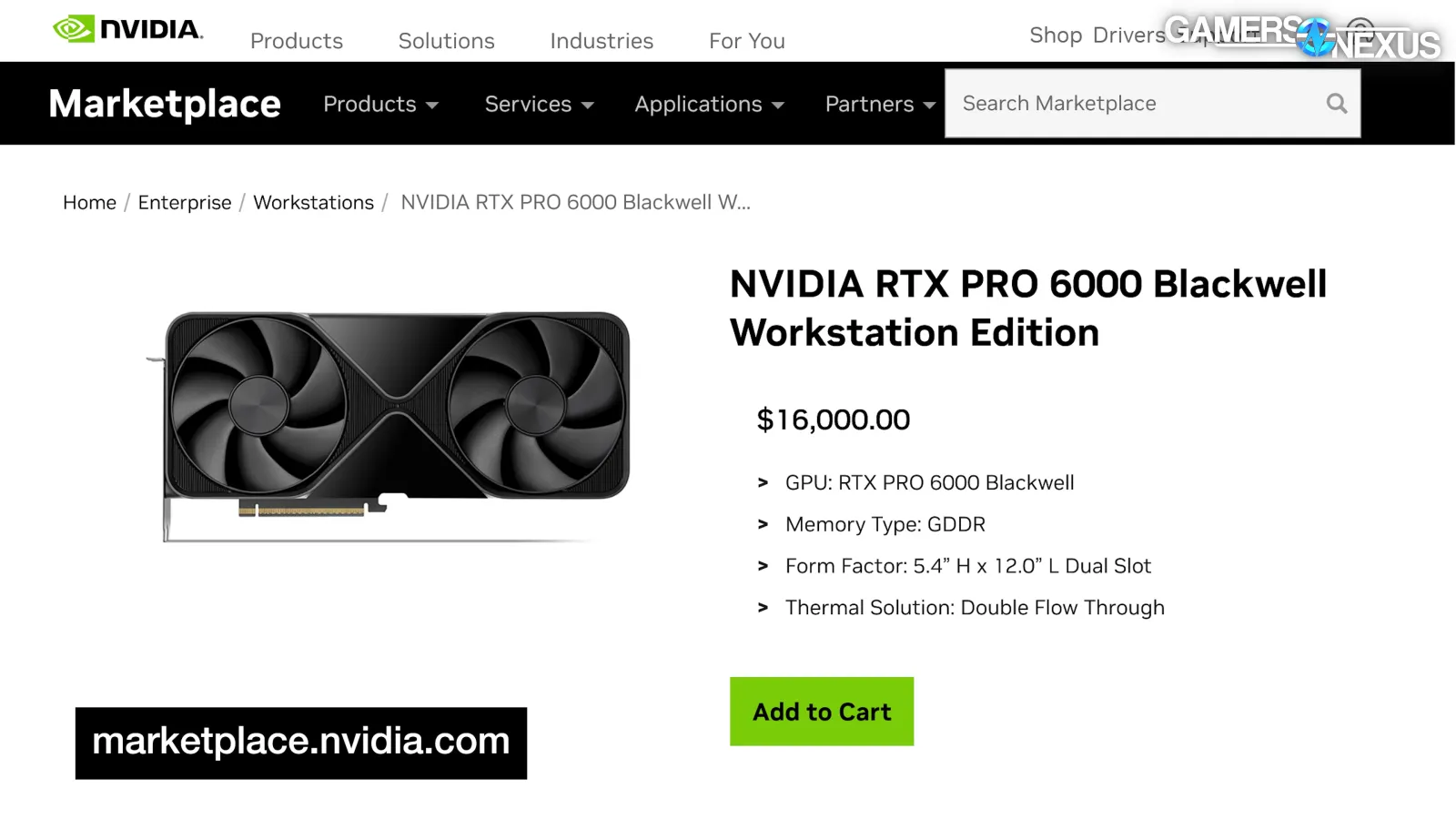
And while NVIDIA refuses to adjust the MSRP of any consumer cards despite them being basically impossible to purchase at those prices, NVIDIA just silently increased the price of its RTX PRO 6000 workstation GPU (read our review) to $16,000 on its marketplace, making it nearly double its $8,565 March 2025 launch price.
At least now we know exactly what Jensen meant when he said, “And so I think the fact that everything is scarce is fantastic for us.”
Methodology

Time to get into the price changes and tracking.
For our methodology:
We collected all new, first-party listings from Newegg for every current-gen GPU in order to capture what we believe is a representative snapshot of the current GPU market. Most of our analysis here will focus on in-stock listings for both pricing and availability.
We’ve decided to exclude out of stock listings mainly due to the possibility that they’re restocked at higher prices. That being said, AVG in-stock prices will likely lean higher due to any given GPU’s cheapest listings typically being the first ones to go out of stock.
We’ll start by going over the current pricing and availability situation, focusing on how the data has changed since the last few times we collected it. We’ll also break down the data by memory configuration as well as by vendor to look for any other interesting trends in the GPU market.
With that out of the way, let’s get into the charts.
In-Stock Average Price Comparison | February to Current | GamersNexus
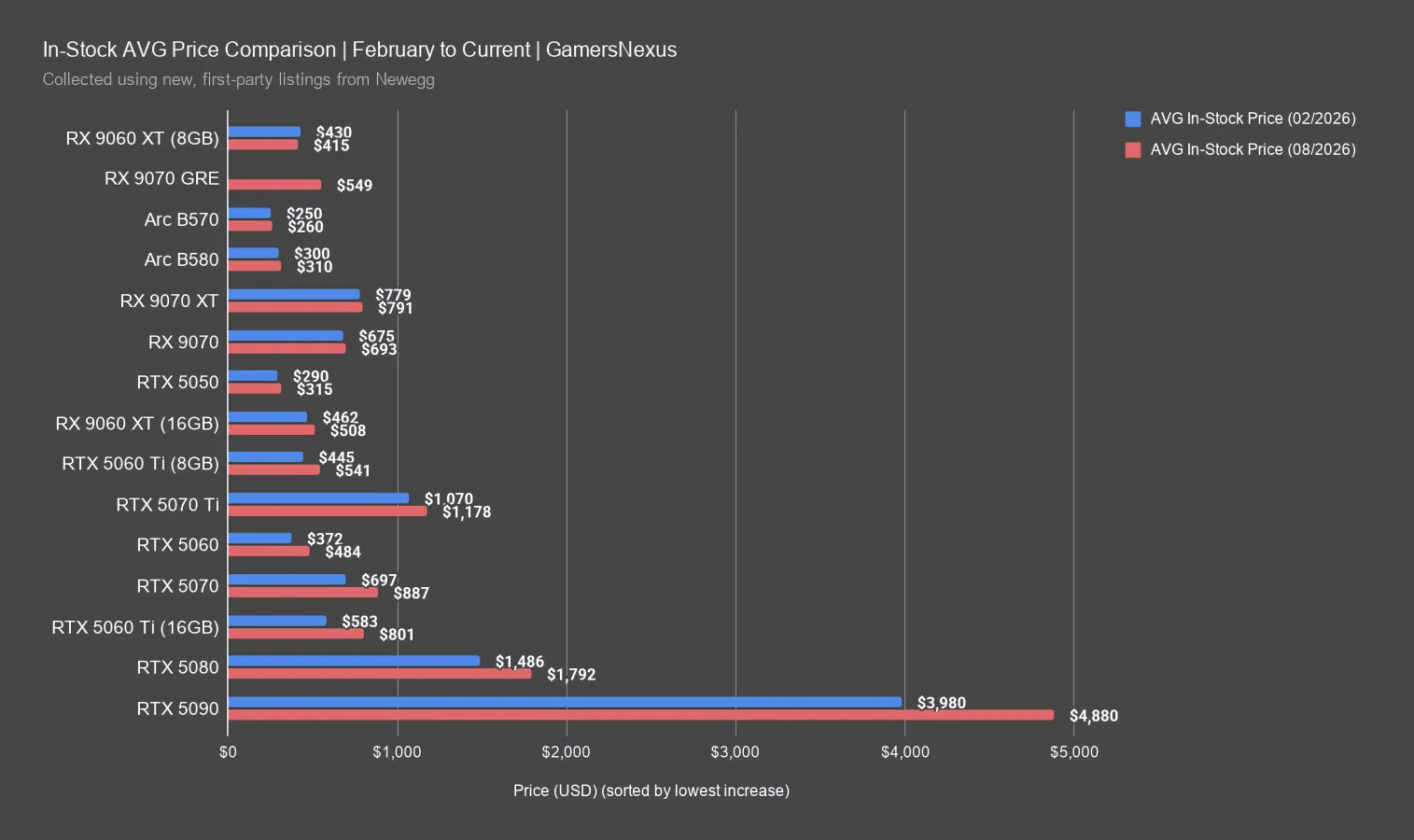
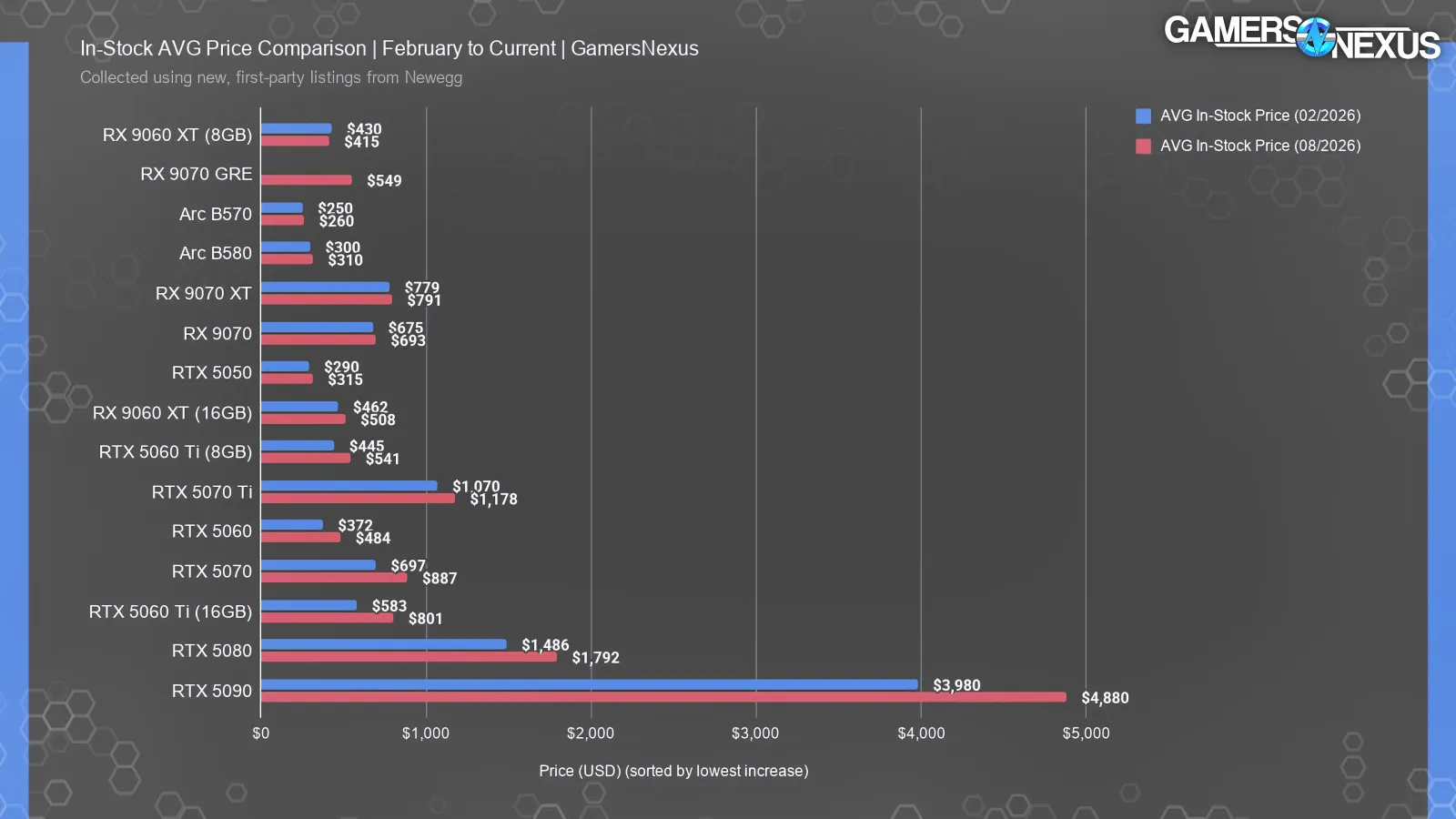
We’ll start with in-stock AVG prices, as compared to the in-stock AVG prices we collected six months ago in February.
The 8GB 9060 XT was the only GPU on this list whose AVG in-stock price decreased since February, dropping by $15. Maybe low demand is finally winning in the supply-and-demand pricing war.
The B570 (read our review), B580 (read our review), RX 9070 XT, RX 9070 (read our review), RTX 5050, and 16GB 9060 XT each saw modest in-stock AVG price increases between $10 and $46.
Moving further down the chart: All NVIDIA GPUs except for the 5050 and 5090 increased by between $96 and $306.
Finally, the RTX 5090’s in-stock AVG price increased by $900 since February.
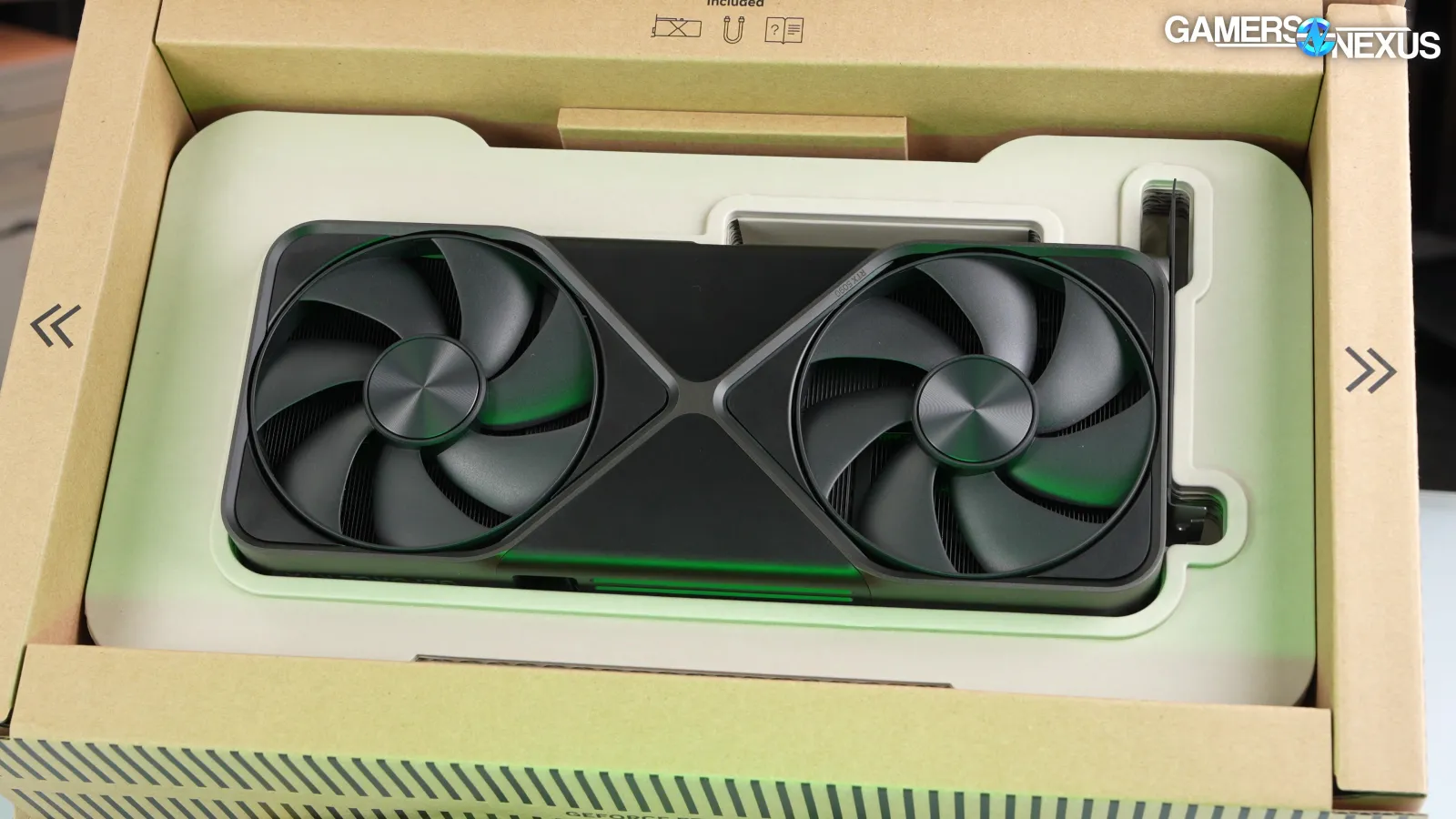
We’d assume that NVIDIA GPUs are likely more affected by the recent price increases due to their use of GDDR7 VRAM as opposed to the previous-gen GDDR6 VRAM that AMD and Intel GPUs possess.
There is effectively nothing at MSRP.
GPU Availability | In-Stock Listings | GamersNexus
Up next is GPU availability. For this, we’ll look at the number of different models each current-gen GPU has in stock.
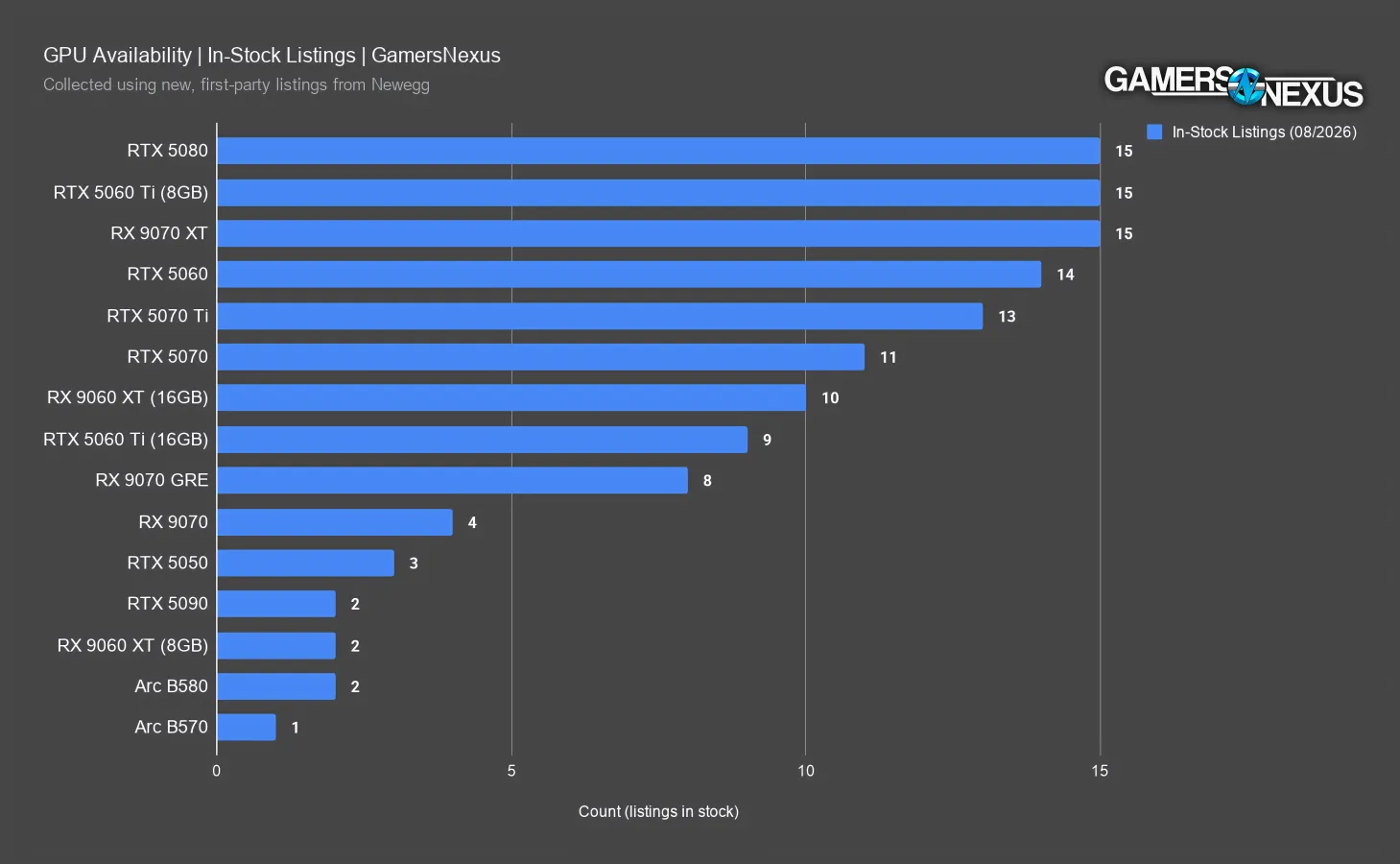
Obviously, this isn’t perfect as we don’t have actual unit counts, but the number of listings a particular GPU has in stock should be fairly representative of its overall availability.
The RTX 5080 (read our review), RTX 5060 Ti 8GB (read our review), and RX 9070 XT (read our review) are all tied for the most listings in-stock, each with 15 GPU models currently available at the time of collecting our snapshot.
On the opposite end of the spectrum, the RTX 5050 (watch our review), RTX 5090, 9060 XT 8GB, and Intel’s Battlemage cards each have three models or fewer in stock. Intel, in particular, has fallen significantly since its Battlemage launch.
We think this chart emphasizes the extremely limited availability for the RTX 5090 and also highlights a particularly concerning area of improvement for Intel, who absolutely must have more than three total GPU listings available if it wants any chance at improving its market share.
In-Stock Average % Over MSRP | GamersNexus
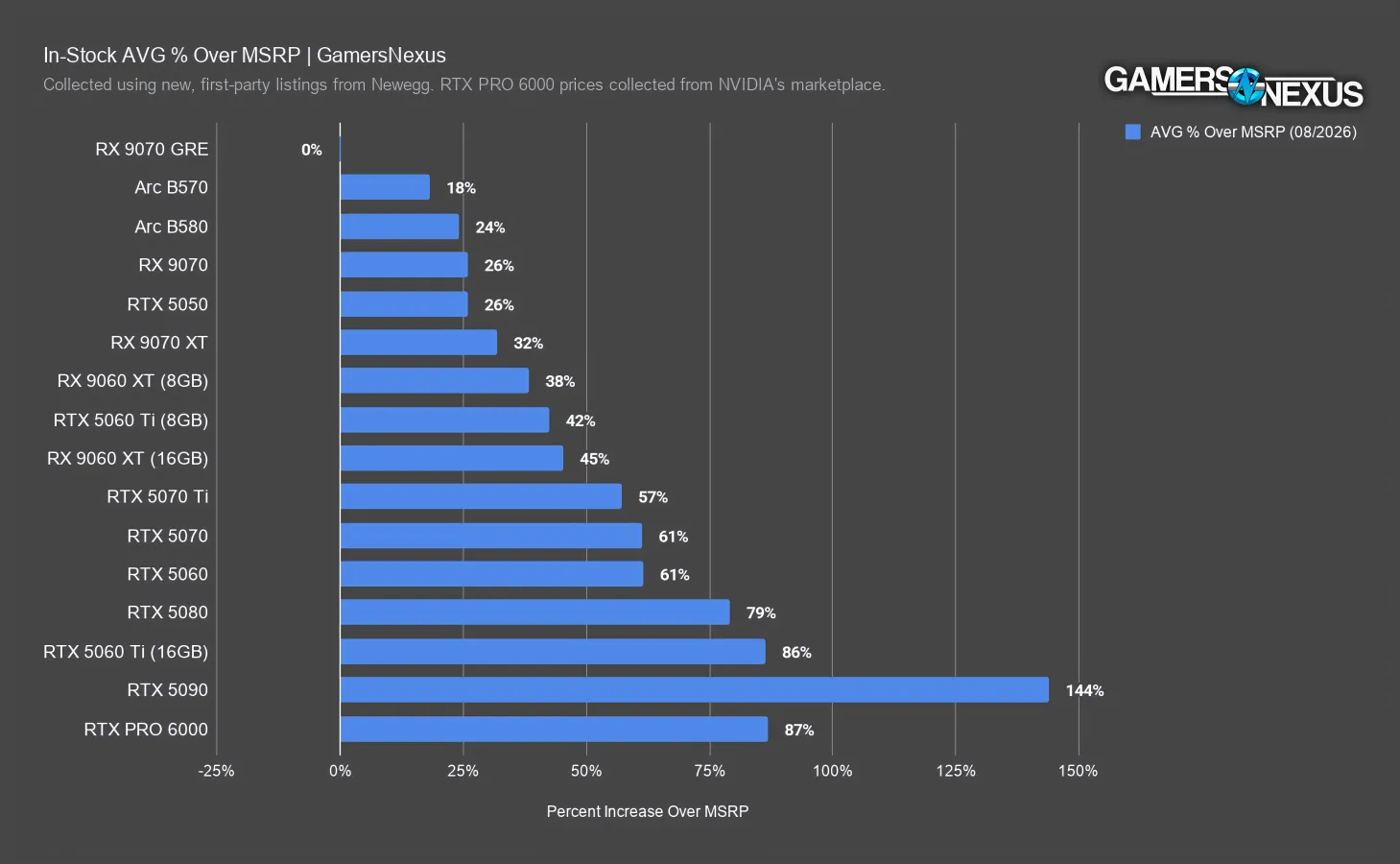
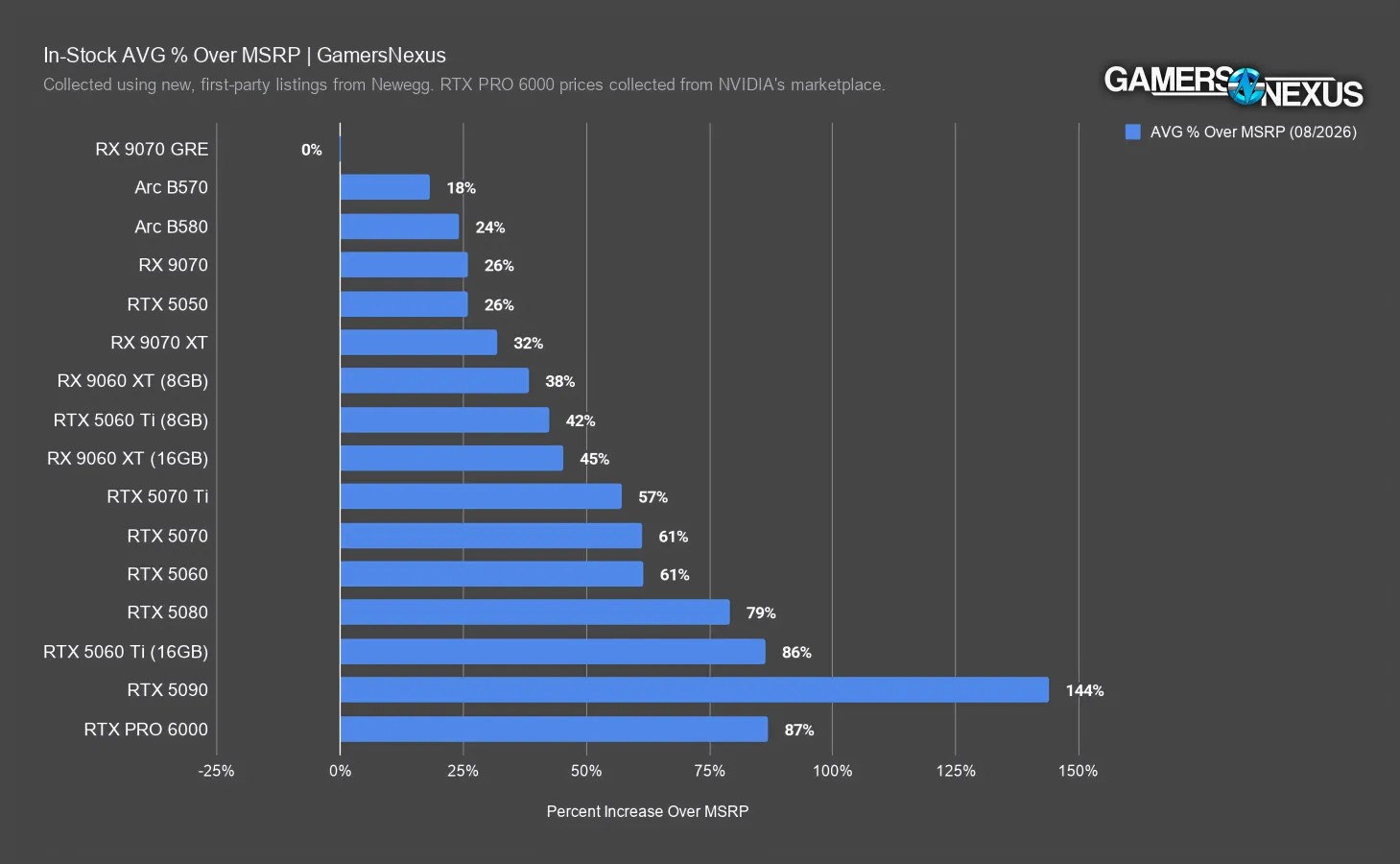
This next chart plots % over MSRP, as calculated against each GPU’s in-stock AVG price.
The RX 9070 GRE was the only current-gen GPU whose in-stock AVG price was equal to its MSRP, which AMD achieved by giving it the same $550 MSRP as the better-performing RX 9070 non-GRE.
Continuing down the chart: Intel’s Battlemage GPUs held an impressive 18% - 24% over MSRP while most Radeon GPUs saw AVG prices between 26% - 45% over MSRP.
Meanwhile, NVIDIA’s 5070 Ti (read our review), 5070 (read our review), 5060 (read our review), 5080, and 16GB 5060 Ti (read our review) each ran AVG in-stock prices between 57% - 86% over MSRP.
The worst entry is, once again, the RTX 5090. Its AVG in-stock price reached a preposterous 144% over MSRP. We think the 5090’s skyrocketing price is further exaggerated by AMD refusing to compete at the high-end, in addition to the 5090 being the only current-gen consumer GPU with more than 16GB of VRAM.
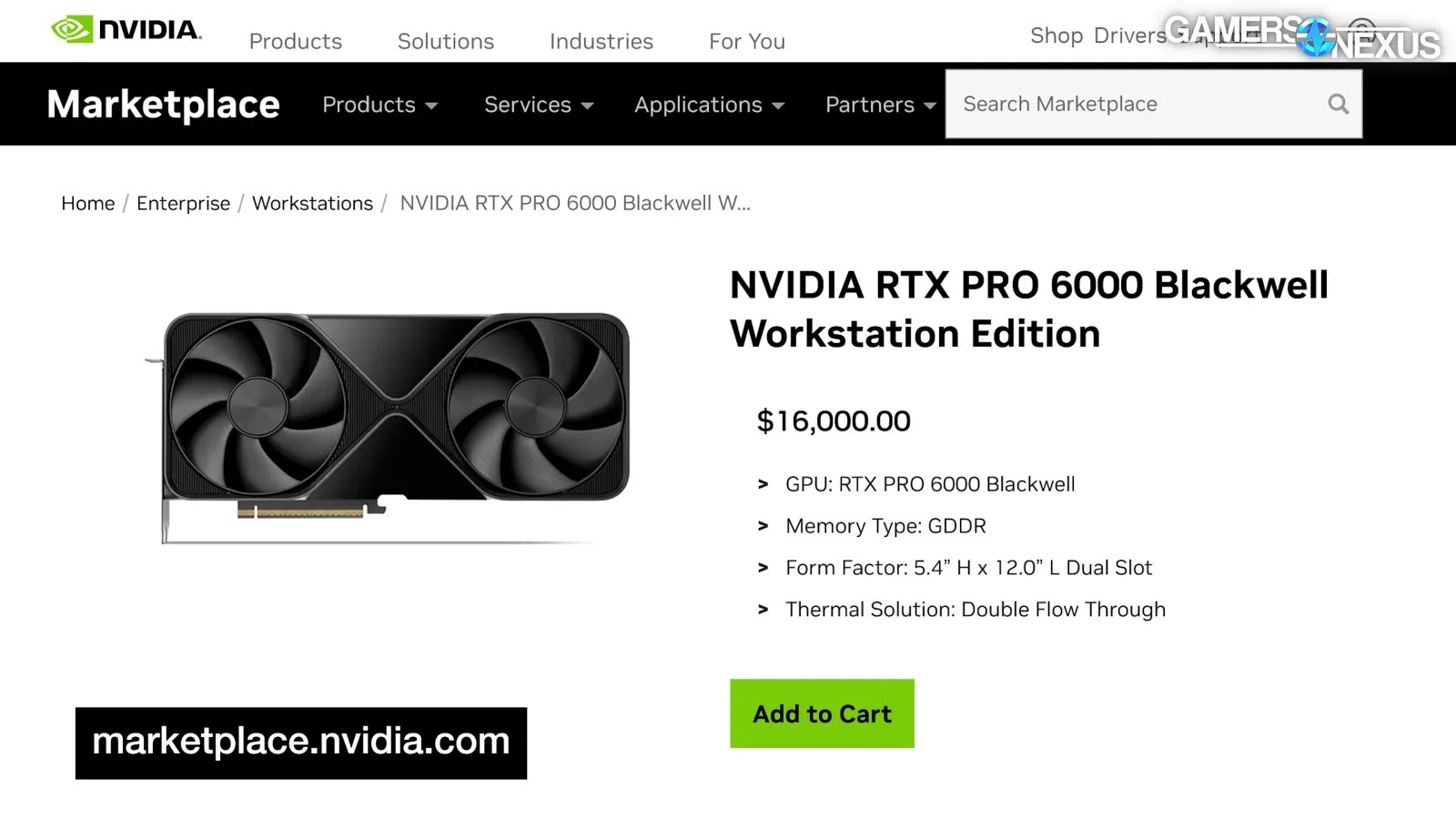
For further comparison, the RTX PRO 6000’s current $16,000 price is roughly 87% greater than its initial $8,565 launch price.
To us, it seems like NVIDIA will likely push the future 6090 into a workstation class. The 5090 is mostly already there, but the company was still marketing it for gaming. Our guess is that they go full prosumer in the next 90-class card and that we come full circle to the Titans. If 5090s are still selling at $4,000 and $5,000, it seems hard to believe that NVIDIA launches an RTX 6090 at the same $2,000 MSRP -- fake as it may be -- as we saw with the 5090. At least, not while having such greatly improved memory specs over the other GPUs.
We’d be thrilled to be proven wrong, of course. That’d be good for everyone.
In-Stock Average Price Over MSRP | GamersNexus
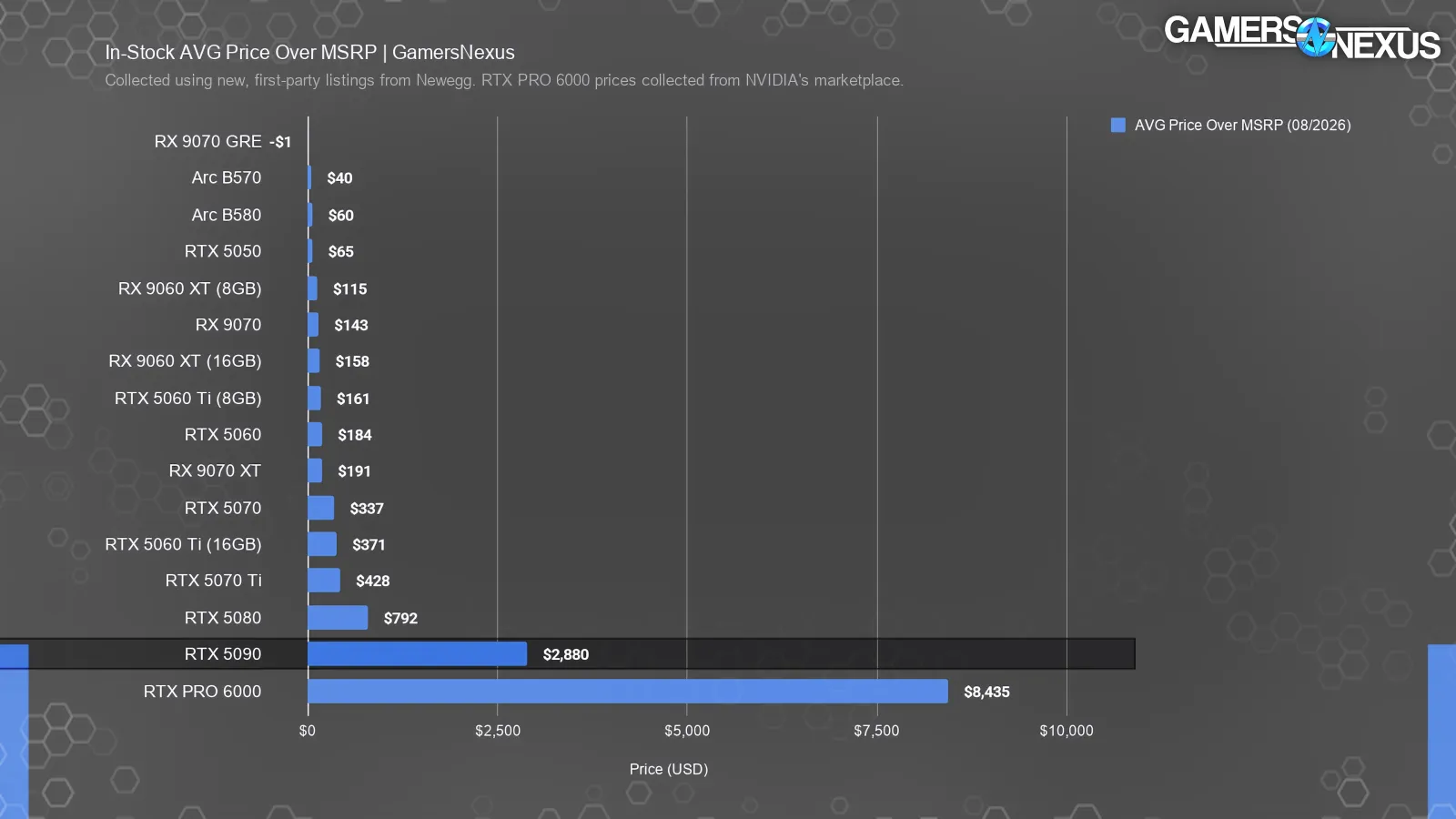
This chart shows the same data covered previously, but this time plots absolute dollar amount increase over MSRP, rather than percentage.
As seen here, several current-gen GPUs land between $100 and $200 over their MSRPs, while all NVIDIA GPUs at 12GB to 16GB of VRAM find themselves between $340 and $800 over their respective MSRPs.
Unsurprisingly, the worst absolute price increase comes from NVIDIA’s RTX 5090, whose in-stock AVG price reaches nearly $3,000 more than its MSRP.
For additional comparison, we also listed the RTX PRO 6000 on this chart, highlighting its ludicrous $8,435 price increase from its initial launch price.
Average % Over MSRP | Based on Memory Configuration | GamersNexus
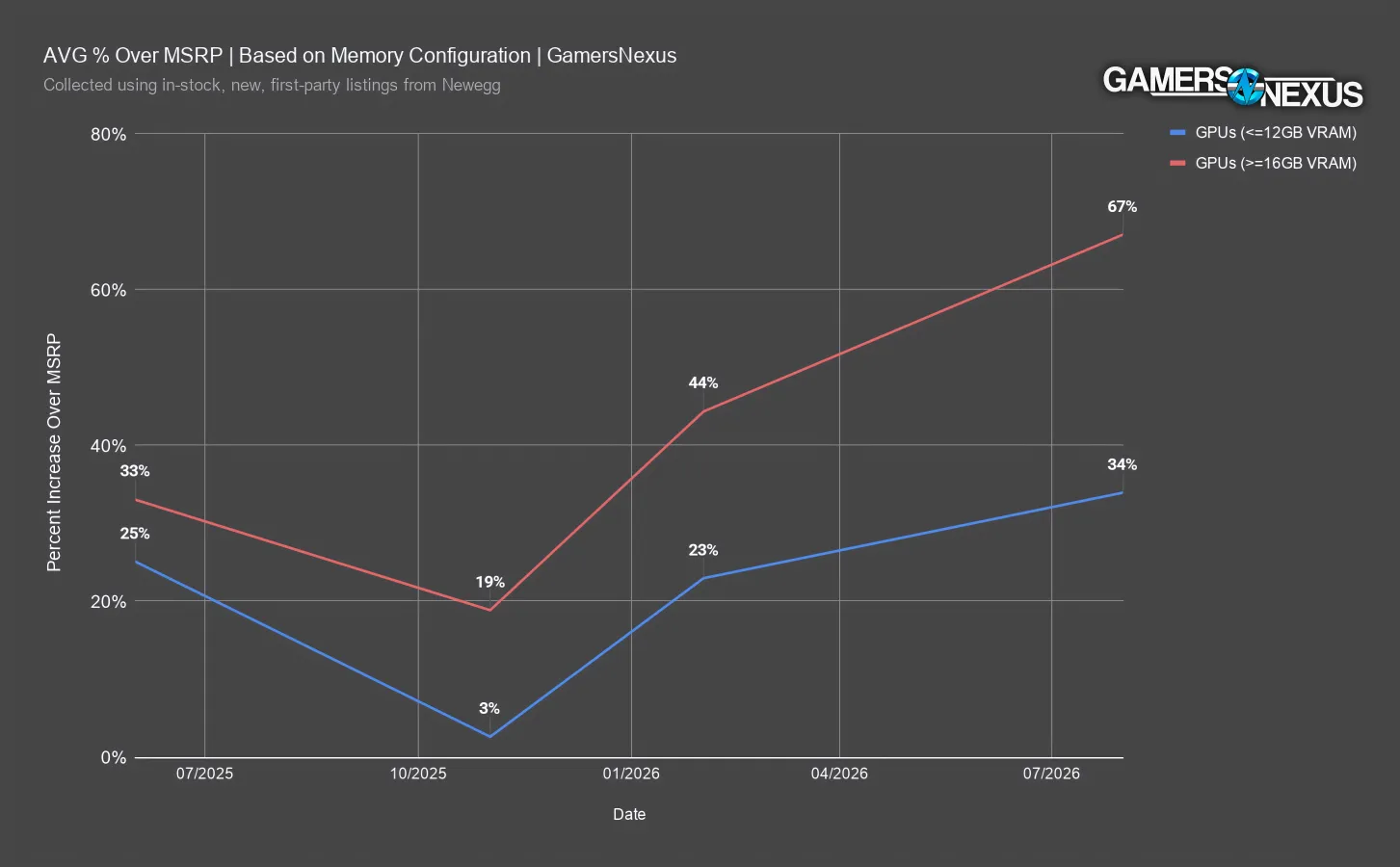
This next chart includes data from previous snapshots we collected in June 2025, November 2025, and February 2026, in addition to our most recent August 2026 snapshot. The focus here is how % over MSRP differs between GPUs based on memory configuration. The X-axis plots the date we collected the data.
November would have been the time to buy. We try not to make predictions, but back then, we felt confident enough that prices would go up to suggest it was the best timing. The June 2025 prices were elevated since it was still relatively close to launch, the November prices were suppressed by a reeling post-GPU launch and mid-tariffs market, and after that, the DRAM prices kicked it into high gear to exceed even the elevated launch scalping prices.
AVG in-stock price for GPUs with 12GB or less VRAM started at 25% over MSRP in June, decreased to 3% in November, jumped to 23% in February, and sits at an AVG 34% over MSRP currently.
Now, just as a note here to be extra clear. It’s normal for the price to be elevated over MSRP for partner cards that have special features, like cards that run extra quiet, extra cool, have a liquid cooler, or have some unlocked overclocking features. Some of that is normal, but what we showed in one of the previous pieces was that compared to prior generations like the 10 series, the 20 series, and even the 30 series, the average increase in price over MSRP today far exceeds what we would typically see back then. And there are fewer at MSRP available listings at any given time.
Average in-stock price for GPUs with 16GB or more VRAM sat at 33% over MSRP in June, dropped to 19% in November, bounced to 44% in February, and skyrocketed to 67% over MSRP currently.
Ultimately, percent over MSRP for all GPUs has steadily increased since November; although, the gap in percent over MSRP between GPUs with smaller and larger memory configurations has continued to widen since launch.
Average % Over MSRP by Vendor | November to Current | GamersNexus
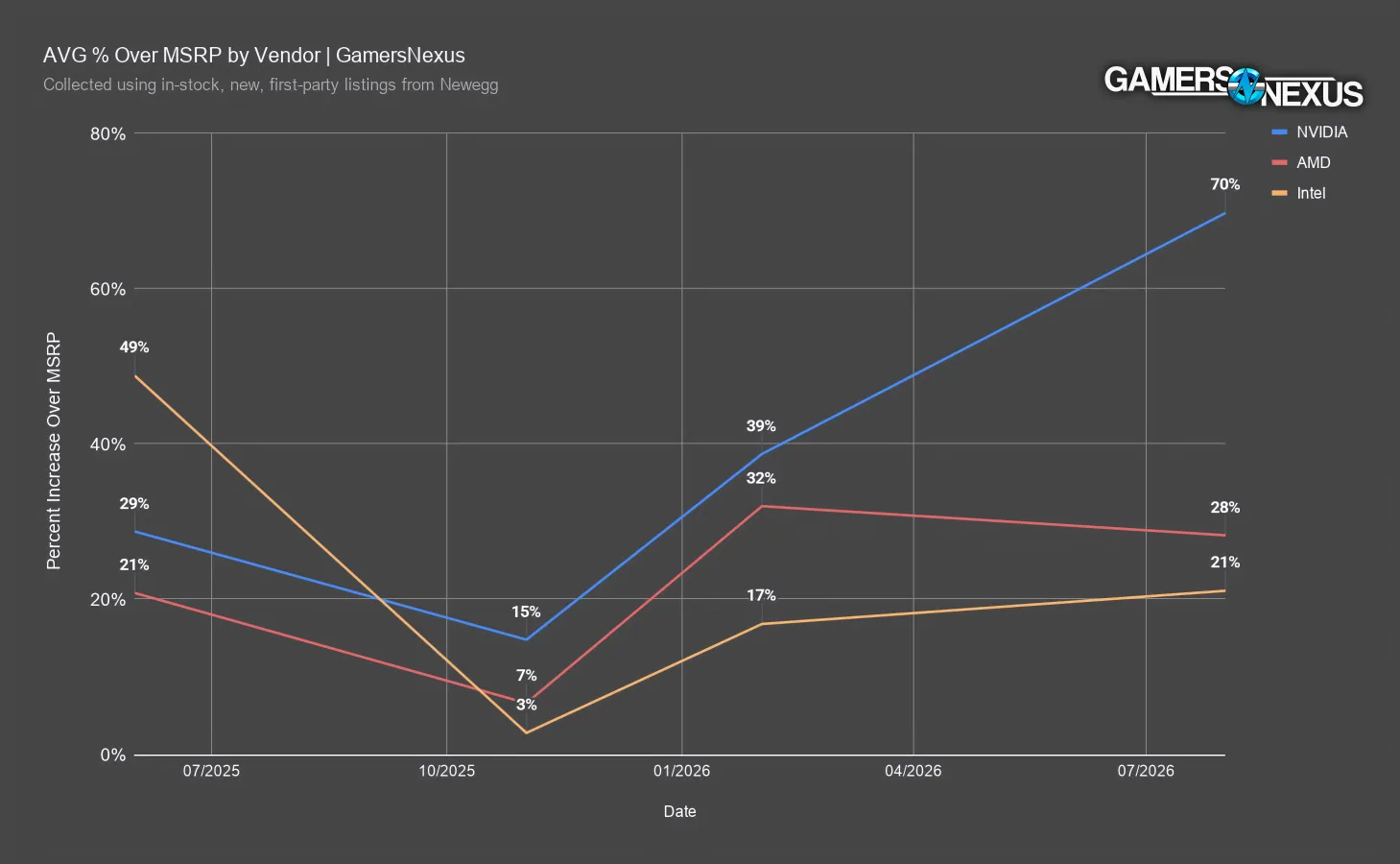
This chart illustrates average % over MSRP by GPU vendor, as collected in our snapshots throughout the past year or so.
NVIDIA’s average % over MSRP was at 29% in June, dropped to 15% in November, and shot to 39% in February, before surging to an average 70% over MSRP currently.
AMD began at an average 21% over MSRP in June, fell to 7% in November, rose to 32% in February, and slightly decreased to an average 28% over MSRP currently, which we think AMD achieved by pricing its recently released 9070 GRE (read our review) to the 9070 non-XT, which forced partners to maintain the lower MSRP of the GRE.
Intel’s average % over MSRP started at a strangely high 49% over MSRP in June (exaggerated by several overpriced Gunnir listings at the time), dropped to an impressive 3% over MSRP in November, and increased to 17% in February, before rising slightly to an average 21% over MSRP currently.
Between our June 2025 and February 2026 snapshots, NVIDIA held a 7-8 percentage point greater % over MSRP than AMD. In our most recent snapshot, however, this gap has widened significantly, with NVIDIA’s average % over MSRP now 42 percentage points greater than AMD’s.
% of Total In-Stock Listings by Vendor | GamersNexus
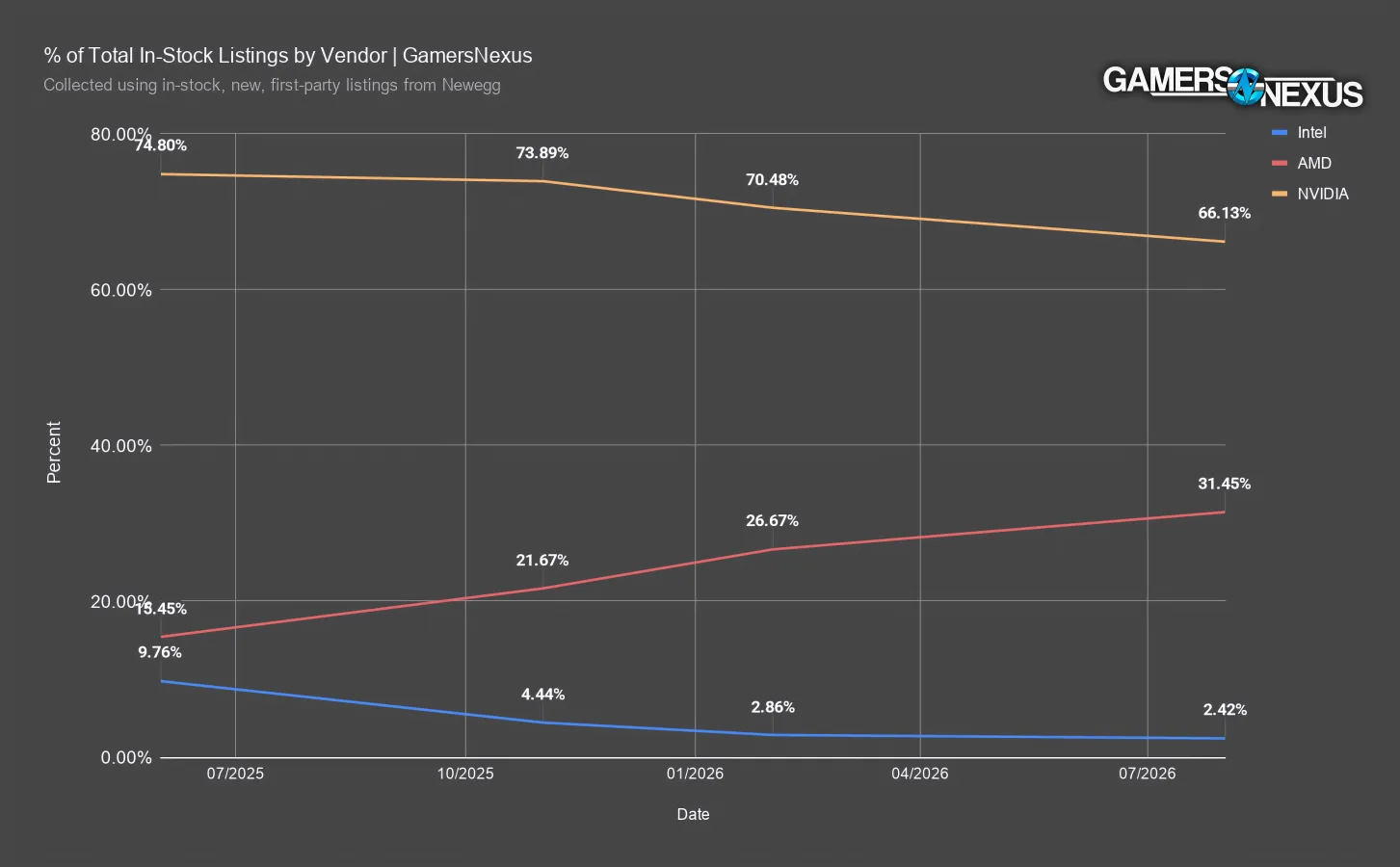
Finally, this chart shows the % of total in-stock listings by GPU vendor.
Since June 2025, NVIDIA’s % of total in-stock listings has gradually declined from roughly 75% to 66%, meaning NVIDIA went from producing 3 out of every 4 in-stock GPUs model listings in June to producing 2 out of every 3 in-stock GPU model listings currently.
In contrast, AMD’s % of total in-stock listings has been on a steady rise since June 2025, increasing from 15% to just under a third of all listings currently.
Intel’s % of in-stock listings steadily declined, peaking at nearly 10% in June 2025 to now just over 2% of in-stock listings.
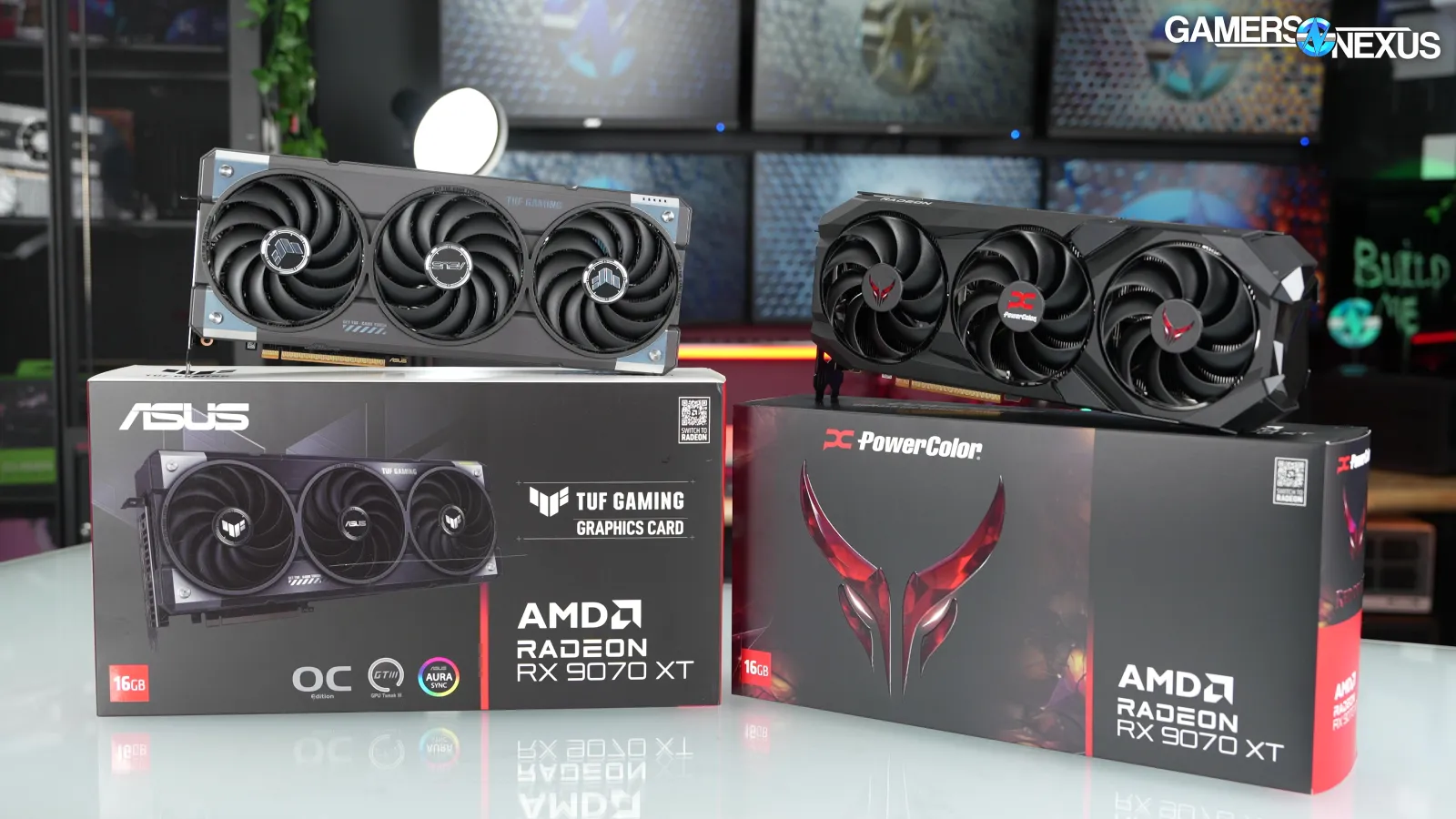
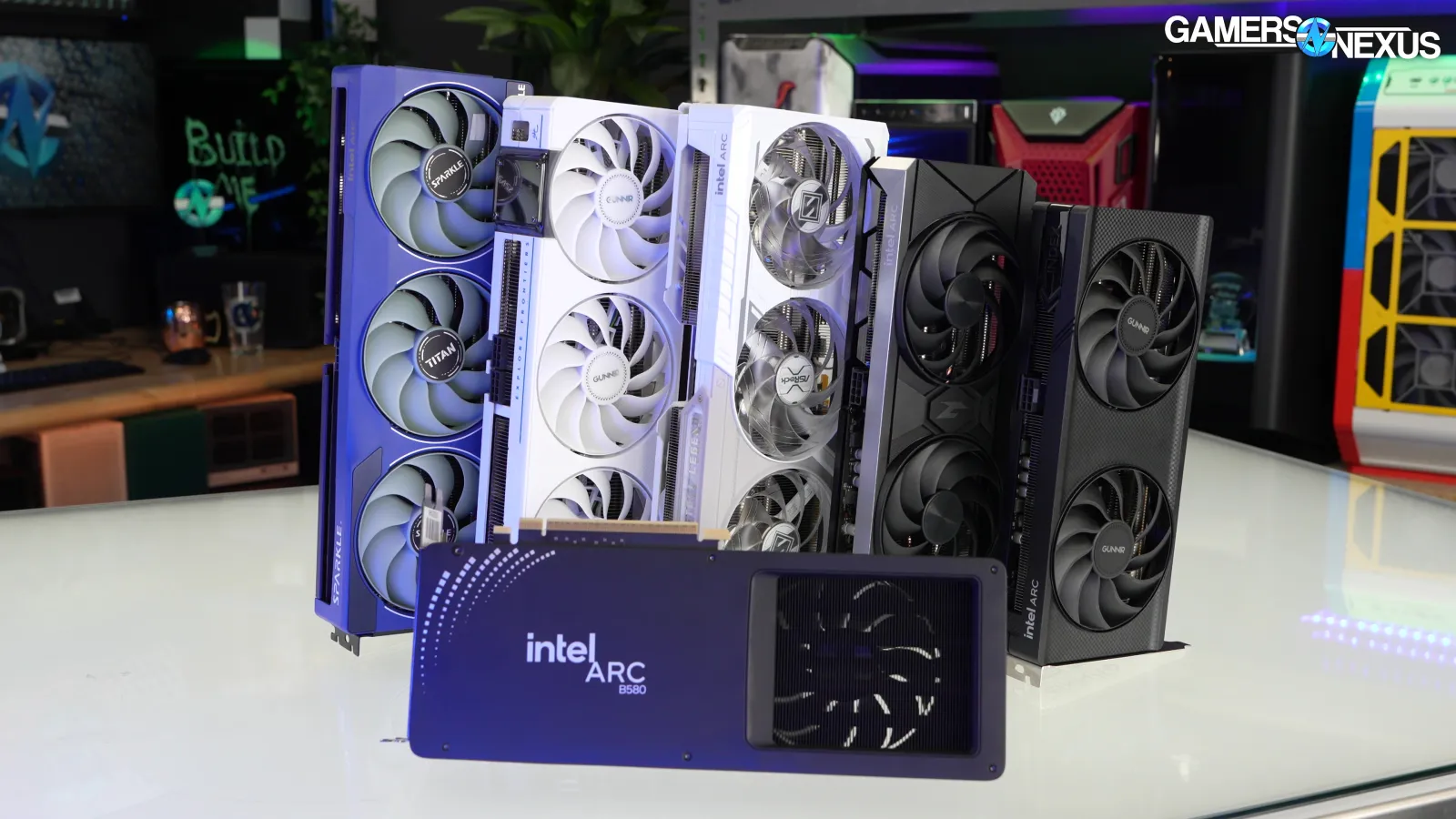
Ultimately, AMD had a significant gain in market presence throughout the past year, while Intel’s presence is now nearly nonexistent.
Conclusion

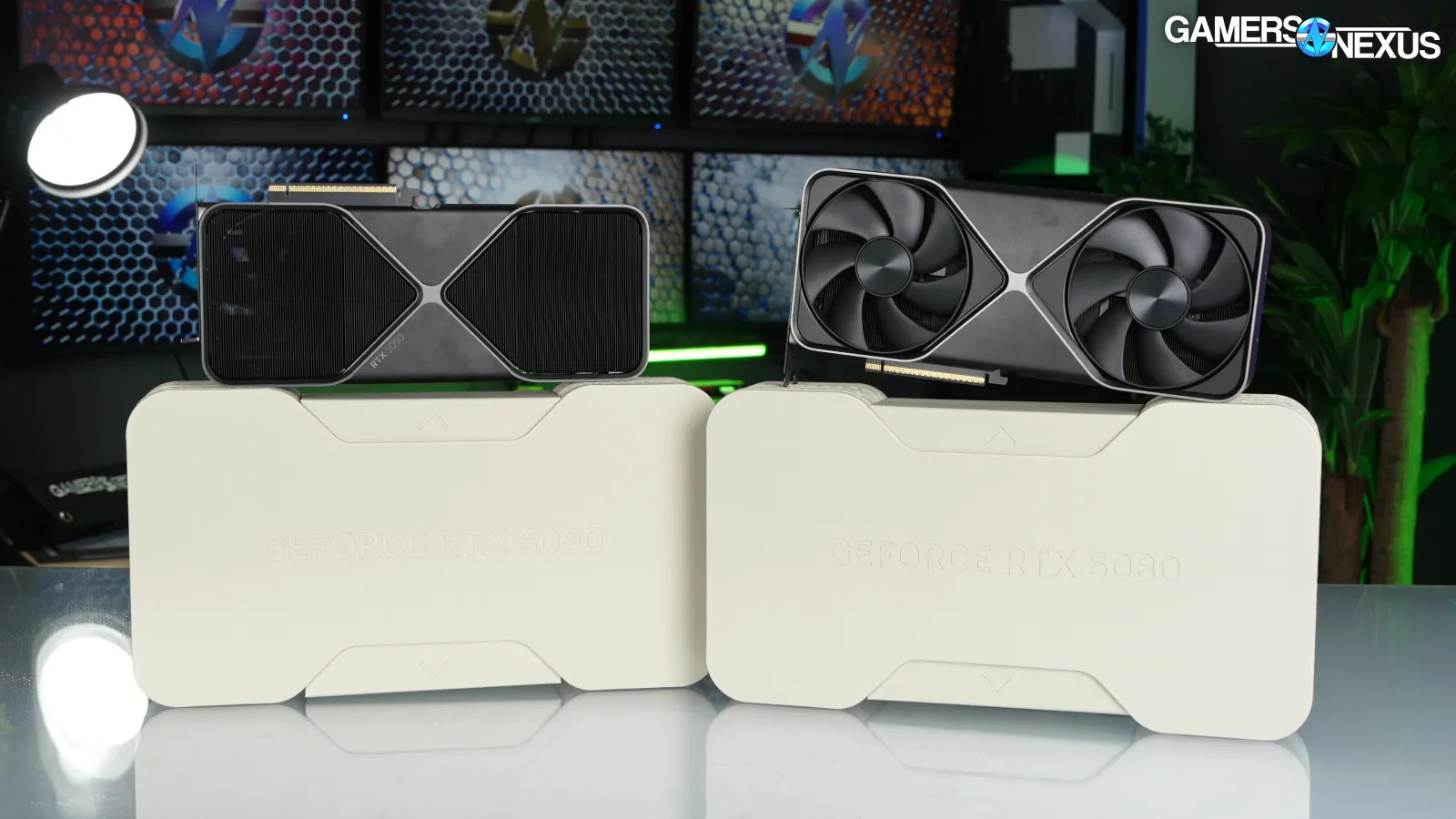
Surprising probably nobody reading this, GPU market conditions worsened noticeably since we collected the data last. That GPU prices continuing to increase over a year and a half after the launch of these GPUs indicates a broader structural change in the GPU market that we believe may in turn lead to next-gen GPUs being priced higher than ever at launch. NVIDIA has been going this way for a while, but it’s becoming more concrete now: There’s no reason to launch a flagship at $2,000 MSRP if it can steadily sell at $4,000 to $5,000. NVIDIA was forced to adjust its RTX PRO 6000 price up since it’s the only seller, so it can’t hide behind partners being the reason for an increase. That now sits at $16,000, up from the launch of around $8,500. We think that gives an indication as to NVIDIA’s direction for the next generation.
The only thing we see slowing this down would be a pop of the AI market, which, we suspect, wouldn’t be good for the economy...
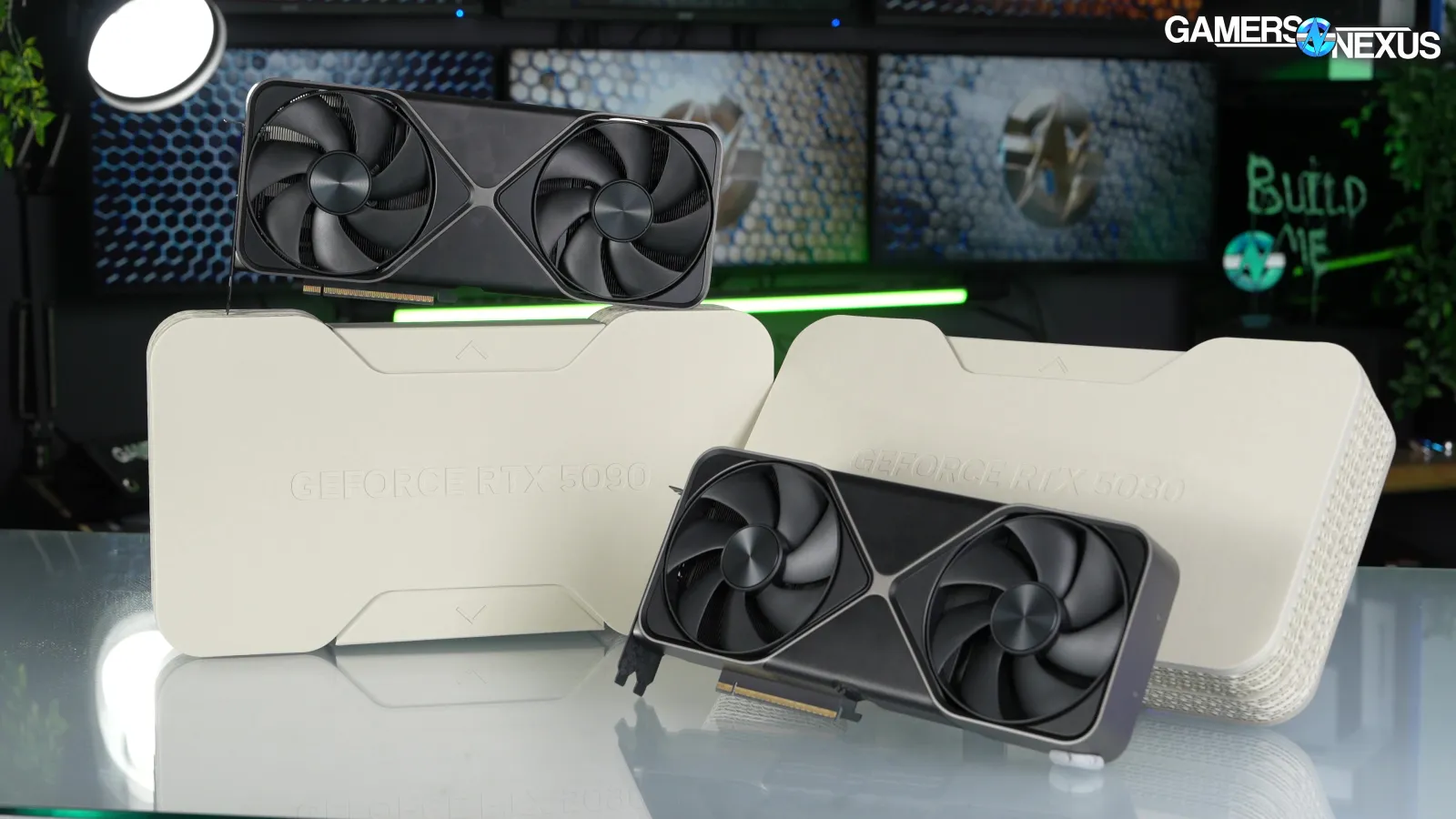
While we don’t like to make forecasts, we’d maintain the same conclusion from our previous GPU pricing update: Ultimately, we’d expect pricing to get worse before it gets better. The difference is that, this time, it doesn’t make a lot of sense to buy any of these unless you’re really desperate. Old hardware suddenly retains more value than ever, and if you can keep it alive, that seems like the best move right now. Given the combined RAM and GPU prices, we would actively advise against building a computer unless you really desperately need one. At the same time, we have no idea when or if there will be another “good time” to build a computer, or if it goes the way of cars where you’re lucky if you can drive it into the ground.
Furthermore, we’d speculate that the only way GPU prices noticeably improve in the near future would be if the AI bubble finally bursts or if memory capacity meaningfully improves, which we don’t anticipate happening anytime soon.