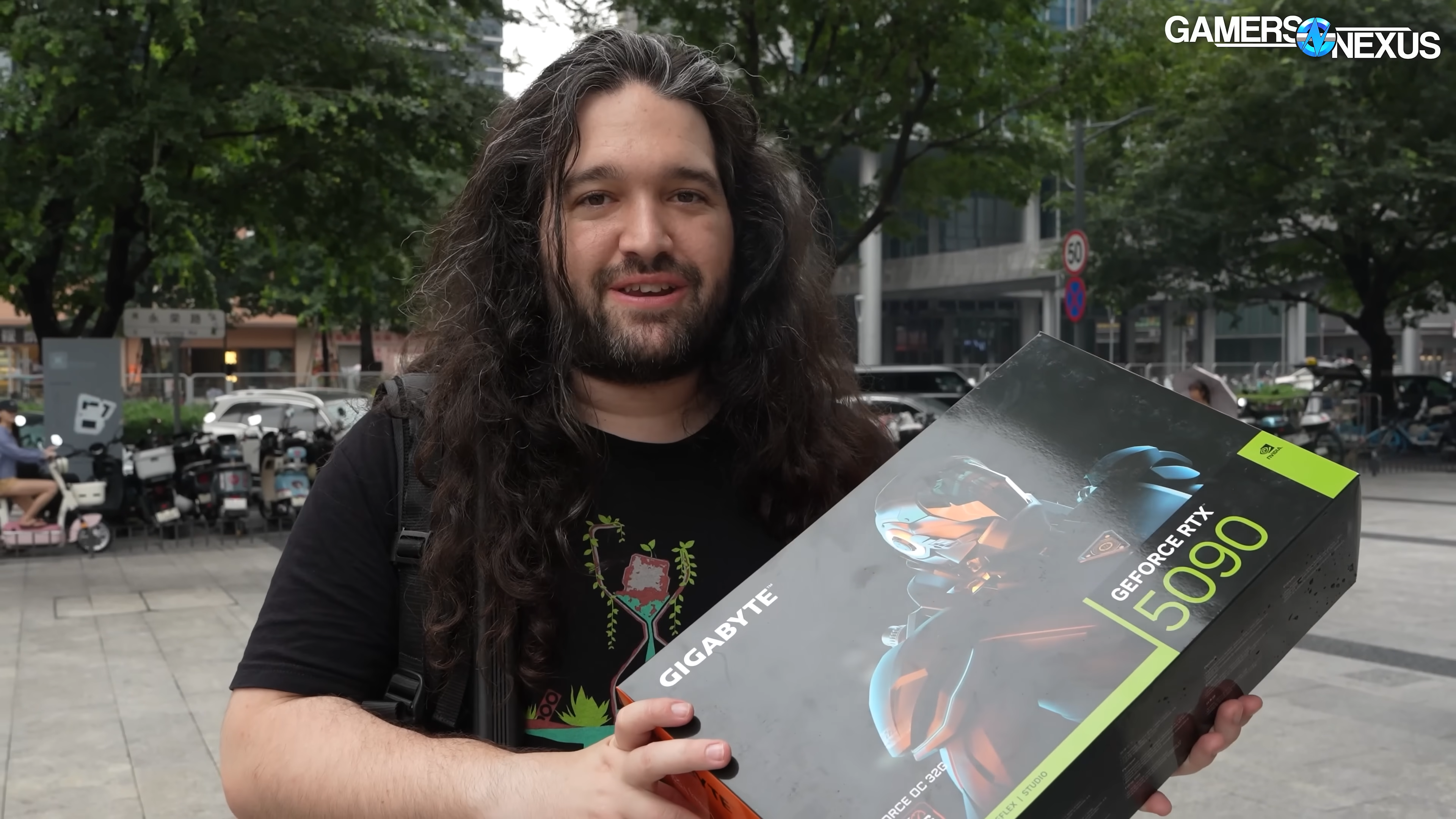
A behind-the-scenes look at some of our research process for preparing large documentaries, shared to hopefully help those interested in similar work!
The Highlights
- Supported by our Black Market kickstarter-style campaign we ran on our store
- The release of this research document insight was funded directly by our viewers.
- Although not complete, this gives a good foundation as to how we begin to form a story
Export Controls Research
When we began, our first research question was, “Why does the US government want to implement export controls on AI GPUs going to China?” In order to answer this question, we dug through government documents dating back several years to identify themes and reasons. This research was important to build our understanding of the issue and properly ask questions of interviewees.
The bolded sections are our ways to note themes, with supporting quotes from government documents and officials.
Government Explanations for AI GPU Export Controls
The US export controls on AI GPUs to China are intended to advance domestic interests and the US’ leadership in artificial intelligence. The federal government provides several arguments supporting this goal. Note that we are not necessarily agreeing with these, just laying them out.
1: The Government believes that leading in artificial intelligence is necessary to protect the United States’ global leadership, national defense, and economic interests.
“The development of AI infrastructure should advance United States national security and leadership in AI. Meeting this goal will require steps by the Federal Government, in collaboration with the private sector, to advance AI development and use AI for future national-security missions… It will also require the use of safeguards to improve the cyber, supply-chain, and physical security of the laboratories at which powerful AI is developed, stored, and used. Additionally, protecting United States national security will require further work to evaluate and manage risks related to the powerful capabilities that future frontier AI may possess.” - Executive Order, Jan. 14, 2025
“The United States has long been at the forefront of artificial intelligence (AI) innovation, driven by the strength of our free markets, world-class research institutions, and entrepreneurial spirit. To maintain this leadership, we must develop AI systems that are free from ideological bias or engineered social agendas. With the right Government policies, we can solidify our position as the global leader in AI and secure a brighter future for all Americans.” - Executive Order, January 23, 2025
2: The US Government believes that restricting China’s ability to use advanced AI will hinder China from improving its military capabilities and cyber operations.
“In the wrong hands, powerful AI systems have the potential to exacerbate significant national security risks, including by enabling the development of weapons of mass destruction, supporting powerful offensive cyber operations, and aiding human rights abuses, such as mass surveillance. Today, countries of concern actively employ AI – including U.S.-made AI – in this way, and seek to undermine U.S. AI leadership.” - US Government Fact Sheet, January 13, 2025
“The export controls announced in the two rules today restrict the PRC’s ability to obtain advanced computing chips, develop and maintain supercomputers, and manufacture advanced semiconductors. These items and capabilities are used by the PRC to produce advanced military systems including weapons of mass destruction; improve the speed and accuracy of its military decision making, planning, and logistics, as well as of its autonomous military systems; and commit human rights abuses.” - Department of Commerce Press Release, October 2, 2022
“Any firm that sells such chips to China should have to certify that the chips will not be used for any designated human rights abuses. Firms that sell such chips should also be required to provide quarterly reports to BIS listing all chip sales, in what quantity, and to which company. This will facilitate U.S. government tracking of chips that are most likely to facilitate abusive uses of AI and deter companies from selling chips to businesses that they know are engaging in such behavior.” - NSCAI report (page 500)
3: The US Government believes that preserving democratic values is important for future progress, global stability, and free speech.
“Congress has to rise to the challenge and get this right. Because if we don’t, the coincidences are dire. Getting it right really boils down to one question. Do we want America or China to be the world’s global innovation leader in the twenty-first century? And the answer to this will impact the course of human history. If America prevails, then we know that democracy, liberalism, individual liberty, and the rule of law will be the global framework for the twenty-first century. If we fail, if China becomes the innovation leader, then autocracy, tyranny, and economic dependency will be the new world order.” - Thom Tillis (R-NC) on National Security Commission on Artificial Intelligence: America and the New Innovation Race, May 14, 2021
“Unlike American AI companies, which impose safeguards to limit genuinely harmful content, DeepSeek functions as a digital enforcer of the CCP, suppressing discussions on topics such as democracy, Taiwan, Hong Kong, and PRC human rights abuses. The model’s responses do not just echo Beijing’s messaging—they actively erase dissent, ensuring that only Party-approved narratives reach users.” - Select Committee on the Strategic Competition Between the United States and the Chinese Communist Party, April 16, 2025
4: The US Government claims, or at least claimed at the time, that artificial intelligence needs to be safe and ethical.
“The Federal Government will seek to promote responsible AI safety and security principles and actions with other nations, including our competitors, while leading key global conversations and collaborations to ensure that AI benefits the whole world, rather than exacerbating inequities, threatening human rights, and causing other harms.” - Federal Register, October 30, 2023
“DeepSeek acquires extensive personal data on the Americans who use the chatbot, including chat history, device details, and even the way a person types. It then, by its own admission, funnels the data directly back to China, creating a pipeline of problematic foreign data access. All data uploaded to servers in the PRC is subject to the country’s sweeping cybersecurity and intelligence laws, which compel companies to share data with state authorities.” - Select Committee on the Strategic Competition Between the United States and the Chinese Communist Party, April 16, 2025
The above helped us understand the scenario as it had developed thus far, and we already found some of the Government's statements disagreeable or unbelievable. For instance, we had seen no evidence of good "safe and ethical" guidelines being enforced.
The above helped us plan the rest of the video.
Question Preparation for Interview Subjects
Another large step of our process involved preparing questions to ensure we don't waste the time of our subjects and ensure we get the best, most vetted information we could.
We needed to be fully prepared when we interviewed people, especially when in China and Taiwan, as the cost to get there was tremendous and we couldn't waste the opportunity. As such, we prepared questions beforehand and committed them to memory. We worked on these questions for sellers and users of "black market" GPUs in China (where it's just a market, because it's not illegal to sell them there). Prepared questions ensure we efficiently use our time and get all the information we need. Steve often adjusts his questions on-the-fly and is known to abandon scripts or prepared questions if the subject takes the discussion another direction, as we try to remain flexible with our interviewees. In other words, rather than fit them into planned content, we try to work with the knowledge they have and are most prepared to share. There are exceptions: In more adversarial or combative interviews, like with Newegg or ASUS staff previously, we do force the matter and maintain a certain level of control to minimize corporate spin.
But, for something like this, we were mostly just talking to "ordinary people" who happened to know things about a specific field.
Our interviews naturally cover more area as the conversation plays out. We do not go into interviews with a script.
We grouped our interview topics based on the "categories" of involvement each person might have with GPUs and smuggling.
Sellers
- How much are these GPUs? Do they cost more than outside of China?
- Where do you obtain AI GPUs? How? Do you know which country they originated from?
- What are the steps involved? For example, from manufacturing to arriving at your distribution center, how many people does it go through?
- Do you stay up to date on US export laws? Who provides that information?
- Do authorities in China ever question the sale or transfer of AI GPUs? Does China care about this activity?
- How many AI GPUs does the typical customer purchase? Are they usually bulk orders?
- What are the most in demand GPUs for customers?
- Who is the typical customer for these? What is the type of user?
- Do you think the government also uses these GPUs?
- Is there any local interest in domestic AI GPUs, such as Huawei Ascend? Does the ban on NVIDIA make it hard enough that people might use other local GPU makers, or is NVIDIA so good that they are the only option?
- When you receive AI GPUs, how do they arrive? What is the packaging like? How do they get in? (Do you ever receive AI GPUs in servers?)
- How do your customers find you?
- Do you have a physical store where you sell AI GPUs?
- Is your customer base entirely in China? Where else do you sell them to?
- Are there any consequences to selling these GPUs?
- Do you ever have to deal with counterfeit AI GPUs? How do you verify an AI GPU’s authenticity when you receive it?
- Do you make any modifications to an AI GPU before selling them into the market?
- Do you think NVIDIA is aware of this activity? Do you think NVIDIA wants to stop it?
- Who in the chain knows that these are smuggled GPUs? (E.g., drivers, ports, etc.)
- Any possibility of going with you to pick some up in the next few days?
- Can we buy a 5090?
Users
- Why do you need AI GPUs? What do you use AI GPUs for?
- Is Nvidia the only viable option for you? Why not AMD, Intel, or domestic options like Huawei?
- What is the real world benefit / improvement of using the banned GPUs vs. the unrestricted GPUs?
- How do you find banned GPUs?
- What is the process to get these GPUs?
- What are the steps involved? For example, from manufacturing to distribution to being installed in a server, how many people does it go through?
- Are AI GPUs hard to get? Are there any consequences for getting them?
- How much are they? Is the price higher than in the West? Who do you think makes the most margin in this chain?
- Can you give an example of the performance difference between a banned and unbanned GPU for your use case?
- What kind of applications have you created by using AI GPUs?
- Can you describe the normal set up for your AI GPUs? How many do you have?
- Does China care if you have them?
- Do you think NVIDIA is aware of this activity? Do you think NVIDIA wants to stop it? Is it in NVIDIA's best interest for these to sell into the China market?
- Have you ever accessed AI GPUs through offshore cloud services? Are those restricted?
- Which GPUs are most valuable for your use cases?
- Any possibility of going with you to pick some up in the next few days?
- Have you ever purchased modified AI GPUs, such as GPUs with added memory? Why or why not?
- How do you fund your AI research?
Obviously, a lot more goes into shooting and planning a 3+ hour documentary, but some of the above give you an example to what we thought we'd be interested in before arriving. It always changes when we get there, and being flexible enough to know when to stick to a plan versus when to cast it aside for something more interesting (once exposed to the knowledge of its existence) is key to these videos.
Shot Location Planning
Another key part of our research is shot preparation for hosted, solo aroll segments. We don't do much of this, but for places on the other side of the planet, we try to at least identify some options that we can choose from when on the ground.
Although we may have scripting for some of this, we often will instead shoot several options of connecting "aroll" to go between sections in the video.
Hong Kong
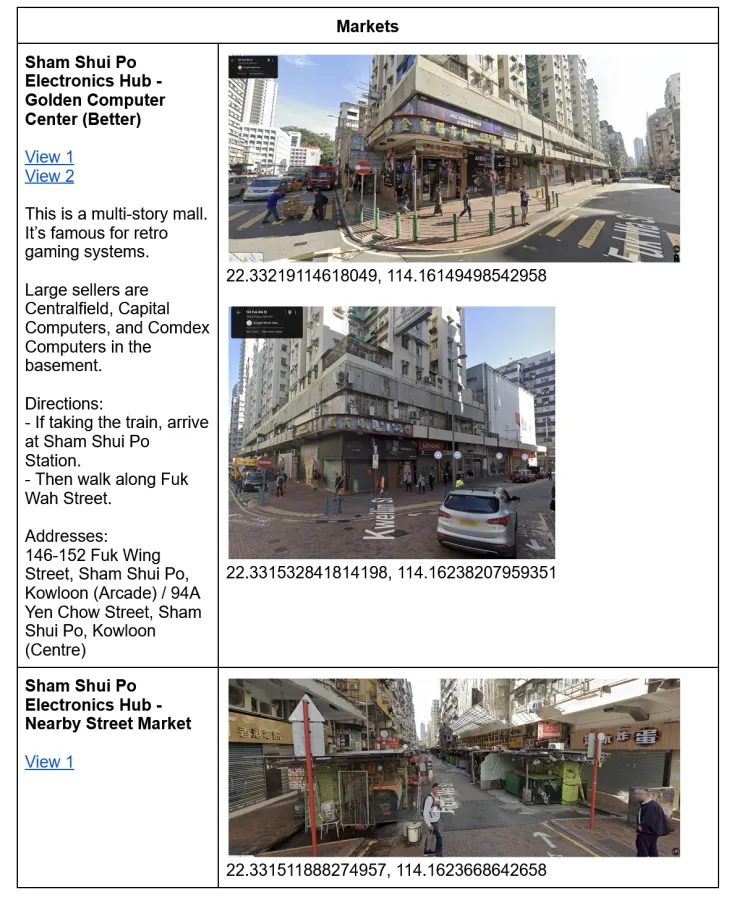
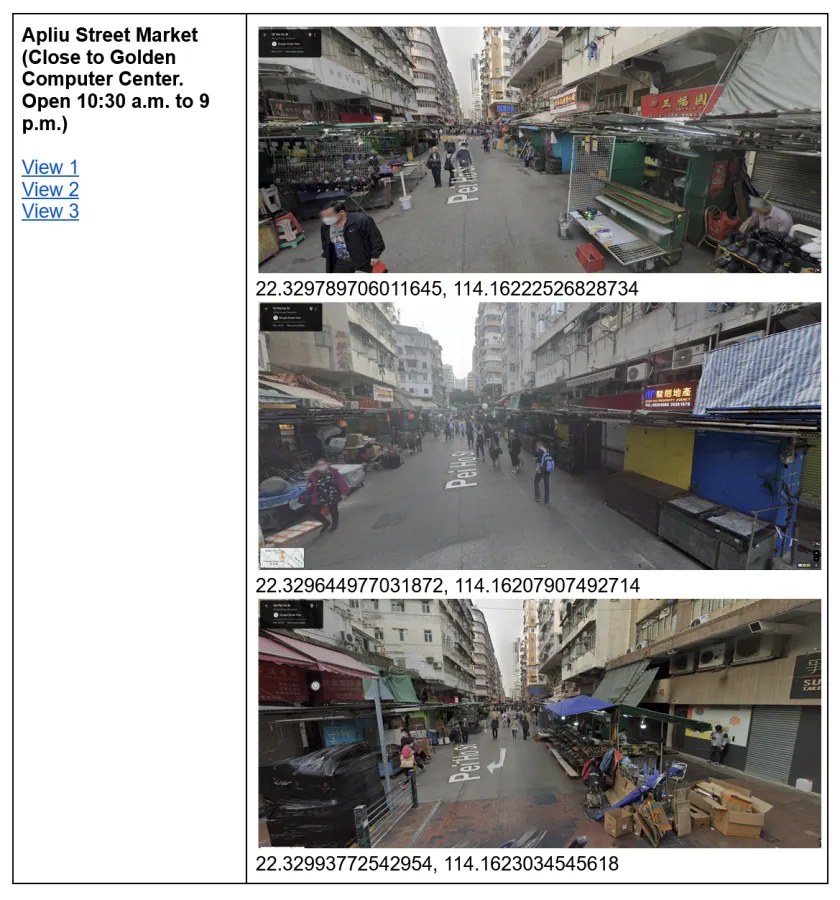
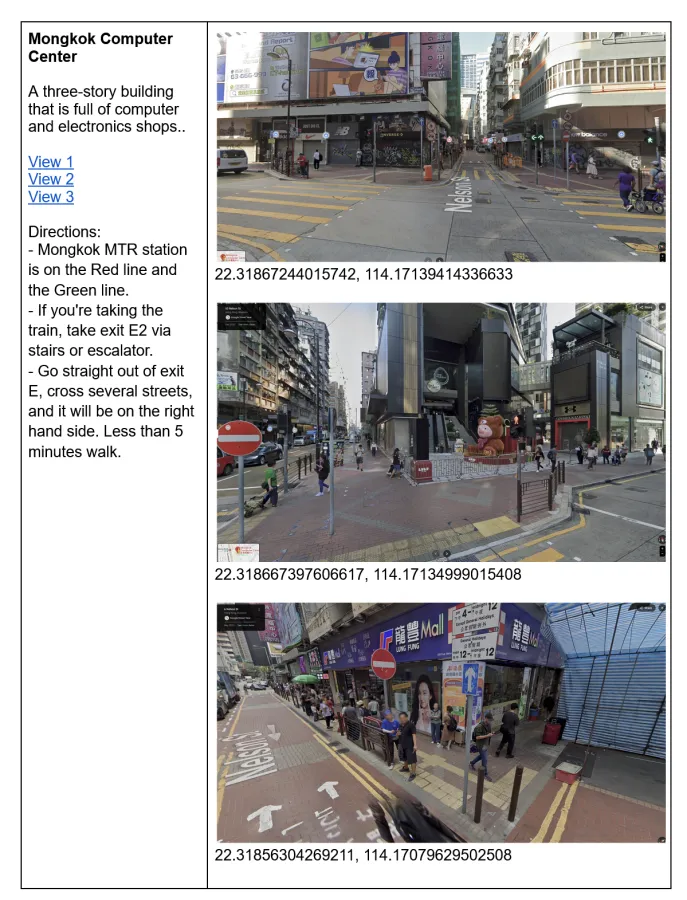
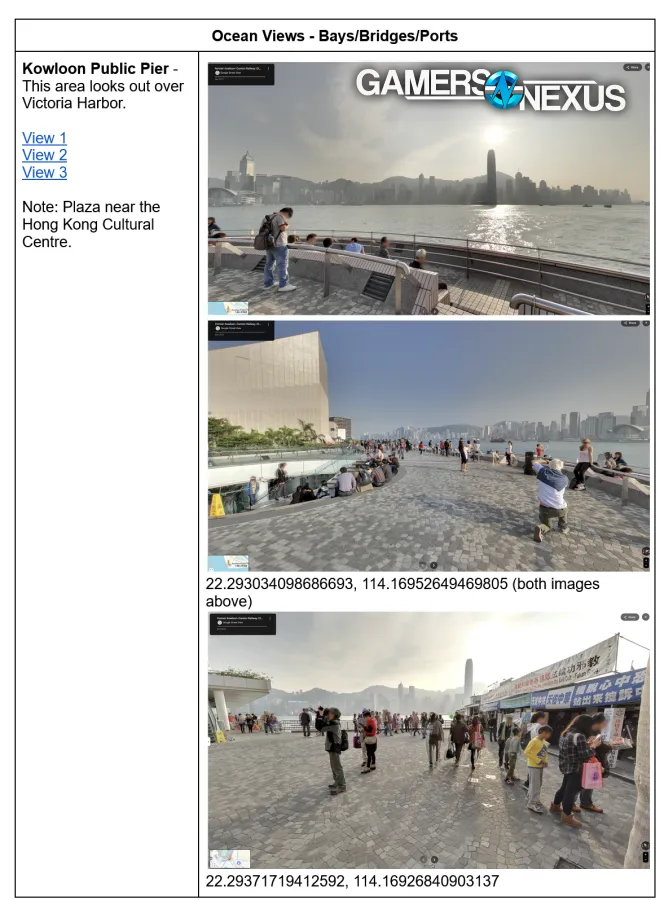
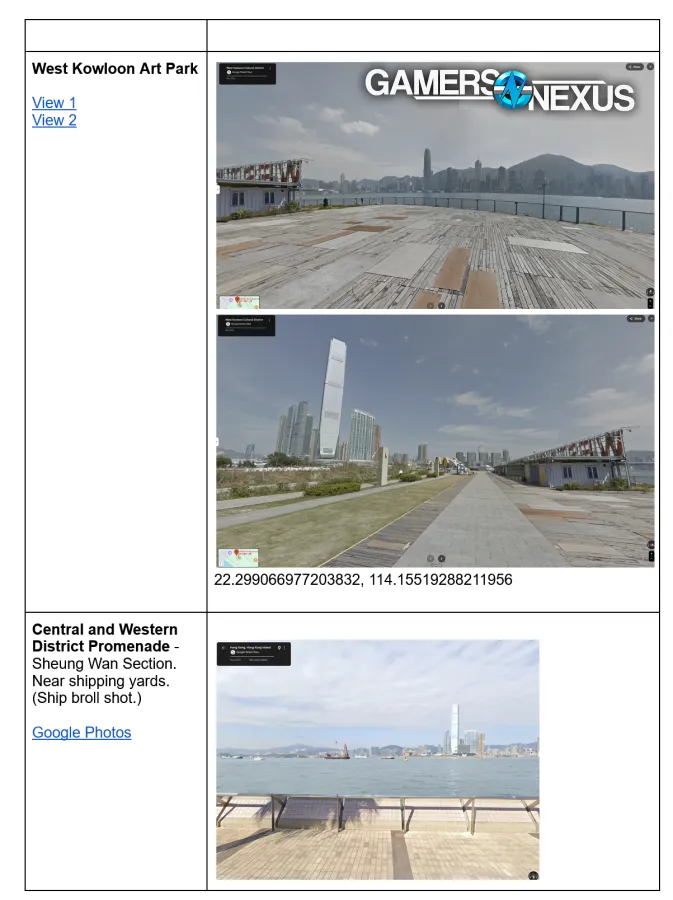
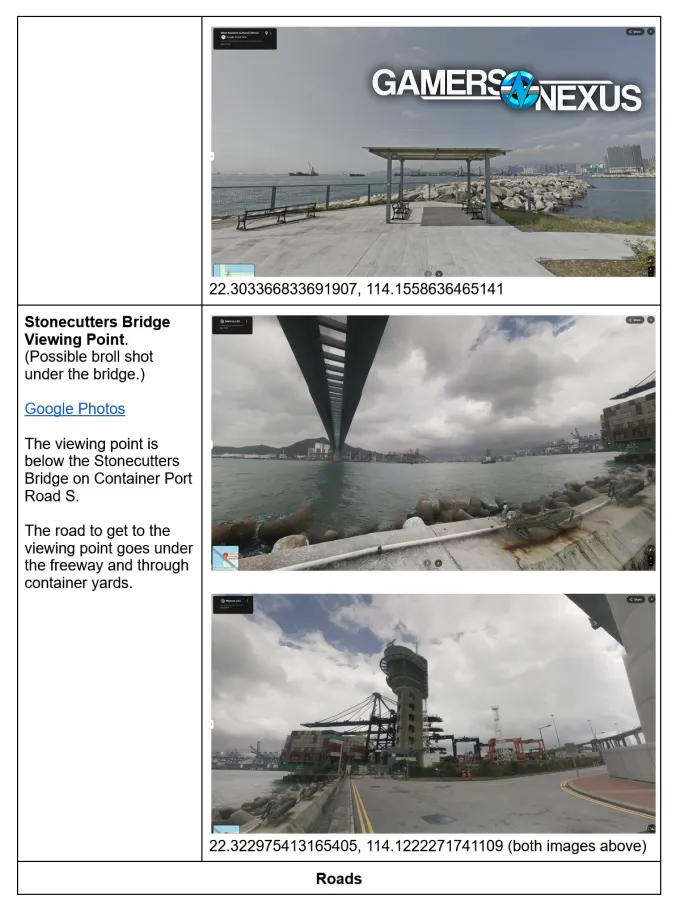
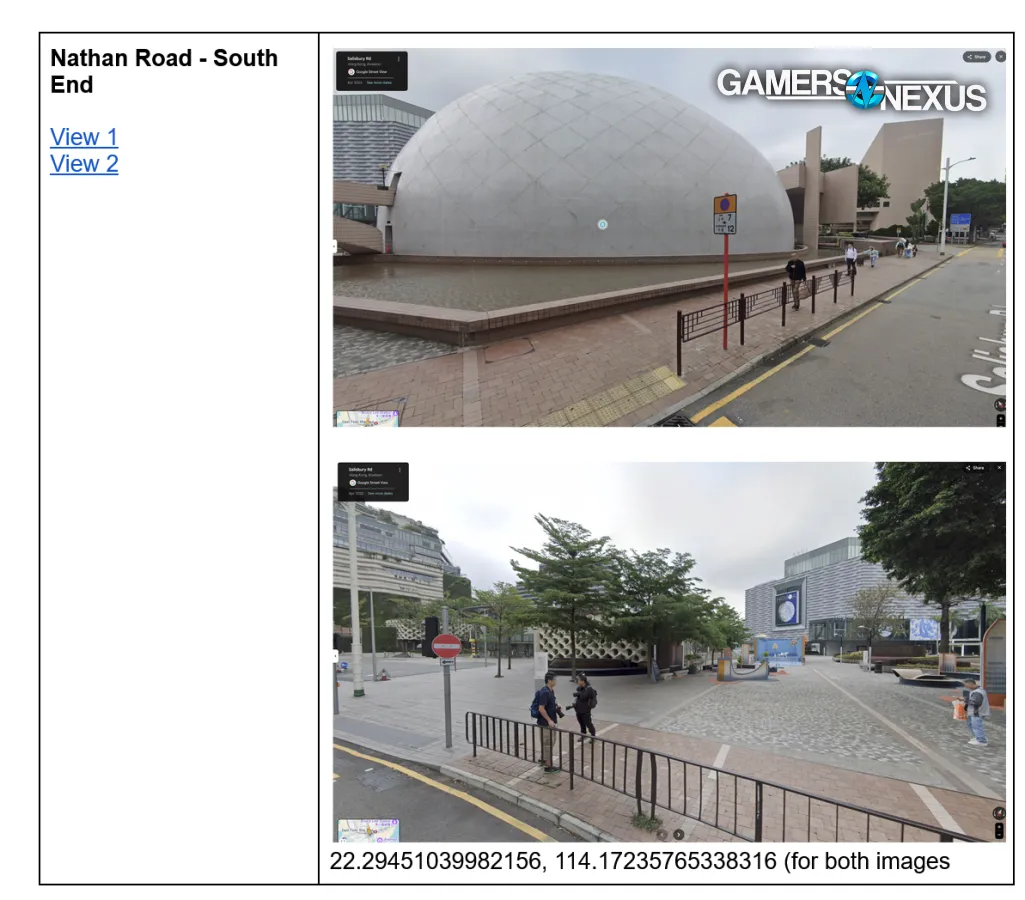
Prior to traveling, we scouted for shot locations in Hong Kong by using Google Maps. Our goal was to find unique locations before landing in Hong Kong, so we wouldn’t have to look for places on arrival.
We organized the shot locations by markets, ocean views, roads, and cityscapes. We used Google Maps’ Street View to identify what certain angles and views look like. Exact coordinates from Google Maps are below the photos. When necessary, we included directions for our team on the ground and indicated which locations would be good for broll or aroll.
We didn’t travel to all of these sites or include all this footage, but the diversity of locations gave us options and served as important scenes for our documentary.
We'll paste screenshots of the raw research document to give you a better behind-the-scenes. The document was written by Ben, not in attendance on-site, and provided to Steve and Tannen.
Shenzhen Shot Locations
We did the same process for Shenzhen.
We researched Shenzhen- and Hong Kong-based AI companies, ports, marketplaces, and resellers prior to traveling. Our goal was to find places to go once we arrived, since we need to be efficient with our time. We did not visit every location or place we identified, but it was important to have many options. We don’t have time for additional research once we are filming and interviewing. We also used Alibaba to help identify GPU and electronics resellers in Shenzhen.
| AI, Machine Learning, and Deep Learning Companies List created by looking for top AI companies in China (specifically, Shenzhen and Hong Kong) from 5/14-5/15 | ||
| Company | Notes | Location |
| HiSilicon | Wikipedia Wikichip Largest domestic chip designer in China. Owned by Huawei. | Shenzhen |
| SenseTime | Wikipedia Facial recognition, remote sensing. State owned. | Hong Kong |
| BYD | Autonomous cars, automotive intelligence Partnered with DeepSeek | Shenzhen |
| UBTECH Robotics | Humanoid robots Partnered with Huawei Wikipedia link | Shenzhen |
| Intellifusion | Visual processing Crunchbase link | Shenzhen |
| RoboSense | Sensors, robotics Wikipedia link | Shenzhen |
| Deeproute | Autonomous driving developer Partnered with Qualcomm | Shenzhen |
| Xbiome | Microbiome drug development company | Shenzhen |
| Orbbec | 3D vision technology Robotic sensors YouTube link | Shenzhen |
| Pudu Robotics | Robotics start-up LinkedIn page | Shenzhen |
| Smartmore Technology | Smart manufacturing Endorsed by the state | Hong Kong |
| Syrius Robotics | Autonomous robots LinkedIn page | Shenzhen |
| Links for reference: MIT Tech Review: Four Chinese AI startups to watch beyond DeepSeek Technode: Meet China’s top six AI unicorns: who are leading the wave of AI in China South China Morning Post story: “Shenzhen is currently home to more than 2,600 AI companies, including six unicorns - start-ups valued at over US$1 billion. The city also boasts 34 listed robotics firms, nine of which are unicorns.” | ||
| Marketplaces & Ports The below places are Shenzhen’s most cited marketplace and ports based on media and online mentions. | ||
| Location | Type | Notes |
| SEG Electronics Market (SEG Plaza Building) | Electronics marketplace | One redditor pointed to Huaqing north of SEG plaza. According to this article, GPUs are mainly found on floors 5 and 6. Cited as a key seller of banned GPUs on YouTube here. |
| Yantian Port | Container ship port | One of the world’s largest container ports. Handles one-quarter of China’s exports to the US. One of the largest electronics hubs in the world. |
We also had a table for distributors & resellers, but won't share that as we want to keep some of them anonymous (per their requests).
The above is how we start building a travel plan, though.
Broadcast Clips
Finally, although we're skipping many other steps, we like to prepare a number of broadcast clips that show the current conversation in the less technical mainstream.
We used news clips and commentary from broadcasters, government officials, and NVIDIA throughout our AI GPU Black Market Documentary. This is a time-consuming task to find broadcast clips, since we need to comb through footage and mark specific sections for editors. Our method is to track notable broadcast clips weekly when we are working on a story. That way, we have the data and information readily available when we are for scripting and editing. However, we often don’t know exactly what clips we are looking for during the research phase, so we always have more clips identified than we use.
For our documentary, we had dozens of pages noting clips and quotes for possible use. The below sections collecting quotes from broadcasters and NVIDIA are just part of our research.
Broadcaster quotes
Wall Street Journal - August 12, 2024
- https://youtu.be/O-CDwrQ8jVA?si=FcvqzaaRWiJX_Mw-&t=36
- 0:36 - “China has spent decades modernizing its military with the express goal of catching up to the US. AI-enabled drones are key to achieve that goal.”
CNBC - January 10
- https://youtu.be/3x1flGiE3PQ?si=aoMztQW1GO1Q_ylo&t=27
- 0:27 - “The export ban did prevent China from getting the highest end AI chips but it did not stop China from catching up.”
- https://youtu.be/3x1flGiE3PQ?si=x_rFMXgn85LLDulx&t=99
- 1:38 - “The export ban has also led to smuggling and loopholes.”
CNBC - January 24
- https://youtu.be/WEBiebbeNCA?si=Pc5ZCiFgdwUb1XoL&t=335
- 5:35 - “China’s breakthrough undermines the lead that our AI labs once had.”
CNBC - May 16
- https://youtu.be/hg4AQ82C3Oc?si=oA-7P8BvbMs5x87Y&t=135
- 2:15 - “NVIDIA is being used as a bargaining chip.”
CNBC - June 12
- https://youtu.be/x-GljskBgDg?si=7Rzpx8a7tdJRcGzX&t=102
- 1:40 - “China’s AI technology is getting a lot better.”
CBS News - July 14
- 1:40 - https://youtu.be/vm6gNF7rYzc?si=B2FWam2zBqynUJZp&t=100
- CBS covers the CNN interview where Jensen says that the Chinese military will not use NVIDIA’s chips.
- 2:27 - https://youtu.be/vm6gNF7rYzc?si=qlmhSy7Px3FAj42t&t=147
- “Jensen is being a little disingenuous here. A lot of his equipment has made it to China through smuggling.”
Bloomberg Podcast - July 15
- 3:30 - https://youtu.be/rnqCn1OixMM?si=p0RsTxF2nxLswzoA&t=210
- “The concern of course in Washington and particularly among the Defense Department, the Pentagon, is that these chips and this hardware and software ends up with the People’s Liberation Army, the military, and will help them accelerate innovations on that front.”
CNBC International - July 28
- https://youtu.be/7JkNWhtZ2wI?si=62U6CBszUy-rAtNA&t=99
- 1:39 - “The concern was… from a national security and defense perspective."
Bloomberg - August 1
- https://youtu.be/8s1vlXhm2t0?si=fOiPeWD7qSzWaDvL&t=291
- 4:51 - “The restrictions are really on advanced semiconductors that could have potential military applications. The intent is to choke China’s AI sector and broader AI ambitions.”
NVIDIA’s Jensen Huang quotes
Milken Institute - May 6
- Export controls start at 20:36 - https://youtu.be/HT8-KPAjpiA?si=sYclvoIE5tBxqqH5&t=1236
- “NVIDIA’s technology is a national treasure.”
- “We want to ensure that access to this technology doesn’t fall into the hands of people who might want to use it for military reasons.”
- 21:55 - https://youtu.be/HT8-KPAjpiA?si=3VK88nKQZ_FHwu7-&t=1316
- “It’s not going to limit shipping additional GPUs and NVIDIA technology, it’s not going to limit their military.”
- 22:55 - https://youtu.be/HT8-KPAjpiA?si=xHCf0ryoVApmEaxv&t=1375
- “[China] is a giant market. When we were limited to ship to China, the Chinese market is about $50B. The market we left behind is utterly gigantic. $50B is like Boeing. Not a plane, the entire company. That’s the business opportunity that we could enjoy.”
Bloomberg - May 17
- “There is no evidence of any AI chip diversion.”
- “You’re not going to be putting [Grace Blackwell systems] in your pocket anytime soon.
Bloomberg - May 28
- 2:00 - https://youtu.be/c-XAL2oYelI?si=55ddmfjec93s_w82&t=121
- “You can’t underestimate the importance of the China market. Second largest AI market.”
CNBC - May 28
- 2:18 - https://youtu.be/7uYtbUQDMJQ?si=iPX5SJPTxHmgijnN&t=138
- “We want the world to build on the American technology stack. We want every developer in the world to prefer the American technology stack.”
TVBS World Taiwan - May 28
- 23:27 - https://youtu.be/PtjDo6QRHMw?si=jjhi55-02u7jnDmf&t=1407
- “Because of export controls, we’ve lost half our market share.”
- 24:50 - https://youtu.be/PtjDo6QRHMw?si=TTmH7lO6fyWW4AAB&t=1496
- “We want every AI researcher on the planet to develop on American technology.”
- 26:56 - https://youtu.be/PtjDo6QRHMw?si=E7ryTIdNFc8_Eoi-&t=1616
- “We’re committed to the China market. China has treated NVIDIA incredibly well.”
CNN - July 13
https://www.cnn.com/2025/07/13/world/video/gps0713-nvidia-us-china-ai
- 1:50 - “We would like the United States to be the world leader.”
- 2:10 - “We want the American tech stack to be the global standard.”
- 2:50 - “Need to make sure the American tech stack is available to markets all over the world.”
- 3:20 - “We don’t have to worry about that” - in regard to the Chinese military. “[The Chinese military] simply can’t rely on it. It could be limited at any time. And there’s plenty of computing capacity in China already” “They don’t need American tech stacks to build their military.”
- 4:30 - Reporter: “Does it matter who gets there first?” Jensen: “In the end, I don’t think it does.”
- 5:15 - “Your question about does it matter who gets there first. In the final analysis, I don’t think it does. However, I believe it is core to the American spirit to want to be the world’s best. We should want to be the world’s best. The computing industry is one of the national treasures.”
China Media Briefing - July 16
- 10:10 - https://youtu.be/dZ98778f880?si=jDxmfGoTgY9QEXzS&t=608
- “We have to invest in China.” “China is the second largest technology market in the world.”
- 17:33 - https://youtu.be/dZ98778f880?si=dHqKztVNt0Uxwi45&t=1043
- “Need to recognize that every country has their own national security policies and trade policies… Our job is to comply to it.”
- 33:19 - https://youtu.be/dZ98778f880?si=aDk5yhwP4FRPKpMo&t=1999
- “I’m going to work hard to accelerate the recovery of Hoppers.”
China briefing - CCTV - July 21
- 18:21 - https://youtu.be/tGPz-uhwH9Q?si=JppzgjDOdppM56t5&t=1101
- “There are companies that compete. There are nations that compete. And all of that coexists at the same time.”
All-In Podcast - July 23
- 43:53 - https://youtu.be/9WkGNe27r_Q?si=MKLLeFbu9DfTT1C1&t=2633
- “What’s the story with the jacket? Do you have one of those?”
- Jensen: “I have something like 50 or 60 of them.”
- 59:40 - https://youtu.be/9WkGNe27r_Q?si=dJ7aETuQkzw-itTp&t=3571
- Discussion about China
- 1:02:15 - https://youtu.be/9WkGNe27r_Q?si=ctFtfLvLpGrMb2GI&t=3736
- “I’ve created more billionaires on my management team than any CEO in the world. They’re doing just fine. Don’t feel sad for anyone at my layer.”
FOX News - July 24
- 2:08 - https://youtu.be/iDy7yBEETcY?si=xJtuqy0AQcg4YeUp&t=128
- “America wins when American technology becomes the global standard.”
That's It!
That's it for this inside look at some of our research process. The full document was around or over 400 pages long and took several months to put together. Our backers wanted to see some of the process, so we're happy to share that with you here!